
A banner ad is a rectangular digital advertisement placed within a music platform’s user interface to deliver visual and textual messages that prompt listener interaction and drive specific actions.
Banner ads are static images, animated graphics, or HTML-rich creatives. They appear in app homescreens, playlist pages, artist pages, and web players. Banner dimensions follow platform guidelines; common sizes include 728×90 pixels (leaderboard), 300×250 pixels (medium rectangle), and 320×50 pixels (mobile leaderboard). Platforms host images, click-through URLs, and tracking pixels. Creative assets include a headline, short body text, and a call-to-action element. Platforms render banners in HTML5 or image formats and serve them via ad servers.
Banner creatives contain an asset package (image or HTML), a destination URL, and metadata for viewability and measurement. Ad servers use impression tags and click trackers. Viewability uses the Media Rating Council standard: 50% of pixels in view for at least one continuous second for display ads. Rich media banners include JavaScript for interactivity and event tracking.
How do music platforms place and target banner ads?
Platforms place and target banner ads using user data, contextual signals, and inventory rules to reach listeners with high relevance and measurable delivery.
Placement begins with inventory mapping: homescreen, player, playlist header, and artist page. Targeting uses first-party data such as subscription status, listening history, saved tracks, and device type. Platforms also use contextual signals like genre pages and time of day. Targeting segments include active free listeners, recent playlist followers, and high-frequency listeners. Ad-serving logic matches creatives to segments and enforces frequency caps to limit impressions per user per day. Platforms deliver banners via programmatic auctions or direct-sold campaigns. Programmatic campaigns set bid floors and targeting rules; direct-sold campaigns reserve specific placements and impressions.
How targeting variables work
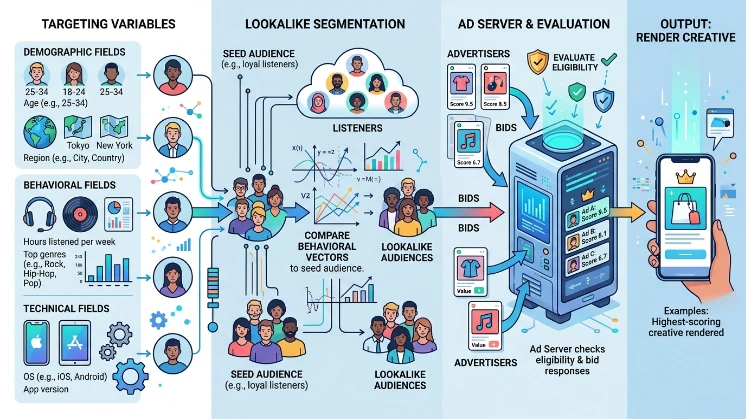
Targeting variables include demographic fields (age, region), behavioral fields (hours listened per week, top genres), and technical fields (OS, app version). Platforms compute lookalike segments by comparing listeners’ behavioral vectors to seed audiences. Ad servers evaluate eligibility and bid responses, then render the highest-scoring creative.
How do banner ads drive listener engagement?
Banner ads drive engagement by presenting concise, relevant messages that prompt clicks, sessions, or feature interactions, and by linking directly to listening experiences that increase stream counts and session length.
A banner’s headline and destination determine the action. Common destinations include track pages, curated playlists, artist radios, and promotional microsites. When a listener clicks a banner, platforms record click-through rate (CTR) and post-click behavior such as streams started, tracks completed, and session duration. Effective banners match the listener’s current context—genre pages link to new tracks in the same genre, playlist headers highlight similar mood compilations. Platforms attribute downstream streams using deterministic identifiers when the click opens an in-app player. Measurement models include last-touch attribution for immediate stream counts and multi-touch models for longer conversion paths.
Metrics used to assess engagement
Key engagement metrics include CTR, time to first stream after click, number of streams per user within 24 hours, and incremental lift compared to control cohorts. Platforms run A/B tests and holdout experiments to verify causal impact.
What components form an effective banner ad creative?
An effective banner creative contains a clear headline, a 1–3-word focal offer or label, a high-contrast visual, and a single destination URL mapped to an in-app listening experience.
The headline communicates the offer or content (for example, “New Indie Release”). The focal label signals the content type (album, playlist, single). Visuals use artist artwork or thematic photography sized for legibility at small screen widths. Text size follows accessibility guidelines: minimum 16px equivalent for mobile readability. The destination URL uses deep-linking to open the in-app player or a specific playlist. Tracking parameters attach to the URL to feed analytics systems. Creative variations test alternative headlines, visuals, and calls-to-action to find the highest-performing combinations.
Creative constraints and accessibility
Platforms limit text-to-image ratios and file sizes to preserve load speed; typical file-size caps range from 150KB to 300KB. Alt text and semantic HTML improve accessibility and indexability. Banners should follow colour contrast ratios of at least 4.5:1 for body text.
How do platforms measure banner ad performance and ROI?
Platforms measure performance with impression and click counts, engagement metrics (streams, session duration), and conversion cohorts to calculate incremental streams and revenue lift.
Measurement pipelines ingest impression and click logs and then join those events to listening logs via device or user identifiers. Analysts construct conversion windows such as 24 hours, 7 days, and 30 days to measure short- and mid-term impact. Incremental lift uses randomised holdout groups or matched controls. Revenue lift includes ad-supported revenue per thousand impressions (RPM) and estimated streaming revenue per stream. Reporting breaks results down by placement, creative, and audience segment. Platforms generate frequency reports to manage ad fatigue. Privacy-compliant measurement techniques include aggregated attribution and differential privacy when required by regulation.
What benefits do banner ads provide for music platforms and rights holders?
Banner ads increase content discovery, raise short-term streams, guide listeners to curated experiences, and support revenue generation without disrupting core playback functionality.
For platforms, banners promote internal features such as new playlist launches and editorial initiatives. Banners lift discovery rates for new releases and increase catalogue utilisation by directing listeners to specific tracks and playlists. Rights holders gain predictable exposure windows and measurable uplift in streams. Banners integrate with promotional calendars to amplify release strategies around release day and week 1 performance, which is crucial for chart visibility. Platforms maintain user experience by limiting frequency and placing banners in non-intrusive zones.
Explore More Expert Insights:
How Ticketing Platforms Nurture Buyers Using Event Reminder Ads
How Event Organizers Increase Ticket Consideration Using Display Ads
What are common use cases for banner ads on music platforms?
Use cases include promoting new releases, highlighting curated playlists, announcing exclusive content, and directing listeners to themed events or seasonal collections.
New-release campaigns link directly to artist pages and single tracks. Playlist promotion campaigns surface mood or genre collections during peak listening hours. Exclusive content banners announce live sessions or video premieres. Seasonal campaigns promote holiday or event-based compilations. Platforms schedule these campaigns around release calendars and listener peak windows—typically 6 PM to 10 PM local time on weekdays in the UK. Campaigns for free-tier listeners focus on discovery and ad monetisation, campaigns for trial or light-subscriber segments focus on conversion to longer sessions or premium trials.
A platform runs a playlist-promotion banner across genre pages between 18:00 and 22:00 for seven days. The campaign targets users who streamed the genre at least twice in the prior week. The platform measures immediate streams and a seven-day retention lift.
Dive Deeper Into This Topic:
How Music Platforms Increase Streams Using Banner Ads
How do banner ads interact with other promotional channels on platforms?
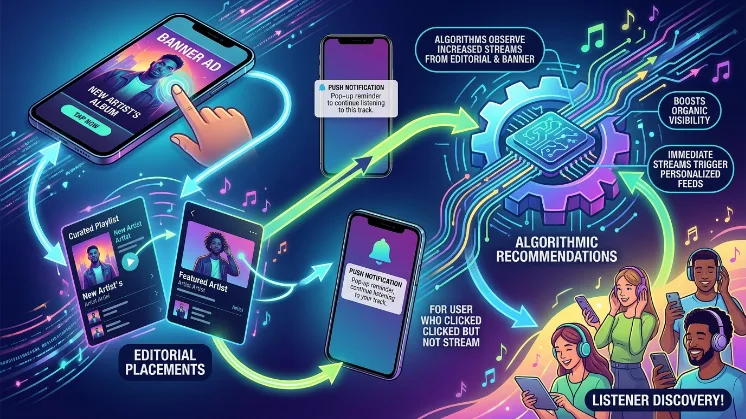
Banner ads integrate with editorial placements, push notifications, and algorithmic recommendations to create multi-channel exposure that increases the probability of listener discovery.
Platforms coordinate banners with editorial features to amplify launches. A banner can link to an editorial-curated playlist or a featured artist page. Push notifications offer a second touchpoint for users who click but do not stream. Algorithmic recommendations then absorb signal from increased streams to further boost organic discovery. Platforms use cross-channel attribution to measure combined effects. When banners trigger immediate streams, recommendation systems factor that activity into personalised feeds.
Learn Everything About It Here:
Music Platform Ads That Convert Listening Interest Into Premium Users