
Show-based banner campaigns are targeted display ads placed inside or alongside a specific show’s viewing environment to promote related content, features, or subscription offers. Show-based banners identify a show (title or episode), link to relevant content, and display within the OTT interface during browsing, playback, or pause states.
Show-based banner campaigns use metadata from the show (title, genre, cast, episode number) plus viewer signals (watch history, completion rate, device) to decide placement. They appear in multiple placements: on the show’s detail page, the episode carousel, the player overlay during playback, and the pause or end-of-episode screens. Campaigns use creative assets tied to the show, key art, episode stills, short animated banners, and concise copy indicating related content or offers. Campaign performance tracks impressions, click-through rate (CTR), view-through conversions, and subscription conversion when an offer is present.
How do OTT platforms select audiences for show-based banners?
Platforms use deterministic and probabilistic signals, including account watch history, viewing time, device type, and show-level engagement, to build audience segments for banners. Selection uses first-party data stored on the platform: titles watched, episodes completed, time spent per show, and search queries. Platforms assign viewers to segments such as “binge watchers of drama”, “paused during episode 3,” or “watched pilot but not episode 2.” These segments inform which show-related banner a viewer receives.
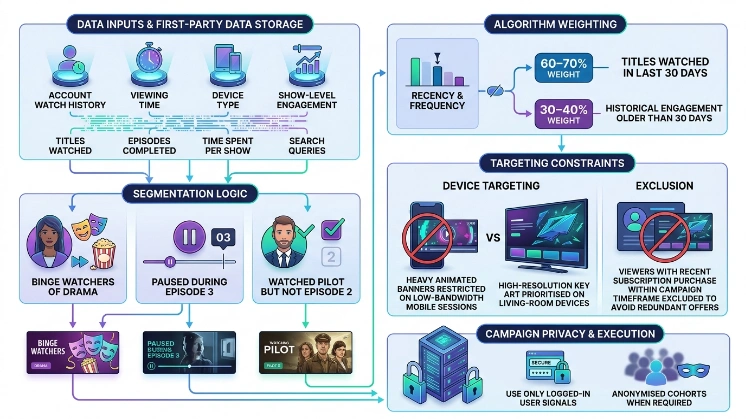
Algorithms weigh recency and frequency: the platform gives 60–70% weight to titles watched in the last 30 days and 30–40% to historical engagement older than 30 days. Device targeting restricts heavy animated banners on low-bandwidth mobile sessions and prioritises high-resolution key art on living-room devices. Platforms exclude viewers with recent subscription purchase within the campaign timeframe to avoid redundant offers. Campaigns also respect privacy, using only logged-in user signals or anonymised cohorts when required.
What creative elements make show-based banners effective?
Effective banners include clear show identifiers, concise offers or next-step prompts, and image or motion tied directly to the promoted episode or season. Show identifier means the show title, season and episode number, or a recognisable cast image. Next-step prompts use short verbs such as “Play episode 2,” “Continue S1,” or “Watch finale.” Visuals use a single dominant still or animated loop lasting 3–5 seconds. Text overlays limit to 6–10 words to remain legible across devices.
Platforms test variants: static key art, animated hero loops, and text-first templates. Control tests measure CTR change per asset with sample sizes of 10,000+ impressions to ensure statistical reliability. Creative rules enforce aspect ratio and file-size limits: 16:9 hero images, max 150 KB for mobile banners, max 2 MB for TV assets. These constraints ensure consistent rendering and fast delivery.
How are show-based banner campaigns scheduled and delivered?
Campaigns follow a timeline tied to content life-cycle events: pre-launch, premiere week, mid-season, and finale, with frequency caps per user. Scheduling aligns with content milestones. Pre-launch banners appear 7–14 days before release to drive awareness. Premiere-week banners run at higher frequency—often 2–3 impressions per user per day—then taper to 0–1 impression daily during mid-season. Finale campaigns increase frequency again for retention pushes. Platforms set frequency caps: 3 impressions per week per placement for logged-in desktop users, 5 per week for mobile app users, and variable caps for smart-TV users depending on session length.
Delivery uses a mix of deterministic placement (show detail pages) and probabilistic insertion (in-stream overlays). Real-time decisioning determines the exact moment of insertion during playback based on buffer events, ad-block signals, and whether the viewer is actively watching or in a backgrounded app. Delivery systems record impression timestamps, placement type, and viewer state for downstream measurement.
What measurement metrics show-based banner campaigns track?
Key metrics include impressions, CTR, view-through rate (VTR), episode starts after click, and subscription conversions attributed within a defined attribution window. Direct engagement metrics: impressions and CTR indicate attention. VTR measures whether a viewer started playback after seeing the banner without clicking; platforms track episode starts within 60 seconds of in-player banner display. Deeper conversion metrics measure episode completions and next-episode starts within 24 hours. Subscription conversion uses a 7-day attribution window for campaigns with offers; platforms compare treatment and control cohorts to isolate lift.
Incrementality tests run holdout experiments with 10–20% randomised control groups to measure lift in engagement or subscriptions. Reporting uses funnel metrics: impression → click → episode start → episode completion → subscription. Each stage reports absolute counts and rates, with confidence intervals reported for experimental results.
What privacy and compliance rules govern show-based banner campaigns?
Campaigns use first-party data, on-device signals, and anonymised cohorts to comply with UK data protection laws and industry privacy standards. Platforms store user consent states and only target banners when lawful basis exists, commonly contractual necessity or consent for personalised recommendations. When consent does not exist, platforms default to contextual targeting: banners based on show metadata or device type without personal identifiers. Anonymised cohort approaches group 1,000+ users per cohort to prevent singling out individuals. Data retention follows platform policy, often 90–180 days for targeting logs and longer for aggregated reporting.
Campaign audits verify consent strings, compliance with the UK Data Protection Act, and adherence to platform-specific advertising policies. Platforms provide opt-out options and disclose personalised advertising practices in privacy settings.
What are the technical components of a show-based banner campaign?
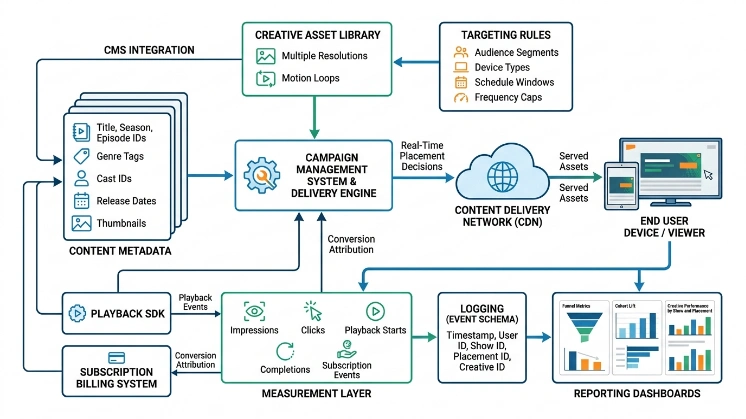
Components include content metadata, creative assets, targeting rules, delivery engine, measurement layer, and reporting dashboards. Content metadata contains title, season, episode IDs, genre tags, cast IDs, release dates, and thumbnails. Creative assets include multiple resolutions and motion loops. Targeting rules specify audience segments, device types, schedule windows, and frequency caps. Delivery engine performs real-time placement decisions and serves assets via a content delivery network (CDN). Measurement layer captures impressions, clicks, playback starts, completions, and subscription events. Reporting dashboards visualise funnel metrics, cohort lift, and creative performance by show and placement.
Integration points connect campaign systems to content management systems (CMS), playback SDKs, and subscription billing systems for conversion attribution. Logging uses event schemas with timestamps, user or cohort ID, show ID, placement ID, and creative ID to support reproducible analytics.
What benefits do OTT platforms achieve with show-based banners?
Platforms increase episode starts, reduce churn for engaged viewers, and raise cross-engagement for related shows through targeted in-app prompts. Show-based banners drive immediate episode starts when positioned on pause or end screens. They lift completion rates by prompting the next episode with a one-tap action. Cross-engagement occurs when platforms promote spin-offs or genre-related shows to viewers who watched specific titles; examples include promoting a crime documentary series to viewers of a related crime drama. These campaigns improve retention metrics: typical lift figures reported in industry analyses show 5–15% increase in episode starts and 2–6% reduction in churn for targeted cohorts, depending on offer presence and creative relevance.
Read More About This Topic:
How OTT Platforms Grow Subscribers Using Banner Advertising
Measurement of long-term subscriber value compares cohorts exposed to banners versus controls to quantify average revenue per user (ARPU) differences and retention over 30–90 days.
Explore More Expert Insights:
How Entertainment Platforms Build Subscription Interest Using Banner Ads
How Food Businesses Improve Engagement Using Mid-Funnel Advertising
What use cases demonstrate show-based banner campaign effectiveness?
Use cases include promoting new seasons, re-engagement of dropped viewers, converting trial users, and cross-promoting niche titles to targeted fans. New-season promotion uses pre-launch banners to build awareness and drive premiere-week starts. Re-engagement targets viewers who stopped after episode 1 with “Continue S1” banners on the show detail page. Trial conversion banners offer time-limited subscription deals after a viewer watches the finale. Cross-promotion identifies niche audiences. Promoting a historical drama to viewers who watched a similar period documentary and delivering targeted banners inside related shows to expand viewership.
These campaigns operate across devices: mobile, web, and TV apps. Performance benchmarks differ by device: mobile CTRs average 0.6–1.4%, while TV in-player overlays measure lower CTR but higher session-based episode starts.
How do platforms optimise show-based banner campaigns over time?
Platforms run A/B tests on creative, placement, frequency, and audience segments; they iterate based on statistical lift and cost per conversion. Optimisation uses sequential tests with sample sizes sized to detect 10% relative lift at 90% power. Tests evaluate creative variants, placement efficacy (detail page versus in-player overlay), and frequency cap levels. Platforms also apply automated budget reallocation toward placements or creatives that show positive incremental lift. Reports show cost per incremental episode start and cost per incremental subscription as primary optimisation targets.
Learn More Here:
OTT Campaign Ads That Turn Show Viewers Into Paying Subscribers
Data pipelines feed test results into recommendation systems that suggest next-step campaign adjustments tighten audience criteria, change creative format, or shift scheduling around episode drops.