A review-based banner campaign uses customer reviews shown on display or digital banners to signal trust and drive visits.It places verified review excerpts, star ratings, or reviewer details on visual ads across websites, apps, and on-premise screens. These banners present third-party validation to new audiences and highlight recent positive experiences.
A review-based banner campaign defines three core entities: the review source, the banner creative, and the distribution channel. The review source is a platform that collected the review, such as third-party review sites, reservation platforms, or first-party review systems. The banner creative is the visual asset that includes review text, star icons, reviewer first name and location, and contextual details (dish name, date). The distribution channel is the ad placement: programmatic display, social media feeds, email headers, or in-restaurant digital screens. Combining these entities produces measurable trust signals that reach potential diners before they search for a restaurant.
How do restaurants set up review-based banners?
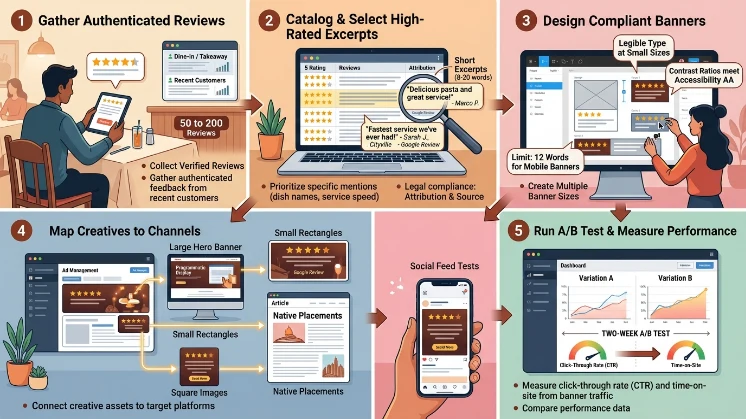
Restaurants collect verified reviews, select high-rated excerpts, design compliant banners, and route them to display channels. The setup begins with gathering authenticated reviews from recent customers. A catalog of 50 to 200 reviews provides a selection of short, 8–20 word excerpts that fit banner layouts. Legal compliance requires attribution: the reviewer’s first name and truncated surname initial or city, plus a clear source label. Design parameters include legible type at small sizes, contrast ratios that meet accessibility level AA, and a limit of 12 words for mobile banners.
Operational steps follow a sequence. First, export reviews with metadata, rating, date, reviewer country, and whether visit was dine-in or takeaway. Second, prioritise reviews with specific mentions (dish names, service speed). Third, create multiple banner sizes using the selected excerpts and include a visible star rating icon. Fourth, map creatives to channels: large hero banners for programmatic display, small rectangles for native placements, and square images for social feed tests. Fifth, run a two-week A/B test to measure click-through rate (CTR) and time-on-site from banner traffic.
What metrics show effectiveness of review banners?
Key metrics include click-through rate, first-time order rate, average order value, and conversion lift compared to control traffic. Restaurants monitor CTR as the immediate engagement metric. Typical CTR benchmarks for display banners are 0.05% to 0.20% in programmatic environments; review banners that include star ratings often achieve 0.12% to 0.30%. Conversion tracking ties banner impressions to first-time orders using tracking pixels or server-side events. A direct metric is first-time order rate: percentage of banner visitors who place their first order within 7 days. Additional metrics include average order value (AOV) for those customers and repeat rate within 30 days.
Attribution requires a control group. Restaurants run the same campaign with non-review creative for a matched audience segment. The conversion lift equals the percentage difference in first-time order rate between groups. For example, if control group first-order rate is 1.4% and review-banner group rate is 2.1%, conversion lift equals (2.1−1.4)/1.4 = 50% . Combine lift with cost metrics to calculate cost per new customer.
Which review content performs best on banners?
Short, specific excerpts that name dishes, mention speed or hygiene, and include a 4–5 star rating perform best.High-performing excerpts reference concrete experiences: dish names, delivery time, staff interaction, or cleanliness. Reviews that contain numbers (delivery time in minutes, price points) convert more often because readers parse them quickly. Ideal banner copy shows 10 to 12 words and a visible 4 or 5 star badge. If space allows, include reviewer first name and locality to increase authenticity.
Content selection follows rules. Prefer reviews within the last 90 days for relevance. Exclude reviews with unresolved complaints or legal flags. Use reviews that represent target audiences: families, commuters, office workers, or students. Rotate excerpts every 14 days to avoid ad fatigue. Keep the proportion of 5-star excerpts at 60% and 4-star excerpts at 40% to balance authenticity and positivity.
How do restaurants design banners for trust and clarity?
Designs emphasize readable text, clear star ratings, reviewer attribution, and an obvious offering cue.Design constraints focus on clarity at multiple sizes. Use sans-serif type with minimum 14px equivalent for mobile. Place the star rating near the reviewer excerpt. Append a short context line: dish or occasion (example: “Great chicken tikka — arrived in 22 minutes, family dinner”). Ensure visual contrast exceeds a 4.5:1 ratio for text on background. Do not include promotional language in the reviewer quote; keep the promotional context in a small separate line such as “Available for delivery and collection.”
Banner variants include static image banners for high-fidelity quotes and lightweight animated banners that rotate through three review excerpts in 4-second intervals. When animating, ensure each quote remains visible for at least 3.5 seconds to allow reading. Include a stable element across variants: restaurant logo or identifier and the review source label (example: “Review from OpenTable” or “Guest feedback, Sept 2025”).
Which channels deliver review-banner impact?
Programmatic display, social feeds, email headers, and in-restaurant screens deliver distinct reach and measurable results. Programmatic display reaches broad audiences while allowing audience targeting by postcode, interest, or browsing behaviour. Social feeds provide social proof in contexts where users already expect peer recommendations. Email headers reach existing subscribers and lift repeat orders by reminding past customers of positive experiences. In-restaurant screens use reviews to reinforce trust among walk-in customers and encourage repeat bookings or direct ordering.
Channel selection depends on objectives. For discovery among local audiences, programmatic display targeted by postcode and radius of 1–10 miles yields local reach. For conversion of past website visitors, social retargeting and email re-engagement show higher conversion rates. For increasing on-premise upsell, in-restaurant screens and table tents display review snippets near POS.
Get the Full Insights Here:
How Food Businesses Improve Visibility Using Banner Ads
What legal and compliance considerations apply?
Ensure reviewer consent, accurate attribution, and adherence to advertising standards and data-protection rules.Restaurants must verify consent to reuse review content. Consent records include the review text, reviewer identifier, date, and the platform source. UK advertising standards require ads to be truthful and not misleading; do not alter review meaning or star ratings. If a review contains a specific claim (for example, “30-minute delivery”), verify that the claim is accurate for the advertised context or remove the claim.
Data-protection rules require that any personal data displayed is minimal. Use only first name and initial or city to identify reviewers. Avoid full names or contact details. Keep records for seven years of consent and use metadata for auditing. In cases where reviews come from third-party platforms, follow the platform’s reuse policy and display the platform name when required.
What are the measurable benefits of review-banner campaigns?
They increase perceived trust, lift first-time order conversions, and reduce cost per acquisition when tested against non-review creatives. Measured benefits show up in key performance indicators. Perceived trust rises as indicated by longer session durations and lower bounce rates from banner traffic. Conversion lift manifests as higher first-time order rates in the review-banner cohort versus the control cohort. Cost-efficiency appears when cost per new customer falls after incorporating review banners into the media mix.
Quantitative examples demonstrate outcomes. Campaign tests of review banners often report 20% to 70% higher click-through engagement than generic banners. Conversion lift for first-time orders commonly ranges from 25% to 60% depending on creative quality and audience match. When combined with targeted retargeting, review banners lower customer acquisition cost by 10% to 40% relative to non-review display campaigns.
Explore More Expert Insights:
How Food Chains Increase Purchase Consideration Using Display Ads
How Cloud Kitchens Nurture Demand Using Menu-Focused Banner Ads
How do restaurants scale and maintain review-banner programs?
Scale by automating review ingestion, templating creatives, and running ongoing A/B tests with clear governance. Automation begins with an API or CSV feed from review platforms into a creative management system. Standard templates accommodate multiple banner sizes and include placeholders for reviewer name, star rating, and excerpt. Governance defines rotation cadence, freshness rules (reviews must be <90 days old), and exclusion criteria for flagged reviews.
Testing protocols include A/B tests for copy variations, size formats, and channel placements. Run each test for a minimum of 10,000 impressions or 7 days to reach statistical relevance. Monitor fatigue by tracking declining CTR over 21-day windows and swap creatives when CTR drops by more than 15% from the initial baseline.
What real use cases demonstrate impact?
Local launch, delivery boost, and reputation recovery campaigns show clear results when review banners target specific outcomes. A local launch campaign uses review banners targeted to a 3-mile radius to generate walk-ins during the first 30 days. A delivery-boost campaign places delivery-specific reviews in programmatic slots during lunch and dinner windows to increase order volume. A reputation recovery campaign highlights recent positive reviews after a negative publicity event and runs in regional news sites to rebuild trust.
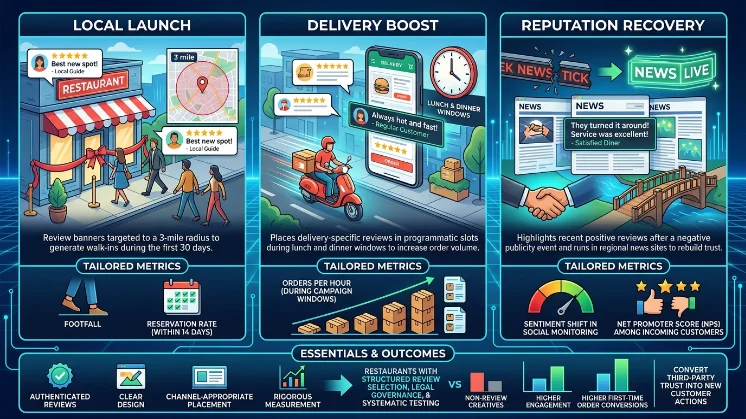
Each use case requires tailored metrics. For local launches, measure footfall and reservation rate within 14 days. For delivery boosts, measure orders per hour during campaign windows. For recovery, measure sentiment shift in social monitoring and net promoter score among incoming customers.
Review-based banner campaigns rely on authenticated reviews, clear design, channel-appropriate placement, and rigorous measurement. Restaurants that implement structured review selection, legal governance, and systematic testing generate higher engagement and higher first-time order conversions than non-review creatives. These campaigns function as a measurable method to convert third-party trust into new customer actions.
Dive Deeper Into This Topic:
Review-Based Restaurant Ads That Convert Trust Into First-Time Orders