
Banner ads are rectangular digital images or interactive elements that display on websites and apps to capture attention and link to a target page, they load with the page and record impressions, clicks, and viewability metrics.
Banner ads display as static images, animated GIFs, or HTML5 creatives. Ad networks and programmatic platforms place banners on web pages based on audience targeting rules and contextual signals. Each ad impression registers when the creative loads; viewability measures count only impressions where at least 50% of pixels appear on screen for one second. Click-throughs record user clicks; click-through rate (CTR) equals clicks divided by impressions. Cost models include CPM (cost per 1,000 impressions), CPC (cost per click), and CPA (cost per acquisition) for conversion-tracked campaigns. Tracking relies on pixels, server-to-server events, and UTM parameters for analytics.
How do banner ads improve visibility for food businesses?
Banner ads increase a food business’s online exposure by delivering repeated impressions to defined audiences across websites and apps, raising brand recognition and driving measurable traffic to menus, booking pages, or information pages.
Banner campaigns target audiences by geography, demographics, interests, device, and browsing context. For food businesses in the United Kingdom, geographic targeting narrows to postcode areas or regions. Frequency capping limits impressions per user to prevent ad fatigue. Creative rotation tests variants to determine which visuals and messages generate higher CTR and engagement. Performance lifts appear as increased organic searches for the restaurant name, higher direct website visits, and more traffic to online menus. Measurement uses baseline comparison: compare average daily sessions before and after campaign start, attribute sessions with UTM tags, and check search volume for brand keywords using analytics.
What are the core components of an effective banner campaign?
Effective banner campaigns include defined objectives, precise audience segments, optimised creatives, placement strategy, and a measurement plan with clear KPIs such as CPM, CTR, and conversions.
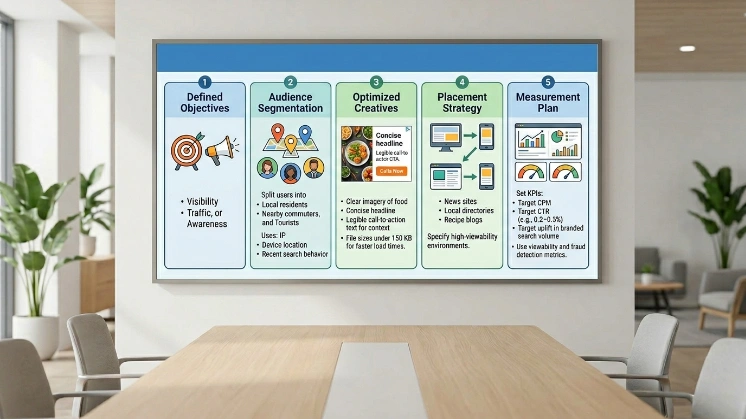
Define objectives first: visibility, traffic, or awareness. Audience segmentation splits users into local residents, nearby commuters, and tourists using IP, device location, or recent search behaviour. Creative must show clear imagery of food, concise headline, and legible call-to-action text for context, with file sizes under 150 KB for faster load times. Placement strategy specifies high-viewability environments such as news sites, local directories, and recipe blogs. Measurement plan sets KPIs: target CPM, target CTR (for example 0.2–0.5%), and target uplift in branded search volume. Use viewability and fraud detection metrics to ensure genuine exposure.
Read the Full Blog Here:
How Restaurants Build Trust Using Review-Based Banner Campaigns
How should food businesses design banner creatives for better visibility?
Design creatives with clear food imagery, one concise headline, readable typography, and consistent brand colours to ensure rapid visual recognition and legibility across devices.
Use high-resolution photos scaled and cropped for common banner sizes. Include one headline of no more than six words and a secondary line of no more than ten words if needed. Keep text contrast high against the background. Use formats that support animation limits: looping animation under 15 seconds and no more than three loops for user experience compliance. Prepare multiple sizes: leaderboard, medium rectangle, wide skyscraper, and mobile banner to cover desktop and mobile inventory. Optimize file size and load behavior; serve WebP or compressed PNG/JPEG for static images and minified HTML5 for interactive creatives.
How does targeting work for local food businesses in the UK?
Targeting combines geographic radius, demographic filters, contextual placements, and behavioural signals to reach users most likely to notice and respond to food-related ads.
Geographic radius targets include postcodes, towns, or a radius in metres from a restaurant location. Demographic filters include age ranges and household income segments when available from data partners. Contextual placements place ads on food, lifestyle, and local news pages. Behavioural signals include recent searches for “restaurants near me,” menu searches, or pages viewed about local attractions. Combine signals to build custom audience lists for repeat exposure. Use frequency capping to limit to a set number of exposures per week, typically 3–7 impressions for awareness goals.
What metrics should food businesses track for banner ad visibility?
Track impressions, viewable impressions, reach, frequency, CTR, session volume to landing pages, and branded search volume to quantify visibility and exposure.
Impressions measure raw ad deliveries. Viewable impressions count exposures meeting the viewability threshold. Reach counts unique users exposed to the campaign. Frequency averages impressions per user. CTR shows engagement percentage. Sessions to landing pages measure traffic driven from the creative using UTM parameters. Branded search volume indicates increases in searches for the business name. Compare pre- and post-campaign baseline metrics and report percentage changes. Use attribution windows—short (1–7 days) for direct response and longer (30 days) for awareness-to-action journeys.
How do banner ad placements and publisher choices affect visibility?
Premium placements on high-traffic pages and contextually relevant publishers increase viewability and raise the chance of positive attention compared with low-quality placements.
High-traffic publishers include local news outlets, recipe blogs, and tourism guides that draw the target audience. Contextual relevance links the creative to article topics such as “best local restaurants” or “weekend dining,” which improves attention. Avoid placements alongside sensitive or unrelated content by using brand-safety filters. Choose inventory with documented high viewability rates, typically above 50%. Validate publisher quality with third-party verification services and use whitelists for consistent performance.
What creative tests and iterations improve visibility?
Run A/B tests for imagery, headlines, colours, and sizes across audiences; measure performance by CTR and viewability, then scale the best-performing variants.
Create at least three distinct headlines and three imagery variants representing menu items, interior, and staff. Rotate across placements and record CTR and viewability per variant. Pause variants with CTR below the campaign median and increase impressions for variants with at least 20% higher CTR. Test one variable at a time headline or image to isolate impact. Track results over a minimum 14-day window to gather stable data across weekdays and weekends.
What are common budget models and how do they influence visibility?
Budget models include CPM for broad visibility, CPC for engagement-driven goals, and fixed-rate sponsorships for guaranteed high-exposure placements; each model trades off predictability and cost per impression.
CPM charges per 1,000 impressions and suits campaigns focused on reach and visibility. CPC charges for clicks and suits traffic-focused campaigns. Fixed-rate sponsorship secures fixed placements on a publisher for a set time and gives predictable high exposure. Set daily and total campaign caps to control spend. Allocate at least 60% of budget to high-viewability placements for awareness objectives, and 40% to run exploratory placements that test new contexts.
Explore More Expert Insights:
How Cloud Kitchens Boost Demand Using Display Campaigns
How Food Chains Increase Sales Using Banner Advertising
What benefits do banner ads deliver to food businesses?
Banner ads deliver increased brand awareness, measurable web traffic, uplift in branded search, and support for seasonal promotions and event announcements.
Awareness results show as more users recognizing the brand in surveys or increased direct website visits. Measured traffic increases come from tracked banner clicks and improved organic search referrals. Seasonal promotions such as weekend brunch offers or limited menus gain accelerated visibility before peak periods. Event announcements like pop-ups or menu launches reach target audiences quickly through geographic and contextual targeting.
What use cases demonstrate successful visibility outcomes?
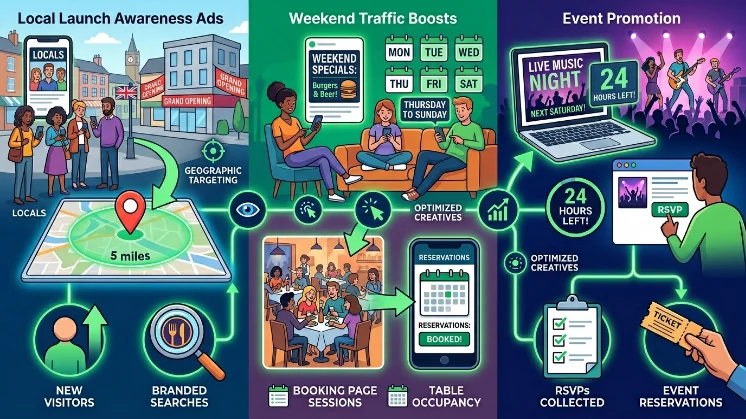
Use cases include local launch awareness, weekend traffic boosts, and event promotion; each uses geographic targeting, creative tailored to the offer, and metrics for reach and traffic.
Local launch awareness campaigns target residents within a defined radius and measure new visitors and branded searches. Weekend traffic boosts concentrate impressions on Thursday–Sunday with creatives highlighting menu or timings, and measure booking pages sessions. Event promotion campaigns run two weeks before an event, increase frequency in the final 72 hours, and track RSVPs or reservations as conversion events.
Find Out More:
Review-Based Restaurant Ads That Convert Trust Into First-Time Orders
Banner ads provide repeatable, measurable exposure for food businesses through targeted placements, optimised creatives, and clear KPIs. Campaigns focus on viewable impressions, reach, and clicks to drive traffic and lift branded search. Follow structured testing, geographic targeting for the UK, and clear measurement to report visibility outcomes.