
Banner advertising for food chains is display ads placed on websites and apps to drive awareness and clicks that lead to orders or visits. Banner advertising includes static images, animated GIFs, HTML5 creatives, and rich media shown on desktops, tablets, and phones. Food chains use banners to present menu items, promotions, locations, and ordering links. Publishers include news sites, recipe blogs, delivery apps, and local directories. Ad networks and programmatic platforms place banners across thousands of sites using targeting signals such as location, browsing history, and time of day.
Banner creatives measure impressions, click-through rate (CTR), viewability, and conversions. Impressions count exposures; CTR equals clicks divided by impressions. Viewability follows the 50% x 1 second standard for display and 50% x 2 seconds for video in most reporting frameworks. Conversion tracking requires a pixel or server-side event to record orders, sign-ups, or store visits.
How do food chains define objectives for banner campaigns?
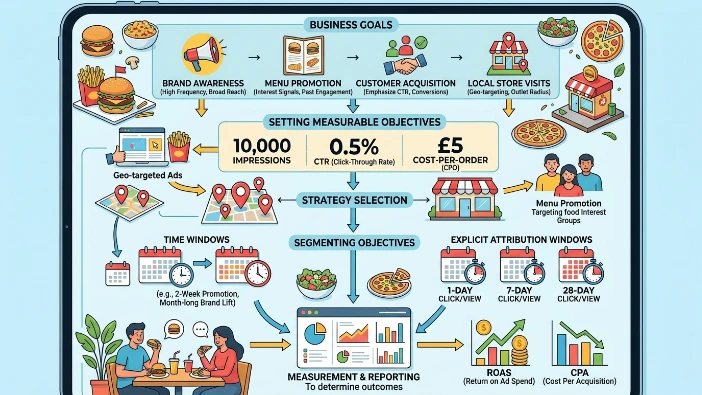
Food chains set measurable objectives such as 10,000 impressions, 0.5% CTR, or a £5 cost-per-order before launching campaigns. Objectives align with business goals: brand awareness, menu promotion, customer acquisition, or local store visits. Awareness uses high-frequency, broad-reach placements. Menu promotion targets users with interest signals for food categories and past engagement. Customer acquisition emphasizes CTR and conversion events. Local store visits use geo-targeted ads within a specific radius of outlets. Objective selection dictates creative format, targeting, bidding, and measurement.
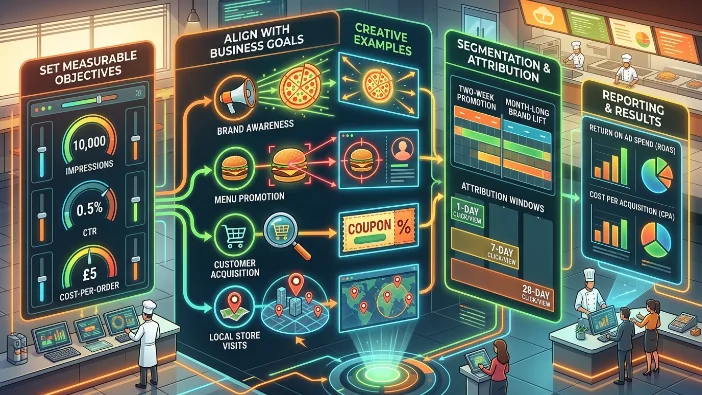
Campaigns segment objectives by time window, for example a two-week promotion or a month-long brand lift effort. Attribution windows are explicit: common choices include 1-day, 7-day, and 28-day click or view windows. Reporting aligns to those windows to determine return on ad spend (ROAS) and cost per acquisition (CPA).
How do food chains select audiences and targeting?
Food chains target audiences by geography, demographics, interests, device, and behavioural signals to reach likely buyers. Geographic targeting uses country, region, city, postal code, or a radius in metres around stores. Demographic filters include age bands, gender, and household income tiers. Interest and behaviour targeting rely on content categories (food, recipes), past search queries, and purchase intent signals from ad platforms. Device targeting separates desktop, mobile, and tablet to tailor creative sizes. Time-of-day targeting schedules ads for peak ordering hours, such as 11:00–14:00 for lunch and 18:00–21:00 for dinner.
Lookalike or similar-audience segments create new prospects based on high-value customers. First-party data such as CRM emails or loyalty IDs enable audience matching and exclusion lists to avoid overexposure. Frequency caps limit daily or weekly exposures per user to prevent ad fatigue.
How are creatives structured for banner ads in food chains?
Creatives include a clear product image, concise offer text, price or discount, and a visible call-to-action mapped to the campaign objective. Image selection highlights the menu item in high resolution with neutral backgrounds and consistent lighting. Text uses a single-line headline and a subline with the offer or price. Fonts use high contrast against the image for legibility on small screens. File formats follow publisher limits: JPEG or PNG for static, GIF for simple animations, and HTML5 for interactive units. File size limits typically range from 50 KB to 150 KB depending on placement.
Creative variations test different visuals, headlines, and offers in A/B or multivariate tests. Standard sizes include 300×250, 728×90, 320×50, and 300×600 pixels to cover common inventory across desktop and mobile. Accessible design includes alt text and avoids text-only images to support users with assistive technology.
How is targeting translated into media buying and delivery?
Media buying uses direct site buys, private marketplaces, or programmatic exchanges to deliver impressions to targeted segments. Direct buys secure premium placements on specific publishers. Private marketplaces negotiate reserved inventory with defined floor prices. Open exchanges use real-time bidding to match impressions with bid requests using targeting signals. Bidding strategies include CPM (cost per mille), CPC (cost per click), and CPA (cost per acquisition). Smart bidding uses automated bid adjustments based on historical performance and contextual features.
Delivery pacing controls spend across campaign duration to meet impression or budget goals. Dayparting allocates higher bids during peak order windows. Geo-pacing shifts budget to high-performing regions. Viewability and fraud filters block low-quality inventory and non-human traffic using third-party verification.
How do food chains measure and attribute results?
Measurement tracks impressions, CTR, viewability, conversions, cost per conversion, and incremental lift using defined attribution windows. Impression and click metrics come from ad servers. Viewability and fraud metrics come from verification partners. Conversion events link to order confirmations, app installs, or store visit events. Cost metrics calculate CPM, CPC, CPA, and ROAS. Incrementality studies compare exposed and control cohorts to estimate causal lift in orders or visits. Lift tests use randomised holdout groups representing 5%–50% of the target audience, depending on campaign scale.
Reporting cadence runs daily for live optimisation and weekly for strategic review. Benchmarks for quick evaluation include CTR ranges of 0.2%–0.8% for display and view-through conversion rates relevant to longer consideration cycles.
What components comprise a complete campaign setup?
A complete setup includes campaign goals, target audience, creatives, placements, bidding strategy, measurement plan, and fraud controls. The strategy document lists objective KPIs and timeline. Audience lists include first-party segments and exclusion lists. Creative folders store final assets and variants. Placement lists include preferred publisher IDs or exchange filters. Bidding defines the pricing model and caps. Measurement includes tracking pixels, event schemas, and analytics dashboards. Fraud controls add verification tags and domain whitelists. Legal checks confirm compliance with advertising regulations and local food labelling rules.
What benefits do banner ads deliver to food chains?
Banner ads increase brand reach, drive menu awareness, generate clicks to order pages, and support local store visits when aligned to clear objectives. Reach builds frequency among high-potential users through scaled impressions. Menu awareness introduces new items or limited-time offers. Clicks drive direct traffic to ordering flows or reservation pages. Local targeting drives footfall to outlets in defined radii. Creative testing refines messaging that yields higher CTRs and lower CPAs. Measurement and incrementality tests quantify contribution to incremental orders beyond organic demand.
Explore More Expert Insights:
How Restaurants Drive Online Orders Using Retargeting Ads
How Food Brands Promote Offers Using Banner Campaigns
What use cases demonstrate effective banner ad campaigns?
Use cases include new item launches, meal-time promos, location-specific offers, and event-driven spikes such as holidays or sports fixtures. New item launches deploy high-frequency banners for 7–14 days to build initial trials. Meal-time promos run dayparted ads with discounted combos during targeted hours. Location-specific offers show geo-fenced banners to users within 2,000 metres of outlets for 24–72 hours. Event-driven campaigns align creative to dates such as national holidays or major sports matches and run multi-week windows.
Example: A chain runs a two-week lunch promotion across news sites and recipe blogs, targets users aged 18–45 near outlets, uses 320×50 and 300×250 banners, and measures orders attributed within a 7-day click window.
How do food chains ensure compliance and user privacy?
Food chains implement cookie consent, use hashed first-party identifiers, and follow local data protection rules when collecting and using data for targeting. Consent banners capture opt-in for personalised ads where required. First-party data uses secure hashing before uploading to matching platforms. Data retention policies define time limits for audience lists. Vendors sign data processing agreements to meet legal requirements. Geo-targeting uses coarse location when precise consent is absent.
Explore More Expert Insights:
How Cloud Kitchens Nurture Demand Using Menu-Focused Banner Ads
Banner advertising for food chains follows a measurable process. Define objectives, target precisely, use clear creatives, select appropriate buying methods, and measure with deterministic and incremental approaches to quantify sales impact.
Complete Details Available Here:
Cloud Kitchen Ads That Convert Menu Browsers Into Active Orders