Local cafe advertising with display ads uses geo-targeted visual ads to reach people near a cafe and convert nearby searches into walk-in customers. Local display ads target devices by location, time, and behavior to drive in-person visits through clear offers, directions, and visit intent signals.
Local display advertising defines the ad type and targeting rules. Display ads are image or HTML5 creatives shown on websites, apps, and programmatic networks. Geo-targeting limits impressions to specific coordinates, radii, postal codes, or custom polygons. Proximity signals include recent search queries, map interactions, and device GPS. Attribution links online clicks or views to store visits through beacon data, Wi‑Fi logs, or location-match models.
How does a local display campaign convert nearby searches into physical visits?
A local display campaign converts by aligning ad visibility windows, targeted audiences, and persuasive creative with clear store-location actions. Conversion follows three steps: reach, relevance, and facilitation. First, platforms serve ads to users within the defined geography during high-conversion times. Second, creatives show relevant messages tied to search intent (for example, “coffee near me” queries). Third, ads include direct location actions such as map links, click-to-call, or time-limited offers that reduce friction to walk in.
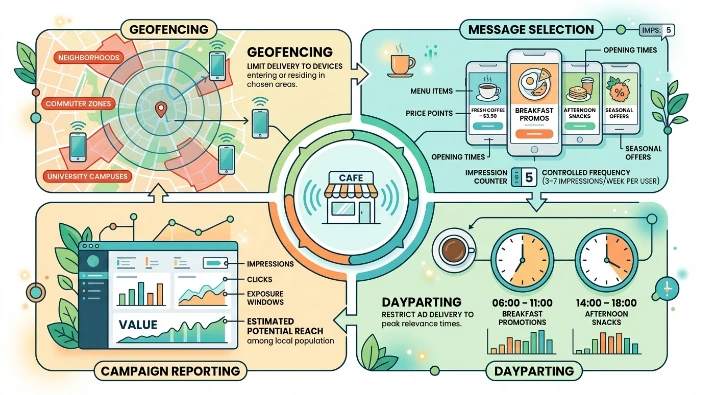
Campaign setup requires audience lists based on recent local search behavior, custom intent keywords, and device-level location history. Bid strategies prioritise impressions within a small radius and during peak windows (for example, 7:00–10:00 and 15:00–18:00). Conversion measurement uses deterministic visits (beacon or Wi‑Fi check-ins) and probabilistic models (look-back windows and location matching) for accurate ROI reporting.
What components make an effective local display ad for cafes?
Effective local display ads combine precise geo-targeting, concise location-first creative, clear call-to-action, and measurable visit tracking. Components break down as follows.
Use a radius of 0.5–2 miles for urban cafes and 2–5 miles for suburban locations. Include devices with recent map searches for “coffee,” “cafe,” or related terms. Add demographic filters only if relevant to product offers (for example, students for discounted lattes).
Show the cafe name, one-line offer, and directional cue. Use a readable image at 1200×628 pixels or responsive HTML5. Limit on-ad text to one headline and one subhead to avoid clutter.
Use click-to-map, click-to-call, or “show directions” buttons. Include business hours and any limited-time offers directly in the creative.
Link to a single-page location URL with map, hours, contact number, and a simple offer code. Ensure page load under 3 seconds on mobile.
Implement store visit conversion tracking with device location matching, POS uplift analysis, and coupon-redemption codes. Use a 7‑day look-back window for view-through attribution and a 24‑hour window for click-to-visit direct attribution.
What targeting strategies increase walk-ins from nearby searches?
Targeting strategies that increase walk-ins focus on precise radius targeting, search-intent audiences, time-of-day adjustments, and exclusion lists to avoid wasted spend. Radius targeting reduces wasted impressions by restricting ad delivery to devices within 0.5–2 miles in dense areas. Custom intent audiences use recent search queries like “best flat white near me” or “cafes open now” to capture high intent. Time-of-day bid modifiers increase bids during morning and afternoon peaks. Exclusion lists remove past visitors in the last 24 hours when repeat visits are unlikely.
Use location-sequence targeting to reach people who recently visited complementary places such as offices, universities, or transport hubs. Combine with contextual targeting on food and drink related content to maintain relevance.
How should creatives be written for maximum walk-in response?
Write creatives that state the offer, location cue, and immediate action in one short line and one call-to-action. Keep headlines to 6–8 words and body lines to one short sentence. Flat White £2 — 8–10am, 50m from King’s Cross. Use a bold map pin icon and a directional button labeled “Get Directions.” Avoid long descriptions or multiple CTAs. Ensure legible fonts at small sizes and contrast ratio that meets accessibility guidelines.
Include price or time-limited language when applicable to create a clear reason to act. Use local landmarks or tube station names to improve local relevance.
How is performance measured for local cafe display campaigns?
Performance measures combine online metrics and store-visit metrics: impressions, clicks, CTR, click-to-direction rate, and verified store visits or POS-attributed sales. Track CTR and click-to-direction rate to measure initial engagement. Use confirmed store visits from location-matching solutions as the primary offline conversion metric. Tie POS transactions to campaigns with unique offer codes or redemption IDs. Calculate cost-per-visit (CPV) by dividing total ad spend by verified visits. Report lift in average daily footfall before and after campaign launch with a comparable seven-day baseline.
Set KPIs: CTR target 0.4%–1.2% for local display; click-to-direction rate target 6%–12%; CPV target depends on average transaction value, aim for CPV under 25% of average sale.
What privacy and compliance steps must cafes follow?
Cafes must follow regional data privacy laws, disclose location-based targeting, and use only consented or aggregated location signals for attribution. In the UK, follow the Data Protection Act and UK GDPR rules on personal data processing. Use location data that is anonymised or aggregated for reporting where possible. Provide clear opt-out options on landing pages and privacy notices. If using deterministic visit tracking, obtain explicit consent for location access via the app and store consent logs.
Ensure third-party measurement vendors maintain contracts with data processing agreements and offer audit trails for user-level matching processes.
Check the Complete Explanation:
How Cafes Increase Foot Traffic Using Display Ads
What are the common use cases and examples for local cafe display ads?
Common use cases include morning rush promotions, event-based offers, new-store openings, and last-minute inventory pushes to nearby customers. Morning rush promotions target commuters with discounted coffee between 7:00 and 9:00. Event-based offers run ads to attendees at nearby conferences with a limited-time menu. New-store openings use heavy frequency in the first 14 days within a 2-mile radius. Inventory pushes advertise surplus pastries at reduced prices during the last two hours before closing.
Example: A cafe near a university runs a two-week morning ad with 20% student discount, served to devices within 1 mile and during 07:30–09:30. Another example: A central-city cafe uses evening ads 16:00–18:30 promoting a “buy one, get one” pastry offer to theater district coordinates.
Explore More Expert Insights:
Restaurant Display Ads That Convert Food Interest Into Checkout Orders
Food Delivery Ads That Turn Offer Engagement Into Completed Purchases
How do cafes integrate local display ads with other local marketing channels?
Integration requires synchronised messaging across maps listings, social profiles, email, and in-store signage, plus shared tracking identifiers for unified attribution.Ensure Google Business Profile and Apple Maps entries match the ad copy and hours. Use the same coupon code across display ads, email newsletters, and in-store posters to attribute redemptions. Coordinate social posts to run alongside display campaigns to increase multi-touch frequency. Feed POS promotions into the ad landing page to maintain consistent offers.
Cross-channel measurement uses a single campaign ID appended to URLs and coupon codes to attribute visits and sales back to the display campaign.
What are the expected benefits and measurable outcomes?
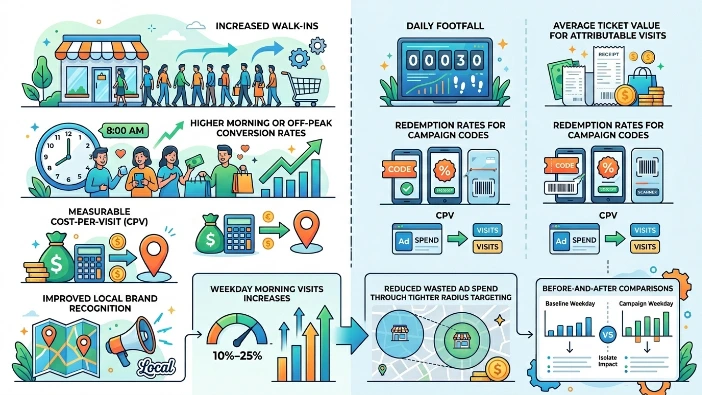
Expected benefits include increased walk-ins, higher morning or off-peak conversion rates, measurable cost-per-visit, and improved local brand recognition. Measure benefits by tracking daily footfall, average ticket value for attributable visits, redemption rates for campaign codes, and CPV. A successful campaign increases weekday morning visits by a target percentage (for example, 10%–25%) and reduces wasted ad spend through tighter radius targeting. Use before-and-after comparisons with the same weekday baseline to isolate campaign impact.
Local cafe display ads convert nearby searches into walk-ins through precise geo-targeting, concise location-first creative, time-based bidding, and verified visit measurement. Implement radius targeting, intent-based audiences, clear CTAs, unified coupon codes, and privacy-compliant tracking to measure cost-per-visit and sales lift effectively.
For stepwise awareness of local banner options, see: