Offer-based banner ads are visual in-app promotions that present time-limited discounts, bundle deals, or free-delivery codes to users to drive immediate orders. They contain a clear offer, an expiry or validity window, and a call-to-action that links to an order flow.
Offer-based banner ads appear inside food delivery apps on home screens, search results, category pages, or checkout flows. They contain graphic assets, concise text, and an action target such as a deep link to a restaurant menu or a prefilled cart. Common offer formats include percentage discounts (for example, 20% off), fixed-value discounts (for example, £5 off), free delivery, and multi-item bundles (for example, two pizzas for £12). Apps measure ad success through impressions, click-through rate (CTR), offer redemptions, and completed purchases.
How do offer-based banner ads move users from engagement to purchase?
Ads convert engagement into purchases by reducing purchase friction, lowering price barriers, and guiding users into a pre-configured checkout with applied offers and fast payment options.
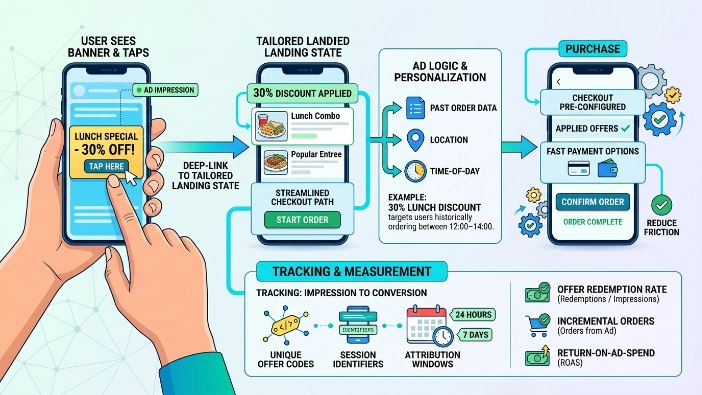
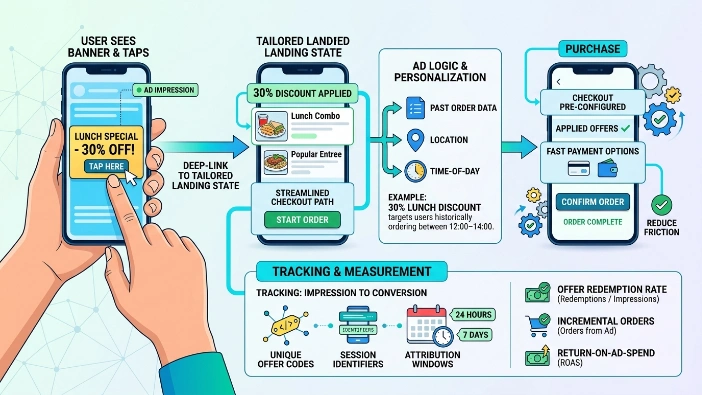
The process begins when a user sees the banner and taps it. The ad deep-links the user to a tailored landing state. The landing state shows the offer applied, relevant menu items highlighted, and a streamlined checkout path. The ad logic often personalises offers using past order data, location, and time-of-day. For example, a 30% lunch discount targets users who historically order between 12:00–14:00. Tracking ties the initial ad impression to final conversion using unique offer codes and session identifiers. Measurement uses attribution windows such as 24 hours or seven days. Conversion metrics include offer redemption rate (redemptions divided by impressions), incremental orders (orders attributable to the ad), and return-on-ad-spend (ROAS).
What components make an effective offer-based banner ad?
Effective ads combine a clear headline stating the offer, an eye-catching visual, a visible expiry or limit, and a deep link that pre-applies the offer to a checkout-ready cart.
Headline clarity requires explicit numbers: discount percentage or monetary value. Visuals use high-contrast food photography sized for mobile screens. Expiry indicators show remaining time or qualifying hours. Deep links route to specific restaurants, categories, or curated menus with the offer automatically applied. Technical components include tracking parameters for impression and click IDs, promo codes for offline verification, and server-side offer validation to prevent misuse. Creative testing uses A/B variants for headline wording, image choice, expiry phrasing, and placement within the app.
How do apps personalise offer-based banner ads?
Personalisation uses user signals past orders, location, time, and device to select offers and creatives that match user preferences and ordering patterns.
Data points feed a decision engine that ranks offers by predicted conversion probability. Past order frequency segments users into high-frequency, occasional, and lapsed cohorts. Location filtering restricts offers to restaurants that deliver to the user’s address. Time-based rules map lunch, dinner, and late-night offers to typical ordering windows. Device signals influence creative size and media type. The system selects menu items to prefill a cart based on previous choices, with swap options for dietary filters. For example, a user who ordered vegetarian curry twice in the past month sees vegetarian-oriented bundle offers with the discount pre-applied.
What tracking and measurement are required to prove offer efficacy?
Proof requires event-level tracking from impression to order completion, unique offer identifiers, and attribution windows that capture delayed conversions.
Tracking includes impression logs, click events, deep-link opens, cart modifications, and final payment confirmation. Each banner carries a unique offer ID to map redemptions back to a campaign. Analytics compute CTR, redemption rate, conversion rate from click to order, average order value (AOV) with the offer, and incremental revenue. Experiments use holdout groups where a subset of users does not see the offer; incremental lift equals difference in orders between exposed and control groups. Financial metrics include cost-per-redemption and ROAS calculated as incremental gross margin attributable to the ad divided by campaign cost.
How do apps prevent fraud and misuse of offers?
Prevention uses server-side validation, single-use or user-bound promo codes, redemption caps, and behaviour-based anomaly detection.
Server-side validation verifies that the order meets offer criteria at checkout. Promo codes can lock to a user ID or device ID. Redemption caps apply per-user or per-offer total. Anomaly systems flag rapid successive redemptions, impossible geolocations, or mismatched payment patterns. Apps enforce minimum order values and product filters where relevant. Logging supports audit trails for disputed redemptions. Regular reconciliation compares redemptions logged in campaign systems with orders recorded in transaction ledgers.
What are the operational steps to run an offer-based banner campaign?
Campaign setup includes defining objectives, selecting target segments, designing creative, configuring deep links and offer parameters, launching, and monitoring with real-time dashboards.
Define objectives such as increasing weekday dinner orders by 10% or raising AOV by £3. Choose audience segments: frequent users, new users, or lapsed users. Create creatives with specific offer copy and expiry details. Configure deep links that prefill carts and apply the offer automatically. Set technical parameters: offer ID, redemption caps, geo-fencing, and attribution window. Launch during a controlled time window and monitor KPIs hourly for the first 24 hours, daily thereafter. Adjust creative or budget based on CTR and redemption rates. Post-campaign, run lift analysis using a holdout control to calculate incremental conversions and revenue.
For more information, explore:
How Food Delivery Apps Boost Orders Using Banner Ads
What are the main benefits of using offer-based banner ads for food delivery apps?
Benefits include faster conversion cycles, measurable incremental revenue, improved user retention through repeated value, and data for optimising future offers.
Offer banners convert users who are already in-app attention into completed orders. They reduce friction by pre-applying discounts and reducing decision time. Measured incremental revenue enables precise budget allocation. Repeat exposure to relevant offers increases retention and order frequency over multi-week cohorts. Campaign data reveals price elasticity and best-performing menu bundles. Example benefits: a campaign that applies a £3 discount increases AOV by £2.50 while driving a 12% uplift in order frequency among occasional users.
What use cases work best for offer-based banner ads?
Use cases include lunch-hour volume boosts, reactivating lapsed users with strong first-order discounts, promoting low-margin peak-hour add-ons, and moving surplus inventory from partner kitchens.
Lunch and dinner volume boosts target habitual time windows with limited-duration discounts. Reactivation uses first-order or comeback discounts for users inactive 30–90 days. Peak-hour add-on promotions sell sides and drinks with targeted bundle savings. Surplus inventory promotions reduce waste by offering discounts on specific dishes available for immediate delivery. Each use case requires matching offer size to margin impact and tracking incremental uplift against historical baselines.
Explore More Expert Insights:
Restaurant Banner Ads That Convert Menu Views Into Online Orders
Holiday Travel Ads That Turn Seasonal Interest Into Final Bookings
How do offer-based banners fit into a full-funnel acquisition and retention strategy?
They function as conversion drivers in the bottom-of-funnel by turning active engagement into purchase, and as retention levers when repeated offers increase order frequency among retained users.
Top-of-funnel channels acquire users via ads and organic search. Middle-of-funnel messaging builds app awareness. Offer-based banners act at the moment of intent inside the app. They close the loop by converting intent to completed transactions and gather signal data for future targeting. Repeated, well-sized offers that maintain margin encourage habit formation and lengthen customer lifetime value (LTV).
How should teams evaluate campaign success and decide next steps?
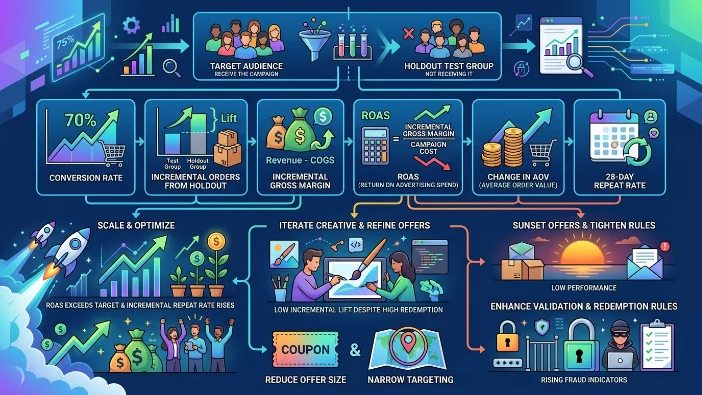
Evaluate with conversion rate, incremental orders from a holdout test, ROAS, change in AOV, and 28-day repeat rate; then scale, iterate creative, or sunset offers based on those metrics.
Learn More Here:
How Food Delivery Apps Nurture Users Using Offer-Based Banner Ads
Run a controlled experiment with a holdout audience. Calculate incremental orders and incremental gross margin. Incremental gross margin divided by campaign cost. Monitor changes in AOV and customer repeat rate over 28 days. If ROAS exceeds target and incremental repeat rate rises, scale the campaign. If the redemption rate is high but incremental lift is low, reduce offer size or narrow targeting. If fraud indicators rise, tighten validation and redemption rules.