Offer-based banner ads are in-app visual promotions that display discounts, combos, or limited-time deals to users to drive engagement and orders. Offer-based banner ads appear in app home screens, category pages, and checkout flows. They contain text, images, prices, and clear callouts such as “20% off” or “Free delivery”. Platforms serve these banners based on user data, inventory, and marketing goals. Entities involved include advertisers (restaurants), ad servers, targeting engines, and analytics systems.
These banners use structured creative headline, image, offer tag, validity, and tappable link. They run for fixed windows, for example 24 hours, 72 hours, or longer seasonal periods. Delivery apps measure performance with impressions, click-through rate (CTR), conversion rate, average order value (AOV), and incremental orders.
How do apps decide which users see which offer-based banners?
Apps use rule-based and algorithmic targeting that combines user profile, past behaviour, and contextual signals to select banners for each user. Targeting starts with user attributes: location, dietary preferences, average spend, and order frequency. Behavioural signals include last order date, time-of-day activity, and restaurant affinities. Contextual signals include local promotions, stock availability, and active restaurant offers. Apps apply prioritisation rules: time-sensitive offers override generic banners; high-margin offers receive preferential placement when inventory supports them.
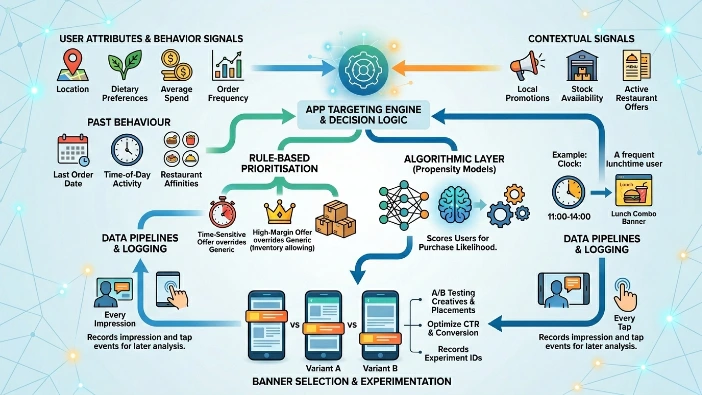
Algorithmic layers use propensity models that score users for purchase likelihood. Scores guide which banner variant shows. For example, a user with frequent lunchtime orders receives lunch combo banners between 11:00 and 14:00. Apps record experiment IDs for A/B testing of creatives and placements to optimise CTR and conversion. Data pipelines log events for every impression and tap for later analysis.
How do offer-based banners guide users through the purchase process?
Banners act as micro-conversion triggers: they capture attention, communicate value, and link directly to pre-configured order flows that reduce friction. A banner leads users to a specific landing state within the app. Landing states include a restaurant menu with the offer auto-applied, a checkout screen with discount code inserted, or a curated collection of eligible restaurants. Reducing steps increases completion rates. Offer mechanics include auto-applied discounts, single-tap add-to-cart for curated combos, and time-limited countdown badges.
Apps implement validation checks at checkout to prevent failed redemptions. They also surface offer terms before the final payment to maintain clarity. Post-click tracking connects the initial impression to the final order for attribution. This enables calculation of incremental conversions attributable to banner exposure versus baseline behaviour.
What components make an effective offer-based banner?
Effective banners include concise headline, clear numeric offer, expiry time, a relevant image, and a precise landing action. Headlines use numeric values such as “£5 off” or “30% discount.” Offer tags highlight eligibility: “first order,” “students,” or “cardholders.” Expiry displays exact times and dates, for example “Ends 23:59 on 12 June 2026.” Images show the dish or meal type; images must match the landing content to avoid mismatched expectations. Landing actions are explicit: “Open menu,” “Apply code,” or “Order now.”
Creative variants test combinations of headline copy and imagery. Technical components include lightweight image formats (WebP), responsive sizes for different device screens, and accessibility labels for screen readers. Measurement tags include campaign ID, creative ID, placement ID, and experiment ID to support granular analytics.
How do offer-based banners improve user retention and lifetime value?
Banners increase repeat purchases by delivering timely, relevant value that encourages users to order more frequently and spend more per order. Targeted offers convert occasional users into regular users by reducing the perceived cost of trying new restaurants or menu items. For example, a 20% discount on a user’s third order can lift retention measured over a 30-day window. Cross-sell banners for add-ons raise average order value by promoting sides or drinks during the checkout path. Bundled offers that include delivery credits improve perceived value for higher-priced orders.
Apps track lifetime value (LTV) changes by cohort: compare cohorts exposed to banners versus control cohorts. They also monitor churn rates and reactivation rates after promotional pushes. Successful banners show measurable increases in 7-day and 30-day order frequency and sustained order value changes beyond the promotion window.
How do apps balance offer frequency and margin preservation?
Apps use segmentation and margin-aware rules to limit offer exposure and protect profitability while maximising incremental orders. Segmentation restricts high-discount offers to users with high incremental probability or low recent spend. Margin-aware rules use restaurant cost and delivery fee data to cap discount levels. For example, offers above 25% are limited to selected restaurants that accept subsidy or to orders exceeding £15. Delivery apps allocate budget per campaign and enforce pacing to avoid overspending early in a promotion.
Apps also deploy frequency capping to prevent banner fatigue. Frequency caps might show a promotional banner no more than three times per user in seven days. When users reach cap, apps rotate to value-added messages like “New menu items” instead of repeated discounts. These controls maintain conversion efficiency and long-term partner relationships.
What measurement frameworks do apps use to evaluate banner campaigns?
Apps apply unified event tracking, incremental lift tests, and revenue-attribution models to measure banner performance and ROI. Event tracking captures impressions, taps, landing interactions, cart additions, checkouts, and refunds. Incrementality testing runs holdout experiments where a control group sees no promotional banners. Lift is calculated as the difference in conversion rates and revenue between exposed and control groups. Attribution models allocate revenue to the first-touch, last-touch, or multi-touch depending on campaign goals.
Key metrics include CTR, conversion rate, cost per incremental order, return on ad spend (ROAS), and change in cohort LTV. For example, a banner campaign that generates 1,200 incremental orders from 60,000 impressions with average order value £18 yields clear per-order ROI when marketing and subsidy costs are included.
What legal and user-experience constraints shape banner design in the UK?
Banners must comply with advertising law, consumer protection rules, and app platform policies while delivering transparent offer information. Legal requirements include clear pricing, accurate saving claims, and straightforward expiry dates. Consumer protection requires that fees, minimum order values, and ineligible items display before final payment. UK regulations demand non-misleading statements; for example, you cannot claim “free” delivery if mandatory fees apply. Platform policies limit disruptive placements and require opt-out options for personalised ads.
User-experience constraints include readability on small screens, high-contrast text, and accessible navigation. Apps provide a terms link for complex offers and keep landing flows short. These practices reduce complaints and refund requests and support compliance with UK advertising standards.
Explore More Expert Insights:
How Restaurants Build Order Intent Using Menu Banner Advertising
How Travel Brands Increase Holiday Consideration Using Banner Campaigns
Where do offer-based banners deliver the most value for food delivery apps?
Banners deliver the most value in reactivation campaigns, off-peak demand stimulation, and menu experimentation for restaurants. Reactivation campaigns target users who have not ordered in 14–60 days with time-limited discounts that drive return visits. Off-peak stimulation runs during slow hours afternoon or late evening using price incentives to smooth demand. Menu experimentation promotes new items with introductory discounts to gather early sales and feedback. Each use case tracks distinct KPIs: reactivation measures return rate, off-peak shows uplift in orders per hour, and experimentation monitors adoption rate for new items.
Examples include lunchtime combo banners for office areas, student-targeted offers near campuses, and weekend family bundle promotions. Each example links banner creative to a landing flow that simplifies redemption and measures impact.
How should product teams structure trials to optimise banners?
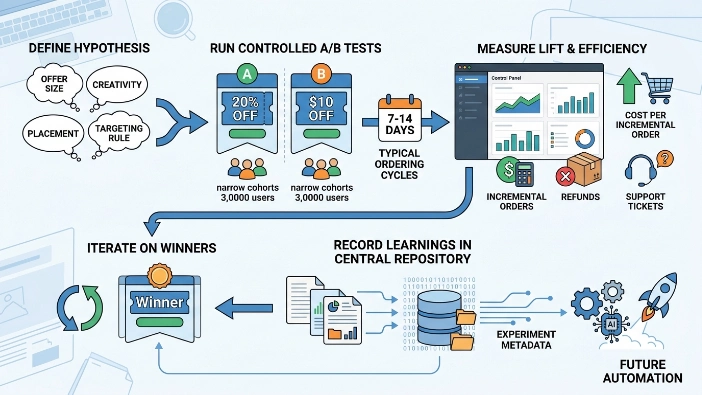
Teams should run controlled A/B tests with clearly defined hypotheses, narrow cohorts, and short test windows to measure lift and efficiency. One variable per test offer size, creativity, placement, or targeting rule. Select cohorts of at least several thousand users for reliable statistical power. Run tests for 7–14 days to capture typical ordering cycles. Track primary KPIs incremental orders and cost per incremental order and secondary KPIs such as refunds and support tickets.
Click Here to Explore More:
How Food Delivery Apps Boost Orders Using Banner Ads
Record learnings in a central repository and iterate on winners. Use experiment metadata to connect campaign settings with outcome metrics for future automation.
Dive Deeper Into This Topic:
Food Delivery Ads That Turn Offer Engagement Into Completed Purchases