
Destination ads are targeted digital or display campaigns that showcase a travel location’s attributes to generate interest and emotional response within a defined audience. They use imagery, concise messaging, and audience signals to increase intent and engagement.
Destination ads define specific travel locations as marketing entities. They include images or video of landmarks, short headlines, and a value proposition such as events, weather, or unique experiences. Common placement types include banner ads on websites, native placements in travel articles, social media feed ads, and programmatic display networks. Destination ads use audience signals search history, past bookings, demographics, and context—to match creative to likely interested viewers. For tourism services, the goal is to change awareness into a measurable engagement event such as a click, time on page, brochure download, or enquiry.
Engagement rate measures interactions per impression. Click-through rate (CTR) shows immediate interest. Time on landing page shows content resonance. Booking intent events track downstream conversions. View-through rate (VTR) captures video ad impressions that lead to later actions.
How do destination ads fit into the awareness-to-booking process?
Destination ads occupy the upper-to-middle funnel where visual appeal and relevance increase consumer consideration and prompt further research or shortlisting.
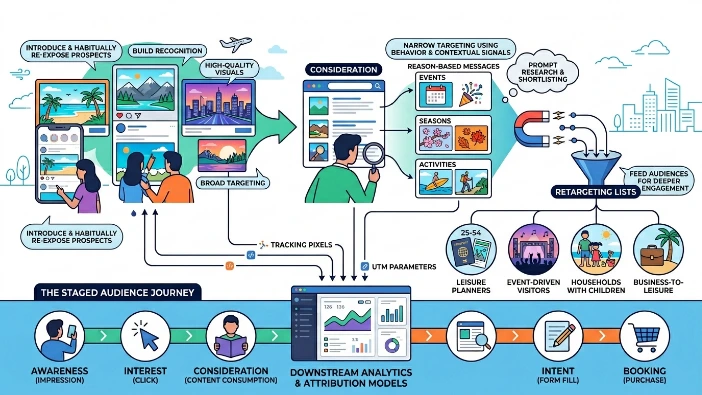
Destination ads introduce and habitually re-expose prospects to a location. In the awareness phase, ads use high-quality visuals and broad targeting to build recognition. In the consideration phase, ads narrow targeting using behaviour and contextual signals to present reason-based messages events, seasons, or activities. These ads feed audiences into retargeting lists for deeper engagement. For tourism services, this staged approach supports an audience journey: awareness (impression), interest (click), consideration (content consumption), intent (form fill), and booking (purchase). Tracking pixels and UTM parameters connect ad exposure to downstream analytics and attribution models.
Leisure planners: age 25–54 with past travel searches. Event-driven visitors: searchers for specific festivals. Households with children indicators. Business-to-leisure corporate travellers with extended-stay interest.
What creative components make destination ads effective?
Effective destination ads use a clear hero visual, concise headline, specific benefit, and a relevant contextual cue such as season or event to drive curiosity and clicks.
Hero visual shows a recognisable or aspirational scene from the destination. Headlines state a single selling point, such as “Coastal walks, nine heritage sites” or “Autumn festivals from October to November.” Benefit lines quantify an offer or experience, for example “3 guided tours per week” or “overnight rates from £79.” Contextual cues add immediacy: dates, weather, or event names. Ads often include simple overlays: a logo or trust symbol, and a short callout like “Free event listings” when appropriate for MOFU tone (informative only). Creative variants test image type (landmark vs. lifestyle), message focus (culture vs. outdoors), and format (static vs. 15–30 second video).
Banner ads follow common dimensions such as 300×250 and 728×90. Video ads typically run 15–30 seconds and use H.264 encoding. Native placements use responsive assets sized to publisher templates.
How do targeting and data drive excitement in destination ads?
Targeting uses demographic, behavioural, contextual, and first-party data to show the most relevant creative to users who demonstrate travel interest, increasing engagement and time spent.
Demographic filters select age, household income bands, and family status to prioritise relevant experiences. Behavioural targeting uses recent travel search terms and site interactions to find users actively planning trips. Contextual targeting places ads on pages about related topics such as hiking guides or local festival listings. First-party lists from newsletter subscribers and past enquirers enable precise retargeting. Lookalike audiences expand reach to users with similar digital behaviour. Together, these approaches raise ad relevance and therefore engagement metrics.
Track impressions to estimate reach. Monitor CTR and engagement rate for creative resonance. Use conversion events such as brochure downloads and enquiry submissions to measure intent. Attribute visits and bookings back to ad exposure using multi-touch attribution.
What testing and optimisation processes improve destination ad performance?
A structured A/B testing regimen that evaluates visual, headline, audience segment, and landing page combinations drives measurable improvements in engagement and intent.
Start with hypothesis-driven tests: change one element at a time image, headline, or targeting. Run tests for a minimum statistical period such as 7–14 days or until at least 1,000 impressions per variant. Use incrementality and holdout groups to measure lift in enquiry rates versus no-ad groups. Analyse cohorts by source, device, and geography. Implement winners and iterate with new variants. Regularly refresh creative after 21–28 days to avoid creative fatigue. For destination ads that use video, test 6–15 second edits against full 30-second versions to find optimal length for attention.
Audience refinement to exclude low-intent segments. Creative rotation frequency to reduce ad fatigue. Landing page speed and relevance to convert clicks into actions. Frequency caps to manage repeated exposures.
What legal and policy considerations affect destination ads?
Destination ads must follow data privacy laws and platform advertising policies, including transparent data use, consent for tracking, and truthful claims about services or experiences.
GDPR requires clear consent for cookies and tracking when targeting or retargeting UK residents. Advertisers must document lawful bases for data processing and maintain records. Platform policies prohibit deceptive claims, such as false availability or fabricated awards. Image licensing requires rights for any stock or photographer assets used in ads. Tourism services must avoid medical or safety claims that go beyond factual statements about conditions or access.
Implement consent management platforms to capture opt-ins. Maintain asset usage logs and licenses. Keep ad copy factual and time-specific where relevant.
Find Out More:
How Tourism Services Increase Engagement Using Banner Ads
What benefits do tourism services gain from destination ads?
Destination ads increase targeted reach, drive measurable engagement metrics, accelerate audience consideration, and build retargetable lists that raise booking probability.
By delivering tailored visual messages, destination ads raise brand and place awareness among defined audiences. They capture early interest and create repeat exposures that move prospects further along the funnel. Ads generate quantifiable signals clicks, page sessions, downloads that feed retargeting strategies. Measured lift in enquiry rates and lower acquisition costs per engaged user provide clear ROI paths. For example, a campaign focused on coastal walking routes produced a 45% higher CTR when images showed people actively walking versus empty landscapes.
CTR for well-targeted display ads ranges from 0.2% to 1.0%. Video VTR benchmarks vary by platform, typically 15%–45% for 15-second assets. Cost per enquiry depends on market and season; track cost per engaged user rather than cost per impression.
Explore More Expert Insights:
How Travel Companies Inspire Planning Using Mid-Funnel Advertising
How Resorts Nurture Guests Using Visual Experience Banner Ads
What use cases demonstrate how tourism services employ destination ads?
Tourism services use destination ads to promote seasonal events, highlight niche activities, retarget past website visitors, and support partner travel packages to drive engagement and enquiries.
Seasonal promotion: ads highlight dates and event details for festivals, boosting event page visits. Niche activity promotion: ads target enthusiasts birdwatchers, hikers with tailored imagery and itinerary points. Visitors who viewed itineraries see follow-up ads featuring booking windows and availability snapshots. Local hotels and tour operators co-promote destination assets to mutual audiences, sharing attribution data where legal.
A regional tourism board targets adult travellers aged 30–55 with prior interest in walking holidays. Ads show curated walking itineraries and list “3 guided trails, 2 visitor centres.” Clicks go to a landing page with route maps and an enquiry form. Retargeted visitors who downloaded maps receive a follow-up ad sequence with accommodation options.
How do tourism services link destination ad engagement to booking actions?
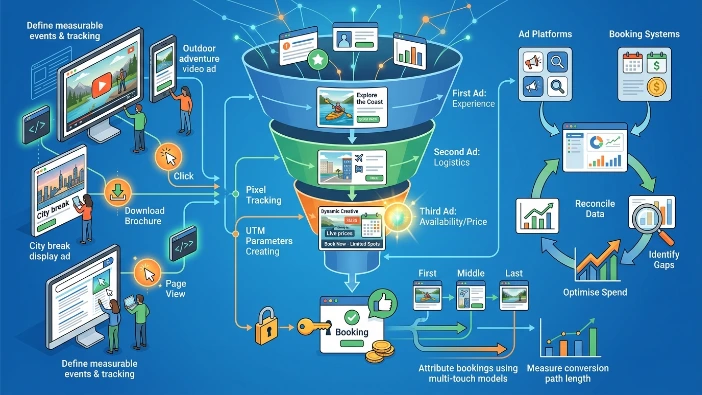
Services map engagement events clicks, downloads, page views to conversion funnels and use retargeting sequences, timed messages, and incentive messaging to convert interest into bookings.
Define measurable events for each funnel step. Use pixels and UTM parameters to record which ad creative drove each event. Build retargeting sequences that increase specificity the first ad focuses on experience, second on logistics, third on availability or pricing. Use dynamic creative for availability and price when permitted by policy. Measure conversion path length and attribute bookings using multi-touch models. Regularly reconcile ad platform data with booking systems to identify gaps and optimise spend.
Dive Deeper Into This Topic:
Tourism Ads That Convert Destination Excitement Into Booking Actions