
Display advertising includes banner ads, interstitials, native display, and video placements. Advertisers use ad exchanges and supply-side platforms to buy inventory at scale. Ads target audiences by demographics, interests, browsing signals, and contextual content. Common formats follow IAB standards for sizes and viewability.
Display campaigns use programmatic buying through demand-side platforms (DSPs). Advertisers set budgets, audiences, and bid strategies. Ad creatives contain imagery, price cues, and date windows. Tracking requires pixels or server-to-server integrations to capture impressions, clicks, and view-through data. Reporting focuses on CPM (cost per 1,000 impressions), CPC (cost per click), CTR (click-through rate), and view-through conversions.
How do travel companies identify audiences for display campaigns?
Travel companies segment audiences by intent signals, demographics, past site behavior, and location to match deals with likely bookers. Intent signals include recent searches for destinations, flight and hotel queries, and travel-related content consumption. Demographic filters use age, income brackets, and household size. Behavioral segments include previous booking history, cart abandoners, and high-frequency site visitors. Geolocation enables country, region, or city-level targeting for local promotions.
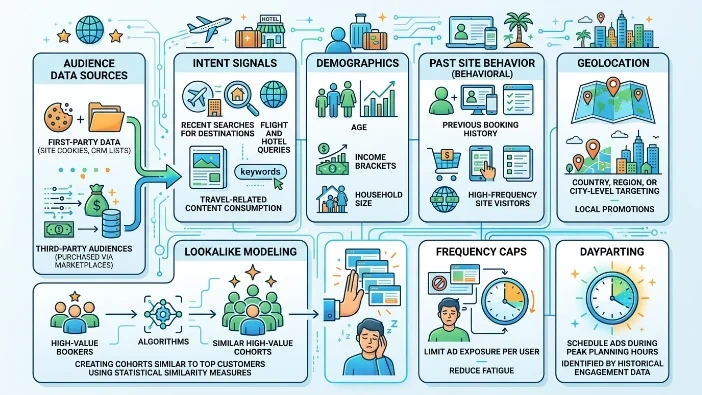
Lookalike modeling creates cohorts similar to high-value bookers using statistical similarity measures. Frequency caps limit ad exposure per user to reduce fatigue. Dayparting schedules ads during peak planning hours identified by historical engagement data. Audiences combine first-party data (site cookies, CRM lists) and third-party audiences purchased via marketplaces.
What targeting methods power display ads for travel deals?
Targeting methods include contextual targeting, audience targeting, retargeting, and geo-targeting to place deals in relevant digital contexts. Contextual targeting places ads on pages about travel, events, or local attractions. Keyword-level contextual matches align creative messaging with article topics. Audience targeting uses user segments—interest categories and past behaviors to reach likely travelers. Retargeting serves ads to users who viewed itineraries, searched specific routes, or abandoned booking flows. Geo-targeting delivers offers specific to a user’s country, region, or city and enables local-language creatives.
Device targeting separates desktop, mobile, and tablet bids to optimise creative and landing experiences. Browser and operating-system targeting adjust for platform compatibility. Inventory quality controls block low-quality sites and maintain brand safety using verified lists and categories. Bid shading and auction strategies optimise for cost-efficient placements across open and private marketplaces.
How are display creatives designed for travel deals?
Display creatives use high-resolution imagery, concise pricing, clear dates, and a visible offer to prompt engagement with a travel deal. Design starts with destination imagery showing landmarks or experiences. Text overlays highlight specific prices, travel windows, or discount percentages. Static images use bold headlines; animated creatives cycle through multiple offers or fare classes. Video ads show short itineraries, accommodation highlights, and booking deadlines. Rich media units include expandable galleries or interactive calendars to show availability.
Creative variations test different headlines, price frames, and visuals to measure performance. Language adapts to the target market; for the United Kingdom, creatives use GBP symbols and UK-centric phrasing. File sizes follow platform limits to preserve load times and viewability. Accessibility includes readable fonts, high contrast, and closed captions for video.
How do travel companies measure display campaign performance?
Measurement focuses on impression metrics, engagement (CTR), conversion rates, revenue per thousand impressions (rRPM), and return on ad spend (ROAS). Impressions measure reach. Clicks and CTR indicate ad engagement. Conversions track booking events, newsletter sign-ups, and price-alert sign-ups. View-through conversions attribute later bookings to earlier ad exposure. Revenue metrics assign monetary value to conversions and calculate ROAS. Lifetime value (LTV) of acquired customers helps evaluate long-term campaign efficiency.
Attribution models allocate credit across touchpoints: last-click, time-decay, and data-driven multi-touch attribution. UTM parameters feed analytics platforms for channel breakdowns. Incrementality tests with holdout groups verify causal impact of display campaigns on bookings. Fraud detection filters invalid traffic and bot activity to ensure data quality.
What ad buying strategies do travel companies use?
Ad buying strategies include programmatic open exchange, private marketplace deals, preferred deals, and direct-sold guaranteed placements. Programmatic open exchange offers scale and lower CPMs. Private marketplaces provide controlled publisher environments with higher-quality inventory. Preferred deals negotiate fixed CPMs for first-look access. Programmatic guaranteed buys reserve impressions at agreed rates for predictable reach. Real-time bidding adjusts bids per impression using signals like user intent and contextual relevance.
Target CPM for awareness, target CPA for bookings, and ROAS bidding for revenue-focused campaigns. Budget pacing spreads spend across campaign dates to maintain consistent impression volume. Automated rules pause underperforming creatives and reallocate budgets dynamically to higher-performing segments.
What data and tech stack components support travel display campaigns?
Key components include demand-side platforms (DSPs), data management platforms (DMPs), ad servers, analytics platforms, and conversion tracking integrations. DSPs execute programmatic buys and apply bidding logic. DMPs unify first-party data with third-party segments for targeting. Ad servers manage creative delivery and track impression-level metrics. Analytics platforms ingest campaign data and CRM outcomes to compute ROAS and LTV. Conversion tracking uses pixels, server-to-server postbacks, and enhanced measurement for offline booking integration.
Identity resolution links device IDs, hashed emails, and logged-in user profiles to create persistent audience IDs. Consent management platforms ensure compliance with privacy regulations like the UK’s GDPR framework. Data clean rooms enable privacy-safe audience analysis between advertisers and publishers.
What benefits do travel companies gain from display advertising?
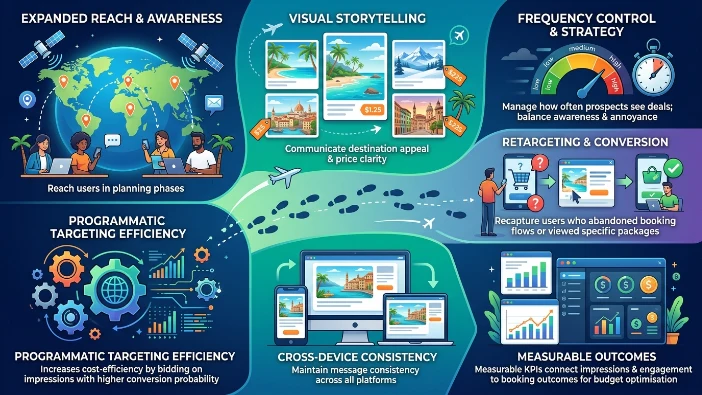
Display advertising delivers large-scale reach, visual storytelling, frequency control, and the ability to retarget interested users efficiently. Reach expands awareness among users in planning phases. Visual formats communicate destination appeal and price clarity. Frequency controls manage how often prospects see deals to balance awareness and annoyance. Retargeting recaptures users who abandoned booking flows or viewed specific packages. Programmatic targeting increases cost-efficiency by bidding on impressions with higher conversion probability.
Display campaigns support funnel progression: awareness at scale, mid-funnel engagement via tailored ads, and retargeting to recover lost conversions. Cross-device capabilities maintain message consistency across phones, tablets, and desktops. Measurable KPIs connect impressions and engagement to booking outcomes for budget optimisation.
Explore More Expert Insights:
How Resorts Boost Occupancy Using Banner Ads
How Booking Platforms Increase Conversions Using Banner Campaigns
What real use cases show display ads promoting travel deals?
Seasonal fare sale targeted by region and travel dates to drive flight bookings with time-limited pricing. Campaigns show specific fares, travel windows, and booking deadlines. Targeting prioritises users who searched those routes and lookalikes of past bookers. Retargeting shows fare reminders to visitors who viewed itineraries but did not complete checkout.
Hotel package promotion using rich media to highlight room photos, cancellation policies, and nightly rates. Ads place carousel images of rooms and amenities. Contextual targeting places ads on travel guides and local attraction pages. Conversion tracking links ad clicks to confirmed reservations and ancillary revenue like spa bookings.
Multi-destination trip inspiration for longer stays using video ads to increase newsletter sign-ups and itinerary saves. Video sequences present a 15-second route overview. Audience segments include users who consumed long-form travel content and domestic planners. Analytics tracks sign-up conversion rates and subsequent booking behaviour.
How should travel advertisers ensure compliance and quality?
Advertisers implement privacy consent, brand-safe inventory filters, and creative review processes to maintain compliance and ad quality. Consent management captures user permissions for cookies and personalisation. Brand safety lists block categories such as adult content and illegal activities. Creative reviews validate claims about prices, dates, and availability.
Explore the Advanced Guide:
How Travel Companies Inspire Planning Using Mid-Funnel Advertising
Complete Details Available Here:
Mid-Funnel Travel Ads That Turn Planning Interest Into Confirmed Trips
Display advertising for travel uses programmatic delivery, precise audience segmentation, and visual creatives with clear pricing to promote deals. Campaigns measure success with impression and conversion metrics, use layered targeting and retargeting to drive bookings, and rely on a robust tech stack and compliance controls to protect data and ad quality.