
Resort experience ads are targeted visual campaigns that showcase stay, dining, and activity experiences to drive direct bookings and paid stays within a defined booking window. Resort experience ads define the offer, present rich visuals, and include booking signals such as price, dates, and availability to move viewers from interest to purchase.
Resort experience ads use images, short video, and interactive formats. They match creative to audience intent, such as weekend breaks, family holidays, or romantic escapes. Core elements include hero imagery, stay details, promotional price or rate range, book-by dates, and a clear booking path. Ads run on display networks, social platforms, programmatic inventory, and travel sites. Campaigns track outcomes with conversion pixels and server-side booking events to attribute paid stays directly to creative exposures.
How do resort experience ads work to convert visual interest into paid stays?
They guide users through a short decision path: attention, relevance, urgency, and frictionless booking to convert clicks into paid reservations. Ads capture attention with imagery or video. They deliver relevance by matching ad creative and copy to user signals, such as past site visits, search queries, or geolocation. Ads add urgency with date-limited rates or limited-room counts. Clicks land on booking pages that pre-fill dates and room types, reducing friction. Conversion tracking links reservations back to the ad creative using UTM parameters and booking identifiers.
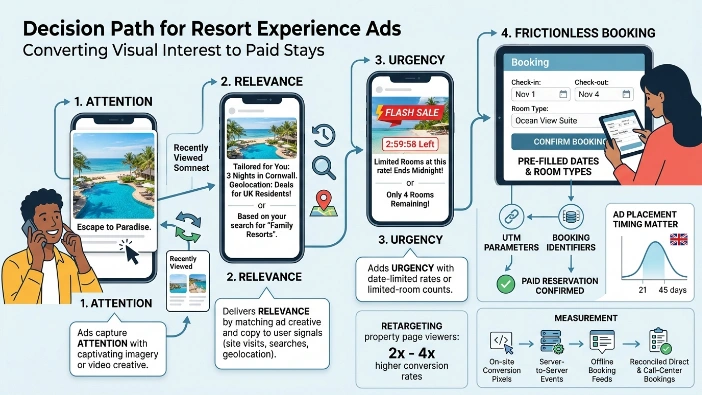
Ad placement timing matters: 21 to 45 days before stay dates yields the highest conversion rate for short breaks in the UK. Retargeting users who viewed property pages increases conversion rates by 2 to 4 times compared with cold audiences. Measurement uses on-site conversion pixels, server-to-server events, and offline booking feeds to reconcile direct bookings and call-center reservations with ad exposures.
What components must a high-converting resort experience ad include?
A high-converting ad includes visual hero, concise offer details, booking signal (price/dates), audience targeting data, and conversion tracking endpoints. Visual hero uses a single strong image or 6–15 second video showing a key product experience: room interior, pool, beach, or local activity. Offer details specify length of stay and price range, for example, “From £99 per night, 2-night minimum.” Booking signals show available dates or a calendar snapshot. Targeting data identifies segment: leisure weekend, family summer, or business retreat. Tracking endpoints include a click URL with UTM tags and a conversion pixel or server-endpoint to record reservations.
Ad formats include static banners (jpg/png), HTML5 interactive creatives, short MP4s, and carousel units highlighting multiple experiences. File size limits follow platform rules: 150 KB for banners, 4–10 MB for short videos on social. Creative refresh cadence for top-performing segments is every 7 to 14 days to prevent frequency fatigue.
How should resorts define audiences for these ads?
Define audiences by booking intent, travel window, demographic attributes, and past interaction to match creative and offer to the user’s needs. Booking intent uses signals such as onsite search queries, date picker interactions, and abandonment of the booking funnel. Travel window segments capture short-break planners (0–30 days), mid-term planners (31–90 days), and long-term planners (91–365 days). Demographic attributes include age band and household composition; for example, target families with school-term calendars for summer offers. Past interaction segments include past bookers, site visitors who viewed rooms, and email openers.
Lookalike audiences extend reach by modelling high-value bookers. Geo-targeting focuses on UK source markets by distance bands from the resort: 0–150 miles for drive markets, 151–400 miles for short flights. Use behavioural exclusions to avoid targeting users who booked in the last 6 months to maximise new revenue.
How do creatives and messaging differ by booking intent?
Creatives use more product detail and clear booking signals for high-intent audiences and broader lifestyle visuals for low-intent audiences. High-intent creatives show specific room types, nightly rates, and available dates. Messaging includes concrete terms: “2 nights from £129, travel 12–14 July 8 rooms left.” Low-intent creatives show experiences and amenities to build desire, such as spa, dining, or local sites, without booking dates. For retargeted users who viewed booking pages, creatives highlight incentives like free breakfast or flexible cancellation and provide direct links to repeat the booking flow.
Visual hierarchy places price and date cues prominently for transactional audiences and places experiential elements first for discovery audiences. Copy length shortens as intent increases: discovery ads use two-line captions; transactional ads use one-line concrete offers.
What targeting and bidding strategies maximise paid stays?
Combine audience segmentation with conversion-focused bidding and time-based bid adjustments to prioritise users likely to book within the campaign window. Use conversion-optimised bidding that targets cost per acquisition (CPA) or return on ad spend (ROAS) rather than clicks. Increase bids for users within 0–30 days of intended travel and for audiences that previously viewed the booking calendar. Apply dayparting to raise bids during high-conversion hours: 08:00–11:00 and 19:00–22:00 local time for UK consumers. Use frequency caps to limit ad fatigue: 4 impressions per user per week for retargeting.
Use inventory controls to place creatives on intent-rich placements such as travel search results, regional news sites for local promotions, and social feeds for dynamic product ads. For programmatic buys, apply supply-path optimisation to favour publishers with historically high booking attribution.
What measurement framework ties ads to paid stays?
A measurement framework uses deterministic tracking for direct bookings and probabilistic modelling for indirect paths, with consistent KPIs: bookings, revenue, and cost per booking. Implement conversion pixels on confirmation pages to record booking IDs and revenue. Send booking events server-to-server to reduce attribution loss from browser restrictions. Reconcile ad platform reports with property management system (PMS) records weekly. Use a 30-day lookback window for last-click, and a 90-day window for assisted conversions. Key performance indicators include number of paid stays, revenue per booking, cost per booking, and booking lead time.
For phone reservations, integrate call-tracking that captures campaign UTM and booking details. For offline or group bookings, use manual feed imports into the ad platform and tag with campaign identifiers. Use lift studies quarterly to validate incremental bookings attributable to creative exposure.
What creative testing process improves conversion rates?
Run multivariate tests on hero asset, price presentation, and call-to-action, and measure impact on bookings and revenue per booking. Test a minimum of three image or video variants against a control. Test price display styles: exact price, price range, and nightly rate. Test CTAs such as “Check Availability” versus “Reserve Now.” Allocate at least 10,000 impressions per variant to reach statistical relevance for UK regional campaigns. Evaluate results using booking conversion rate and revenue per booking. Pause underperforming variants and scale winners across placements and audiences.
Rotate creative sets every 14 days for high-traffic seasons. Keep an archive of top-performing assets by segment for rapid redeployment during promotions or sudden demand spikes.
Explore More Useful Information:
How Resorts Boost Occupancy Using Banner Ads
What benefits do resorts gain from experience-focused ad campaigns?
Resorts increase direct bookings, reduce reliance on third-party channels, and improve revenue per booking through targeted visual offers. Direct-book campaigns lower commission costs. Visual experience ads raise average booking value by presenting upsell opportunities such as room upgrades and add-ons. Targeted ads shorten booking lead time and increase occupancy in specific low-demand windows. Accurate attribution improves budget allocation by identifying the creatives and channels that deliver the highest revenue per booking.
Converting weekend-break creatives increased weekend occupancy by 12% in pilot regions; retargeted visitors who viewed room pages converted at double the baseline conversion rate.
Explore More Expert Insights:
Booking Platform Ads That Turn Browsing Users Into Paid Reservations
Destination Campaign Ads That Convert Interest Into Travel Itineraries
What practical use cases demonstrate these ads in action?
Use cases include seasonal promotions, last-minute weekend fills, family-summer packages, and corporate-retreat upsells targeted with tailored visuals and booking signals. Seasonal promotions run 60–120 days before peak dates with early-bird rates and family package visuals. Last-minute weekend fills run 3–10 days before weekend dates, emphasising limited availability and instant booking. Family-summer packages combine room imagery with kids’ activities and meal inclusions, targeting parents with school-term calendars. Corporate-retreat ads highlight meeting rooms, AV setup, and negotiated room blocks for midweek stays, aimed at travel managers and procurement lists.
Get the Full Insights Here:
How Resorts Nurture Guests Using Visual Experience Banner Ads
Each use case ties creative to a specific booking funnel and measures outcomes using bookings and revenue per campaign.
How should resorts operationalise campaigns to capture bookings quickly?
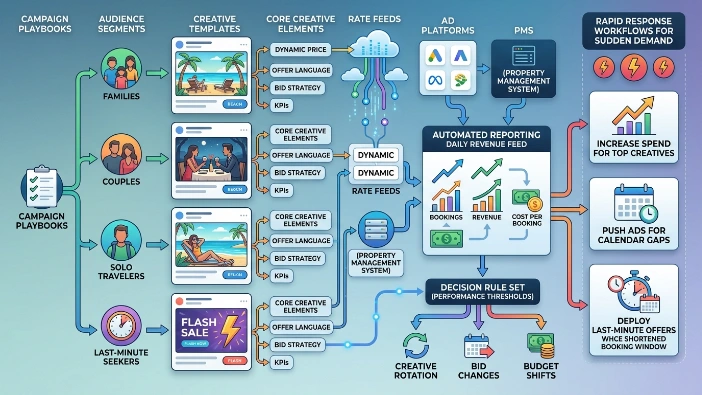
Create campaign playbooks that map audience segments to creative templates, set tracking endpoints for each creative, and automate reporting to daily revenue feeds. Playbooks list target segments, core creative elements, offer language, bid strategy, and KPIs. Use dynamic creative templates to populate price and date fields automatically from rate feeds. Automate daily reporting from ad platforms and PMS to monitor bookings, revenue, and cost per booking. Maintain a decision rule set for creative rotation, bid changes, and budget shifts based on performance thresholds.
Implement rapid response workflows for sudden demand: increase spend for top-performing creatives, push new ad sets for calendar gaps, and deploy last-minute offers with shortened booking windows.