
Travel banner ads are visual digital ads that show destinations, offers, or itineraries; they drive conversions by targeting users with intent signals, persuasive creative, and clear booking pathways.
Travel banner ads are defined as image-based or rich-media advertisements placed on websites, apps, and ad networks to promote travel inventory. Important entities: display ad (static or animated image), rich media (interactive elements or video), programmatic placement (automated bidding and targeting), creative assets (images, headlines, CTAs), and booking funnel (landing page to reservation completion). Conversion means a confirmed booking recorded by the advertiser’s booking system.
Programmatic placement uses bid requests, user segments, and contextual filters to reach high-intent audiences. Creative assets present destination visuals, price, dates, or urgency. The booking funnel links the ad to a landing page or booking engine that records a reservation. Example: a banner shows a seven-night Algarve stay with dates and a “Book Now” CTA that leads to a pre-filled booking page.
How do you measure the effectiveness of travel banner ads?
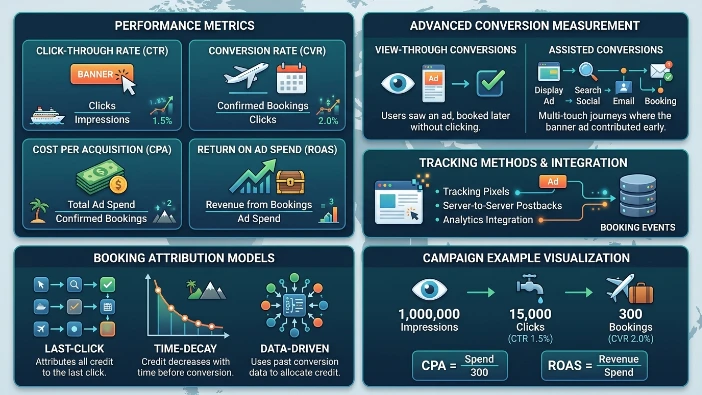
Click-through rate (CTR), conversion rate (CVR), cost per acquisition (CPA), return on ad spend (ROAS), view-through conversions, and assisted conversions.
CTR equals clicks divided by impressions. CVR equals confirmed bookings divided by clicks. CPA equals total ad spend divided by confirmed bookings. ROAS equals revenue from bookings divided by ad spend. View-through conversions capture users who saw an ad and booked later without clicking. Assisted conversions record multi-touch journeys where the banner ad contributed earlier.
Use tracking pixels, server-to-server postbacks, and analytics integrations to record booking events. Attribute bookings using last-click, time-decay, and data-driven models to understand banner role. Example: A campaign with 1,000,000 impressions, 15,000 clicks (CTR 1.5%), and 300 bookings (CVR 2.0%) has CPA = spend/300 and ROAS = revenue/ spend.
What are the core components of high-converting travel banner ads?
Core components: targeted audience signal, compelling visual, concise headline, clear price or offer, explicit booking CTA, and a direct landing page that reduces friction.
Targeted audience signals include intent keywords, recent search for flights, recent hotel lookups, past booking data, or travel-date signals. Compelling visual uses high-resolution destination photography or short looped video. Headline communicates place and benefit in under 15 words. Price or offer shows a specific number or discount percentage. CTA uses concrete verbs: “Book,” “Reserve,” or “Check dates.” Landing page pre-fills traveller details, shows price breakdown, and supports immediate payment.
Include tracking elements: UTM parameters, click trackers, and conversion pixels. Include contextual placement: travel content sites, weather pages, or airline meta-search sites. Example: A banner targets users who searched “Lisbon flights June” and shows a picture of Lisbon with “Return flights £99 — Book Now” leading to a one-click booking flow.
Read More to Understand Better:
How Travel Brands Boost Bookings Through Banner Advertising
How do you design banner creative that converts travel interest into bookings?
Design creative with legible imagery, single-focus messaging, a visible price or date, and an explicit CTA; reduce ambiguity and visual clutter.
Beach, city skyline, or landmark. Limit text to headline and price line. Use high contrast for CTA and place it in the bottom-right quadrant. Use a legible font at 14px or larger for body text and 18px for CTAs in typical desktop pixels. Maintain brand assets: logo maximum 10% of ad area. For rich media, limit interaction to 5 seconds of auto-loop and one interactive step that leads to a booking page.
Test two creatives per audience segment and rotate weekly for at least 14 days. A/B test price prominence versus itinerary benefits. Two banners targeting couples: version A highlights “£499 per person” while version B shows “5-night Andalusia Flights included.” Compare CVR to find winner.
How do you target audiences for highest booking intent?
Target audiences using intent signals: recent travel searches, category-specific browsing, past booking history, lookalike modelling, and contextual placement on travel content.
Intent signals include search queries, recent visits to accommodation pages, and cart abandonment. Past booking history identifies repeat travellers and value segments. Lookalike models use seeded customer lists to find similar users. Contextual placement means placing banners next to relevant editorial content or itinerary guides.
Use time windows: target search signals within 7 to 30 days for short-haul flights, and 30 to 90 days for long-haul holidays. Prioritise users with high lifetime value and those who added dates or travellers on-site. Example: Retarget users who abandoned a booking within 48 hours with a banner showing the same itinerary plus a limited-time discount.
What landing page and booking flow elements increase conversion from banner ads?
Landing pages must match ad creative, show final price, pre-fill booking details, provide secure payment, and complete checkout in three or fewer steps.
Same image, same price statement, same dates. Display total price with taxes and fees upfront. Offer progressive disclosure: present essential booking fields first, optional add-ons later. Use saved passenger profiles for returning customers. Provide multiple secure payment methods and show trust signals: SSL badge, accepted card logos, and transparent cancellation policy.
Use calendar pickers, autofill for address, and one-click payment options for returning customers. Track booking abandonment at each step to optimise forms. A landing page linked from a banner pre-fills traveller dates and calculates the final price in step one; the booking completes in two more steps.
What bidding and budget strategies maximise bookings from real users?
Use CPA or ROAS bidding with conversion windows aligned to booking cycles, separate budgets by intent and geography, and allocate 20–30% of spend to retargeting audiences.
Set CPA targets based on historical booking value. Use ROAS targets when revenue data is reliable. Align conversion windows: 7–14 days for flash-sales, 30–90 days for holiday packages. Segment budgets by geography: allocate more to regions with higher conversion rates. Reserve at least 20% of budget for retargeting users who clicked but did not complete booking.
Implement bid multipliers for high-value inventory such as travel content publishers and premium placements on mobile apps. Example: For a £100 average booking value and target CPA £25, bid strategies should prioritise placements that have historically met that CPA.
What legal and privacy requirements affect travel banner campaigns in the UK?
Obtain lawful basis for personal data, provide transparent cookie notices, maintain opt-out mechanisms, and secure data transfers for cross-border processing.
Collect consent for non-essential cookies before using behavioural targeting. Record consent logs and provide an accessible privacy policy. Use hashed customer lists for lookalike modelling and follow ICO guidance for direct marketing. For cross-border data transfers, use UK adequacy or appropriate safeguards like SCCs. Retain personally identifiable booking data only as needed and follow retention schedules.
Document data processing activities and complete Data Protection Impact Assessments when profiling high volumes of users. Example: Use first-party booking data hashed and uploaded to an ad platform via secure transfer, and keep records of customer consent.
Explore More Expert Insights:
Educational Finance Campaign Ads That Turn Users Into Final Conversions
Security-Focused Finance Ads That Convert Trust Signals Into Customer Leads
What are common optimisations and experiments that increase booking rates?
Run experiments on creative variations, price prominence, landing-page continuity, bid strategies, and retargeting windows; measure outcomes with controlled A/B or holdout tests.
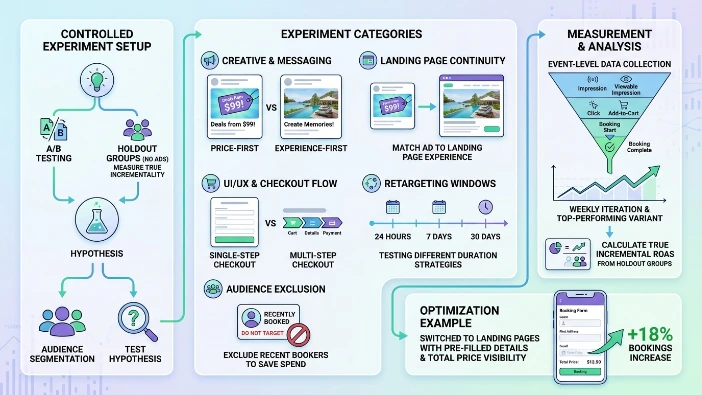
Test price-first versus experience-first messaging. Test single-step checkout versus multi-step checkout. Test retargeting windows: 24 hours, 7 days, and 30 days. Test audience exclusion rules to reduce wasted spend on recent bookers. Use holdout groups that see no ads to measure incremental bookings and compute true incremental ROAS.
Collect and analyse event-level data: impression, viewable impression, click, add-to-cart, booking start, booking complete. Iterate weekly using the top-performing variant. Example: A travel campaign increased bookings by 18% after switching to landing pages that pre-filled traveller details and displayed total price on the first screen.
What use cases prove banner ads convert travel interest into bookings?
Use cases include flash-sale promotions, abandoned-booking retargeting, destination inspiration campaigns tied to dynamic pricing, and loyalty-member reactivation drives.
Flash-sale promotions use urgency and price to convert users who search within 1–7 days. Abandoned-booking retargeting recovers users who left the booking funnel with banners showing the same itinerary plus trust signals. Destination inspiration campaigns retarget users who viewed destination guides with personalised pricing. Loyalty-member drives target past customers with exclusive rates and priority inventory.
A flash-sale banner for a 48-hour fare drop targeted users who searched specific routes that week and produced a 3x uplift in nightly booking volumes compared with non-promoted periods.
Travel banner ads convert interest into confirmed bookings when campaigns combine precise intent targeting, clear and consistent creative, friction-minimised booking flows, and measurement tied to bookings. Implement CPA or ROAS bidding, match ad creative to landing pages, and use retargeting windows aligned to travel decision timelines. Monitor CPA, CVR, and ROAS and run controlled experiments to prove incremental bookings.
Explore More Expert Insights:
How Travel Brands Inspire Bookings Using Destination Banner Ads