
Market insight ads are targeted display or native ads that deliver concise, data-driven market analysis to defined investor audiences to raise awareness and drive engagement.
Market insight ads present short, verifiable facts, charts, or headlines about asset classes, sectors, or economic indicators. Platforms display these ads on financial websites, news portals, social feeds, and programmatic display networks. Advertisers choose audience segments by demographics, firmographics, behavioural signals, interest categories, and recent content consumption. Creative units run as banner ads, native placements, interactive cards, or short video clips. Each ad links to a landing page, report download, or gated insight to capture leads and measure engagement.
Why do investment firms use market insight ads for awareness?
Firms use market insight ads to position expertise, increase brand recall, and route qualified prospects into the funnel using measurable ad metrics.
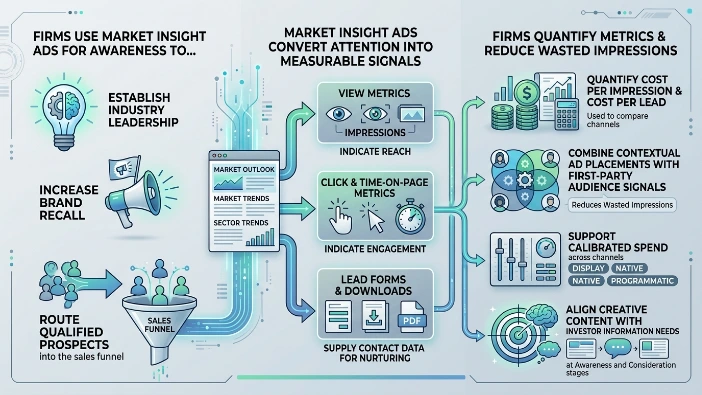
Market insight ads convert attention into measurable signals. View metrics indicate reach. Click and time-on-page metrics indicate engagement. Lead forms and downloads supply contact data for nurturing. Firms quantify cost per impression and cost per lead to compare channels. Combining contextual ad placements with first-party audience signals reduces wasted impressions. This approach supports calibrated spend across display, native, and programmatic channels. It aligns creative content with investor information needs at awareness and consideration stages.
How do firms define target audiences for market insight ads?
Firms define audiences by investor role, asset exposure, firm size, wealth band, regulatory status, and behavioural intent signals.
Define investor role: retail investor, private client advisor, institutional portfolio manager, family office executive. Define asset exposure: equities, fixed income, alternatives, cash. Define firm size: assets under management bands such as £10M–£100M, £100M–£1B, £1B+. Define wealth band by investable assets: £50k–£250k, £250k–£1M, £1M+. Use behavioural intent signals: recent reads on economic outlook, search queries for sector reports, and content engagement on market commentary. Combine first-party CRM segments with third-party data for scale. Use exclusion lists to avoid non-investor audiences.
What creative formats perform best for market insight ads?
High-performing formats are single-insight banners, short native summaries, data visual cards, and 6–15 second explainer videos with clear metrics or charts.
Single-insight banners show one headline and one metric. Native summaries use a 20–40 word lead followed by a chart thumbnail. Data visual cards display a small, legible chart and a numeric takeaway. Short explainer videos show a key chart animation and a one-sentence conclusion. Each format highlights a single callout: percentage change, rate, ranking, or forecasted impact. Use plain numeric labels, clear axis markers, and a branded but minimal footer. Maintain a 1.91:1 or 16:9 aspect ratio for cross-platform compatibility. Ensure creatives pass platform readability thresholds for small screens.
Which distribution channels deliver the best awareness for investment firms?
Top channels include financial news sites, programmatic display with contextual targeting, social platforms with professional targeting, and native networks on investor-focused publications.
Financial news sites reach active market readers and deliver contextual adjacency. Programmatic display with private marketplace deals gives scale and control over inventory quality. Social platforms provide professional and interest-based filters to target advisers and retail investors. Native networks place content-marketing style ads inside financial articles. Combine channels to balance reach and relevance. Allocate spend based on CPM efficiency and engagement metrics from test campaigns. Use site-level performance data to scale placements that yield high view-through and low bounce rates.
How do firms measure success for awareness campaigns?
Measure success with view metrics, ad recall studies, engagement rates, time on insight pages, and incremental lift in branded search queries.
Primary KPIs: impressions, viewable CPM (vCPM), view-through rate (VTR), and ad recall lift from surveys. Secondary KPIs: click-through rate (CTR), time on page for linked insights, scroll depth, and download rate for reports. Attribution: use incrementality tests such as geo-based holdouts or uplift testing to capture causal impact. Monitor branded search volume and direct traffic increases as indicators of awareness. Track downstream metrics: increase in marketing-qualified leads and growth in retargeting pools.
What compliance and regulatory considerations apply to market insight ads in the UK?
UK compliance requires clear disclosure of authorship, avoidance of misleading performance claims, and adherence to Financial Conduct Authority rules for financial promotions.
Label content with the issuer and date. Avoid past-performance extrapolation and unqualified forecasts. Include necessary risk warnings for regulated products. Keep promotional language separate from factual market data. Retain audit trails for creatives and landing pages for record-keeping. Confirm that targeting excludes restricted audiences under FCA guidance where applicable. Work with legal and compliance teams to pre-approve templates and to maintain version control for all ad assets.
How do firms integrate market insight ads with content and lead nurturing?
Create a landing page that expands the ad insight into a 300–1,000 word brief, a downloadable report, and a short video. Use progressive profiling on forms to collect role, firm size, and interest areas across two or three fields. Route captured leads to relevant nurture tracks: market commentary emails, sector deep dives, or event invitations. Use ad retargeting to re-expose visitors with complementary insights. Tag leads with content interests to match sales outreach with stated preferences.
What are typical budgets and timelines for awareness campaigns?
Typical initial test budgets range from £10,000 to £50,000 over 8–12 weeks, then scale to £50,000–£250,000 for sustained national campaigns.
A test phase runs 8 weeks to gather baseline CPMs, CTRs, and site engagement. Evaluate results at week 4 and week 8. For regional targeting within the UK, allocate smaller CPMs and shorter flight times to refine audience segments. For national campaigns tied to macro events, plan 12-week windows around earnings seasons, central bank meetings, or fiscal events. Adjust budgets based on CPMs, viewability, and lead conversion rates.
Explore More Expert Insights:
How Finance Brands Improve Conversion Intent Using Retargeting Ads
How Fintech Platforms Educate Users Using Feature Banner Campaigns
What benefits do firms gain from using market insight ads?
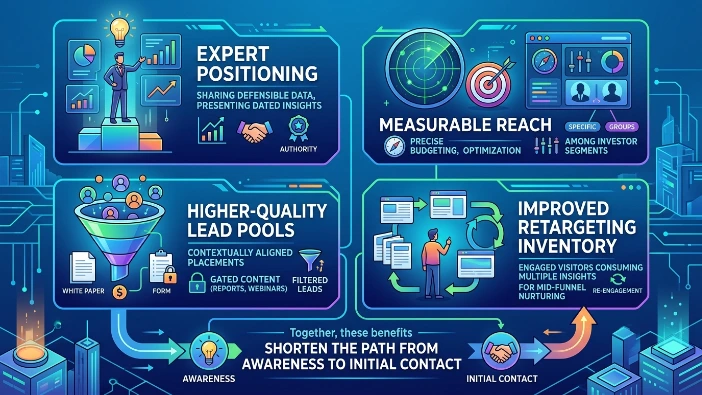
Benefits include increased expert positioning, measurable reach among investor segments, higher-quality lead pools, and improved retargeting inventory for mid-funnel nurturing.
Expert positioning arises from sharing defensible data and dated insights. Measurable reach allows precise budgeting and optimisation. High-quality lead pools result from contextually aligned placements and gated content. Retargeting pools grow from engaged visitors who consume multiple insights. Together, these benefits shorten the path from awareness to initial contact.
Discover More Insights:
How Investment Firms Attract Clients Using Banner Advertising
What use cases demonstrate ROI from market insight ads?
Use cases include asset-allocation announcements, sector rotation alerts, thematic strategy launches, and macro outlook publications that generate qualified leads and event registrations.
An equities team launched a sector-rotation insight card. The campaign drove a 35% higher time-on-page compared to standard banners and yielded 1,200 report downloads in eight weeks. A fixed-income group promoted a short-rate outlook video. The campaign produced a 22% lift in branded search and 320 webinar registrations within six weeks. A multi-asset strategy published a quarterly outlook linked from native placements. The campaign increased marketing-qualified leads by 18% over a quarter.
Market insight ads deliver concise, data-led messaging to specific investor segments across financial publishers, programmatic marketplaces, and social platforms. Firms design single-insight creatives, measure view and engagement metrics, and route engaged prospects into staged content and nurture paths. Compliance requires clear sourcing and risk disclosures in the UK. Typical testing budgets run £10,000–£50,000 over 8–12 weeks. Successful campaigns show measurable increases in branded searches, time-on-page, downloads, and qualified leads.
For a deeper exploration of client conversion tactics, see:
Investment Insight Ads That Turn Market Awareness Into Client Onboarding