
Banner advertising is a form of display advertising that uses image- or HTML-based ads on web pages to deliver investment-related messages and drive audience awareness. Banner ads appear in designated page areas, include visual elements, and link to relevant content.
Banner advertising defines ad units by size and format. Common sizes include 300×250, 728×90, and 160×600 pixels. Formats include static images (JPEG, PNG), animated GIFs, and HTML5 rich media. Investment firms use banners to present market headlines, data snapshots, event promotions, and educational offers. Entities involved include publishers (websites hosting ads), ad networks (aggregators selling inventory), demand-side platforms (DSPs that buy impressions programmatically), and supply-side platforms (SSPs that manage publisher inventory).
How do investment firms plan a banner advertising campaign?
Campaign planning sets objective, target audience, budget, creative brief, and measurement plan before buying ad inventory. Planning begins with defining one primary objective: brand awareness, lead generation, or event promotion. Next, define audience segments by demographics, firmographics, and behavioural signals. UK examples include targeting private investors aged 35–65 with high net worth indicators, or institutional roles such as pension fund managers in London.
Budget allocation uses daily or monthly spend with frequency caps. Typical budgets for initial awareness pilots start at £5,000 per month for national reach on premium sites. Measurement plan defines KPIs: viewable impressions, unique reach, view-through rate (VTR), and brand lift surveys. Set attribution windows for cross-channel analysis, often 7–30 days for awareness metrics.
What targeting methods do firms use for banner ads?
Firms use contextual, demographic, behavioural, and contextual-plus-intent targeting to reach relevant investor audiences on publisher sites and apps. Contextual targeting places ads on pages with related content, such as financial news articles about equities or fixed income. Demographic targeting uses age, gender, and location data; UK campaigns commonly target postcode-level regions like Greater London or the Southeast. Behavioural targeting leverages past web activity, such as frequent visits to investment research sites. Contextual-plus-intent combines page content with signals such as recent searches for “UK gilts” or “retirement planning”.
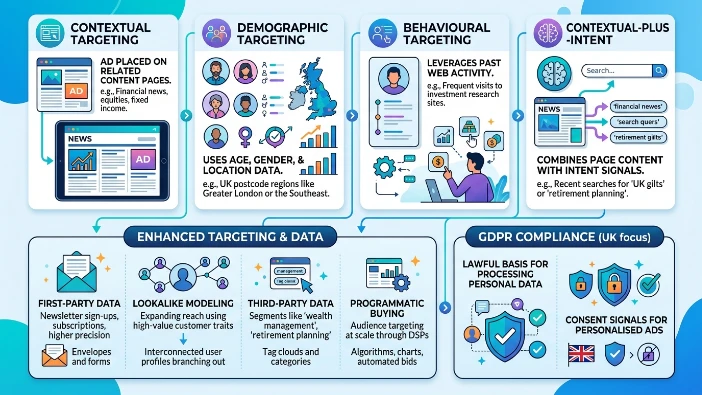
Programmatic buying provides audience targeting at scale through DSPs. First-party data from newsletters or subscription lists improves precision. Lookalike modeling expands reach using high-value customer traits. Third-party data segments provide interest categories like “wealth management” or “retirement planning”. GDPR compliance requires a lawful basis for processing personal data and use of consent signals for personalised ads in the UK.
What creative elements work in investment banner ads?
Effective creative includes concise headline, clear numeric insight, brand-safe visual, and a single call-to-action framed as educational value. Headline length typically stays under 30 characters for clarity. Numeric insights use precise figures, for example “UK equities +6.2% YTD” or “Yield: 3.4%” to convey concrete information. Visuals use charts, index tickers, or professional imagery that signal credibility. Fonts remain legible at small sizes; contrast follows accessibility guidelines (WCAG AA). Animation duration stays under 15 seconds and loops no more than twice to avoid disruption.
Include legal and compliance text when required, such as regulatory risk statements or suitability notices, placed legibly. Use alternate static creatives for environments that block scripts. Ensure creatives pass ad verification checks for viewability and malware scanning.
How do firms buy banner inventory?
Firms buy inventory via direct publisher buys, private marketplaces (PMPs), and open programmatic exchanges using DSPs. Direct buys secure premium placements on targeted publisher sites with guaranteed impressions and fixed CPM. PMPs use invitation-only programmatic auctions with curated inventory and often include first-look deals. Open exchanges use real-time bidding (RTB) for scale and lower CPMs but less placement control.
Use of private data connectors connects CRM or first-party lists to DSPs for secure audience matching. Bidding strategies include fixed CPM for guaranteed reach or dynamic bidding for cost-per-thousand viewable impressions (vCPM) and cost-per-click (CPC) where engagement matters. Utilise frequency caps to limit ad exposure, typically 2–4 impressions per user per week for awareness campaigns.
How do firms measure banner ad performance?
Measurement focuses on viewable impressions, unique reach, time-in-view, engagement metrics, and brand lift tests to quantify awareness impact. Viewable impressions measure impressions meeting viewability standards (50% of pixels in view for one second for display). Unique reach counts distinct users exposed to ad creative. Time-in-view records how long an ad stayed visible to a user; aim for median time-in-view above 2.5 seconds for meaningful exposure. Engagement metrics include click-through rate (CTR), hover interactions, and ad-driven page visits.
Brand lift tests use randomized control groups to measure changes in awareness, consideration, and message recall. Combine ad server logs with measurement partners to triangulate results. Use incrementality tests for lead generation elements by comparing test and control cohorts. Report metrics with confidence intervals and sample sizes to ensure statistical validity.
What compliance and safety rules apply in the UK?
UK campaigns require adherence to FCA rules, ASA standards, and GDPR privacy requirements for targeted advertising. Firms must follow Financial Conduct Authority (FCA) guidance on financial promotions. Ads must be fair, clear, and not misleading. Include risk warnings when presenting performance figures and avoid selective presentation of returns. Advertising Standards Authority (ASA) rules require substantiation of claims and clear presentation of charges. GDPR requires lawful basis for processing personal data; most programmatic advertising uses consent or legitimate interests with documented assessments. Use IAB categories and brand safety controls to avoid placement next to inappropriate content.
What are the main benefits of banner advertising for investment firms?
Banner advertising delivers measurable reach, repeat exposure, and contextual relevance to build market awareness and audience familiarity. Banners scale across premium finance sites and niche publisher networks. Repeated exposures increase recognition of firm messaging and thematic positions, such as equity market outlook or bond yield commentary. Contextual placements align ad messages with topical content, improving message relevance. Programmatic methods enable precise pacing and budget efficiency.
Quantified benefits include reaching hundreds of thousands of unique users on national campaigns and achieving CTRs of 0.05%–0.30% on well-targeted creatives. Brand lift studies show improvements in unaided awareness ranging from 3%–9% after sustained campaigns with viewable frequencies of 3–6 exposures.
Explore More Expert Insights:
How Fintech Companies Acquire Users Using Banner Ads
How Finance Brands Promote Credit Cards Using Display Campaigns
What use cases suit banner advertising in investment marketing?
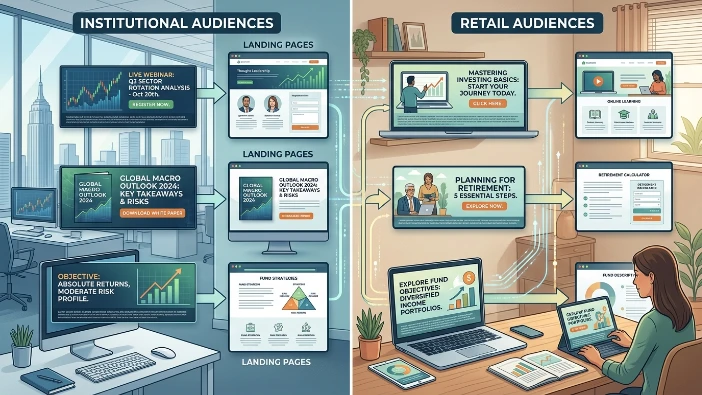
Use cases include market commentary distribution, webinar and event promotion, whitepaper downloads, and fund or strategy awareness. Market commentary banners highlight short-term market moves and link to full analysis. Webinar promotion banners announce dates, speakers, and registration links. Whitepaper banners drive downloads by showcasing key takeaways and page counts, for example “24-page UK equity outlook.” Fund awareness banners present strategy objectives and risk profiles without sales pitches.
For institutional audiences, banners support trade show promotion and thought-leadership placement on specialist sites. For retail audiences, banners support education on investing basics and retirement planning. Each use case ties to tailored creatives and dedicated landing pages that maintain compliance requirements.
How do firms optimise banner campaigns over time?
Optimisation uses A/B creative testing, audience refinement, frequency management, and cross-channel attribution to improve KPI performance. Run creative A/B tests on headlines, numeric claims, and imagery. Allocate more budget to top-performing creatives by measuring vCPM and CTR. Refine audiences by excluding low-value cohorts and focusing on segments with higher engagement. Adjust frequency caps to balance reach and ad fatigue. Use conversion lift and multi-touch attribution models to credit channels accurately. Reassess placements monthly and move budget toward high-viewability publishers.
Banner advertising provides investment firms with a structured, measurable method to build market awareness across digital publisher environments. Define objective, target precisely, create compliant and concise creatives, buy inventory through direct or programmatic channels, and measure using viewability and brand lift metrics. Proper governance includes FCA, ASA, and GDPR compliance.
For further exploration of campaign development and solution types, see the following:
How Investment Firms Build Awareness Using Market Insight Ads
For converting awareness into client onboarding, see the following:
Investment Insight Ads That Turn Market Awareness Into Client Onboarding