
A mid-funnel banner ad targets users who have shown interest and frames relevant offers to move them from consideration toward booking intent. Mid-funnel ads use audience signals and contextual placement to influence decision-making after initial awareness and before final conversion.
Mid-funnel banner ads occupy the consideration phase between broad awareness and direct conversion. Developers design these ads for audiences that visited listing pages, searched for specific locations, or engaged with property comparison tools. Top-funnel ads focus on broad reach and brand recognition. Bottom-funnel ads focus on direct calls to action and transactions. Mid-funnel ads balance relevance and persuasion; they present tailored value propositions and micro-offers that increase intent to book without hard selling.
Mid-funnel inventory appears on property portals, content articles, and retargeting networks. Ads incorporate dynamic creative that updates price, availability, or features based on the user’s browsing session. Developers connect ad delivery to session data and user signals through cookies, first-party identifiers, or privacy-compliant alternatives. This connection enables sequential messaging that aligns with the user’s place in the booking journey.
How do developers capture the right audience signals for mid-funnel targeting?
Developers collect specific behavioural and contextual signals, then map those signals to audience segments used by mid-funnel banners to increase intent. Signals include page views, search queries, dwell time, saved listings, and prior booking attempts.
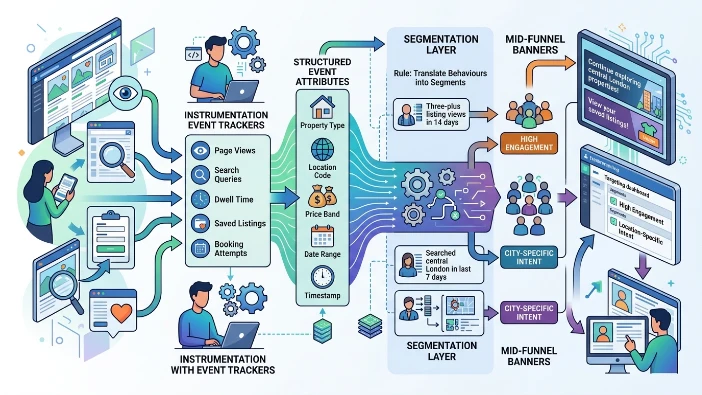
Signal collection begins with clear event definitions. Developers instrument listing pages, search results, booking forms, and saved-item actions with event trackers. Each event includes structured attributes: property type, location code, price band, date range, and interaction timestamp. Event data flows into a segmentation layer where rules translate behaviours into segments such as “three-plus listing views in 14 days” or “searched central London in last 7 days.”
Developers use server-side and client-side methods to persist segments across sessions. Server-side segments use hashed identifiers and privacy-preserving joins to keep long-term intent signals. Client-side segments use local storage and consented identifiers for rapid personalization. Both methods feed ad decisioning services to select creative variants and bidding strategies that prioritise users with higher booking intent.
What components must be built for effective mid-funnel banner campaigns?
An effective system requires event instrumentation, segmentation logic, dynamic creative, real-time decisioning, and measurement endpoints. Each component works together to deliver personalised banners that guide consideration toward booking.
Event instrumentation captures user interactions and structures them as named events with attributes. Segmentation logic groups events into intent segments with clear thresholds and expiry rules. Dynamic creative templates accept property variables—image ID, nightly rate, available dates—and render personalised visuals and copy. Real-time decisioning evaluates segment membership, creative eligibility, and bid price within 50–200 milliseconds for display auctions. Measurement endpoints collect view-through and click-through conversions, and attribute them to segments using deterministic or probabilistic models.
Developers implement data governance measures for consent, retention, and deletion to comply with UK data protection law. They maintain an audit trail linking creative variants to segment definitions and performance outcomes. This audit trail supports optimisation cycles and documentation required for compliance reviews.
How do creatives and messaging increase booking intent without hard selling?
Mid-funnel creatives use contextual relevance and micro-conversions to increase intent by highlighting availability, relevant amenities, and limited-time incentives without aggressive calls to action. Messaging focuses on facts that reduce friction in the booking decision.
Creative elements include a clear property image, concise feature line, price band, date availability, and social proof metric where available. Messaging emphasises concrete details: “Two-bedroom flat, central Manchester, from £95 per night, free cancellation until 48 hours before check-in.” Creatives present micro-conversions such as “view availability,” “check dates,” or “save to shortlist” to move users closer to booking. This approach reduces psychological resistance by offering low-effort steps aligned with consideration behaviour.
Developers implement A/B tests that vary a single factual element per test—price band vs. availability date, amenity highlight vs. location highlight—to isolate which facts drive higher booking-intent signals. Tests run for statistically significant sample sizes and use holdout audiences to measure lift in booking requests.
How should delivery and bidding be optimised for mid-funnel banner ads?
Delivery optimisation uses intent-weighted bidding and frequency caps while prioritising placements with proven conversion quality. Bidding links audience segment value to bid multipliers and pacing rules.
Developers configure bid strategies that treat mid-funnel segments with different expected value. For example, users who shortlisted a property receive a 2.0 bid multiplier compared with users who only viewed search results. Frequency caps limit impressions to reduce ad fatigue; typical caps range from 3 to 7 impressions per user per week. Placement prioritisation favours contextual matches such as articles about neighbourhoods and listing pages where intent is high.
Pacing rules smooth spend across a campaign window and reserve budget for peak decision times—weekends and evening hours for UK travel bookings. Developers monitor placement-level conversion rates and reallocate spend programmatically to inventory with the highest booking request yields.
What measurement and attribution methods prove mid-funnel impact on booking intent?
Measurement combines immediate interaction metrics and downstream booking signals across view-through and click-through attribution with experiment-based lift tests. Attribution must connect mid-funnel exposure to later booking requests using deterministic joins and controlled experiments.
Immediate metrics include impressions, viewability, click-through rate, and micro-conversion completions. Downstream metrics include booking requests submitted 1–30 days after exposure, conversion rate on shortlisted properties, and revenue per exposed user. Deterministic attribution uses persistent identifiers when available to join ad exposure to booking requests. Where deterministic links do not exist, probabilistic models estimate contribution using temporal and behavioural covariates.
Developers run incrementality tests using randomized holdouts. One cohort receives mid-funnel banners while a control cohort does not. The difference in booking request rates yields causal lift. Tests use statistically significant sample sizes and pre-defined measurement windows (commonly 14–30 days) for reliable results. Reporting includes confidence intervals and segmentation by device, source, and property type.
Explore:
How Property Portals Increase Traffic Using Banner Ads
What benefits do mid-funnel banner ads bring to property portals and developers?
Mid-funnel banners increase qualified booking requests, improve yield on media spend, and reduce friction in the booking funnel by delivering relevant facts at scale. The combination of targeted delivery and factual creatives creates measurable uplift in intent signals.
For portals, mid-funnel ads convert engaged browsers into booking prospects and increase monetisable actions such as shortlists and contact form submissions. Developers deliver improved ad performance through reduced wasted impressions and clearer attribution between ad exposure and booking outcomes. Campaigns that implement dynamic, data-driven creative report increases in booking request rate and lower cost-per-booking compared with non-personalised display.
Examples include campaigns where banners displaying real-time availability increased booking requests by double-digit percentages compared with static creative. Campaigns that used price and date variables reduced booking abandonment on mobile by improving relevance of the first conversion step—checking availability.
Explore More Expert Insights:
How Real Estate Brands Improve Lead Quality Using Retargeting Campaigns
How Realtors Educate Buyers Using Property Comparison Banner Ads
What are practical use cases and implementation steps for developers?
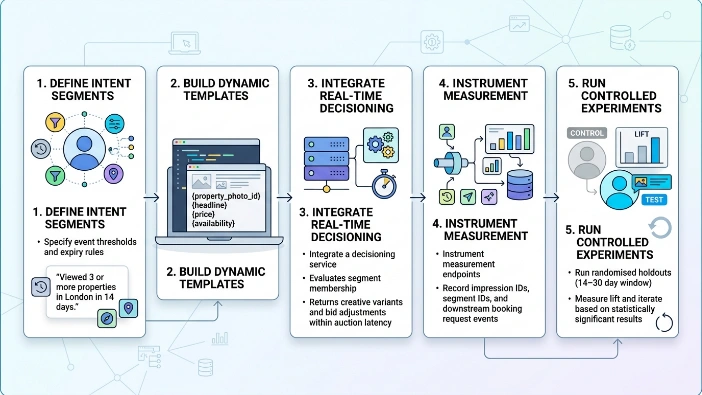
Developers implement mid-funnel banners by defining intent segments, building dynamic templates, integrating real-time decisioning, and running controlled experiments to measure lift. Implementation follows defined technical and measurement phases.
Define segments by specifying event thresholds and expiry rules, for example: “Viewed 3 or more properties in London in 14 days.” Build dynamic templates that accept variables for property photo ID, headline, price, and availability. Integrate a decisioning service that evaluates segment membership and returns creative variants and bid adjustments within auction latency constraints. Instrument measurement endpoints to record impression IDs, segment IDs, and downstream booking request events. Run randomised holdouts to measure lift over a 14–30 day window and iterate based on statistically significant results.
How do privacy and compliance affect mid-funnel banner implementations?
Privacy rules require explicit consent for personalised targeting and retention limits for user-level data; compliance influences segmentation and measurement design. UK and EU regulations require consent for non-essential tracking and mandate user data deletion upon request.
Design segmentation to operate on consented data or use aggregated, cohort-based methods when consent is not present. Implement data minimisation by storing only required attributes and enforce retention windows aligned with legal requirements. Use hashed identifiers and encrypted joins for deterministic attribution. Provide transparent user-facing controls to opt out and include clear data retention disclosures.
Mid-funnel banner ads increase booking intent by delivering targeted, factual creative to users who show clear consideration signals. Developers implement these campaigns by capturing structured events, defining precise intent segments, deploying dynamic creatives, optimising delivery and bidding, and measuring causal lift through controlled experiments. Proper privacy design and compliance ensure lawful operation while preserving measurement fidelity.
For teams focused on converting intent to bookings, see:
Mid-Funnel Property Ads That Turn Intent Into Booking Requests