
Banner ads are static or animated visual ads placed on websites and apps to present service information and drive users toward further evaluation. Banner ads include static images (JPEG/PNG), animated GIFs, and HTML5 creatives. They follow IAB sizes such as 300×250, 728×90, and 300×600. Publishers include health news sites, GP practice portals, and lifestyle blogs. Ad servers report impressions, clicks, viewability, and engagement. Banner ads differ from search ads because they focus on awareness and consideration through visual content rather than response to explicit search queries.
How do banner ads move patients from awareness to consideration?
Banner ads present targeted information that prompts users to read service details, compare options, and visit informative landing pages for deeper evaluation. The process starts with audience selection. Marketers select demographic filters (age, gender), contextual placements (condition-related pages), and geo-targeting (postcode or city). Next, creatives present service scope, eligibility, and common questions. Landing pages provide comparative information such as benefits, procedures, waiting times, and cost transparency. Campaigns use mid-funnel metrics—time on page, pages per session, and content downloads—to measure consideration rather than immediate bookings.
What components structure an effective consideration-focused banner campaign?
An effective campaign combines segmented audiences, compliant creatives, informative landing pages, measurement tags, and iterative testing. Segmented audiences define patient profiles by age range, clinical interest, and location.
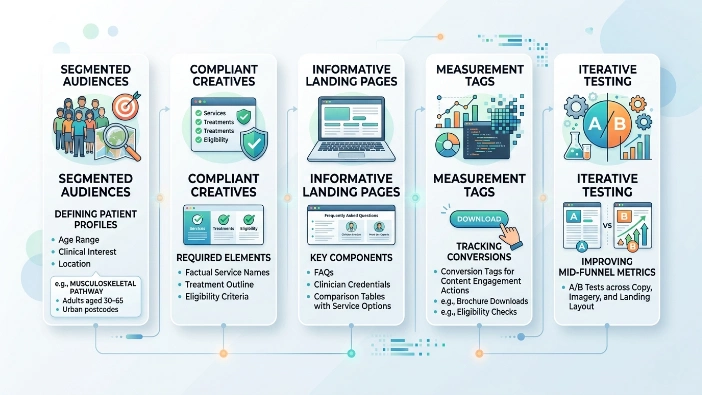
For example, a musculoskeletal pathway targets adults aged 30–65 in urban postcodes. Creatives include factual service names, treatment outline, and eligibility criteria. Landing pages contain FAQs, clinician credentials, and comparison tables with service options. Measurement uses conversion tags for content engagement actions like brochure downloads and eligibility checks. A/B tests run across copy, imagery, and landing layout to improve mid-funnel metrics.
How should targeting be set for improving service consideration?
Use contextual targeting, layered demographic filters, and behavioural signals to reach users actively researching relevant health topics. Contextual targeting places banners on pages about specific conditions, for example, putting joint-pain banners on arthritis articles. Layer demographic filters such as age 50–75 for screening services. Behavioural signals include users who searched related terms or visited symptom-check pages. Geo-targeting limits delivery to serviceable areas such as a 10–20 mile radius around clinics. Combine prospecting to broaden reach and retargeting to re-engage users who viewed service content.
How must creatives and messaging differ for consideration versus awareness?
Consideration creatives provide actionable information, comparison points, and reassurance while avoiding promotional claims and unsupported guarantees. Headlines use 4–8 words focused on the service name and a clear benefit, for example: “Free Eligibility Check — Knee Arthroscopy.” Body text uses 10–20 words highlighting eligibility, typical wait times, and next steps. Include bullet-style facts about qualifications, treatment duration, and recovery time on landing pages. Avoid emotive language.
Use neutral imagery showing clinical setting or schematic diagrams. For video banners, keep length to 15 seconds focusing on three factual messages: who the service is for, what it involves, and how to check eligibility.
How do measurement and KPIs differ for MOFU banner campaigns?
MOFU campaigns prioritise engagement and consideration metrics: content interaction, form starts, time on site, and assisted conversions. Primary KPIs include click-through rate (CTR), time on landing page, pages per session, brochure downloads, eligibility-check completions, and assisted conversions in attribution models.
Use conversion windows of 7–30 days to reflect patient decision cycles. Supplement with site analytics for scroll depth and video completion rates. Track cohort behaviour to measure how many engaged users later convert to appointments. Use aggregated reporting to protect privacy and comply with UK GDPR.
How do compliance and sensitive-topic handling affect banner campaigns?
Campaigns must follow UK advertising rules and data protection laws and apply conservative targeting for sensitive health categories. Define permissible claims and factual statements before creative production. Avoid definitive medical promises and comparative superiority claims without evidence. For sensitive topics—sexual health, mental health—prefer contextual placements rather than behaviour-based profiling.
Use consent management platforms for cookies and obtain explicit consent before collecting personal health information. Ensure vendors sign data processing agreements and support data deletion requests.
What optimisation techniques improve consideration rates?
Optimise via segmented creative testing, landing page refinement, bid adjustments for high-engagement segments, and frequency management. Run A/B tests across 3–5 creative variants and two landing page designs. Prioritise segments with higher time on page or brochure downloads by increasing bids. Reduce frequency for segments showing ad fatigue by applying caps at 3–5 impressions per week. Route high-intent users—those who completed an eligibility check—to bespoke follow-up content. Use multivariate testing for headlines, imagery, and call-to-action wording to identify combinations that increase mid-funnel engagement.
Explore:
How Healthcare Businesses Drive Patient Growth Using Display Ads
What benefits do healthcare brands gain from focusing banners on consideration?
Mid-funnel banner campaigns increase informed patient interest, reduce friction in decision-making, and improve quality of inbound enquiries. Consideration campaigns produce more qualified leads. Users engage with service details, which reduces appointment no-shows and increases patient satisfaction. Quantitative benefits include higher content engagement rates and lower downstream acquisition costs when compared to untargeted awareness campaigns.
Segmented and tested banners produce 15–35% higher brochure download rates and 10–25% higher eligibility-check completions than non-segmented campaigns in comparable healthcare contexts.
Explore More Expert Insights:
How Telemedicine Platforms Build User Trust Using Display Remarketing Ads
How Dental Clinics Nurture Leads Using Treatment Awareness Ads
What practical use cases exist for consideration-stage banner advertising?
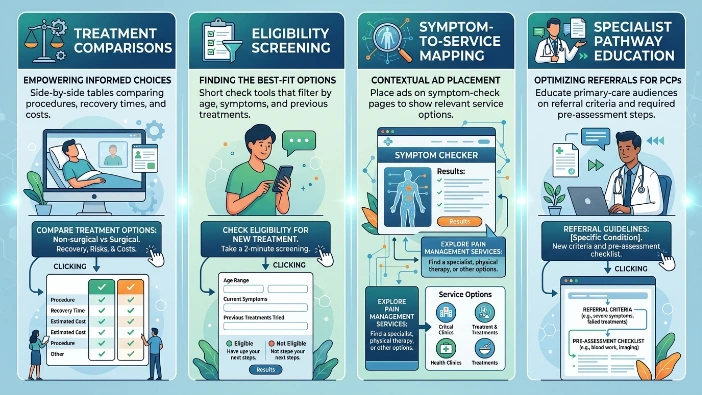
Use cases include treatment comparisons, eligibility screening, symptom-to-service mapping, and specialist pathway education. Treatment comparison banners link to side-by-side tables comparing procedures, recovery times, and costs. Eligibility screening banners drive users to short check tools that filter by age, symptoms, and previous treatments. Symptom-to-service mapping banners place ads on symptom-check pages to show relevant service options. Specialist pathway banners educate primary-care audiences on referral criteria and required pre-assessment steps.
How do banner ads integrate with other mid-funnel tactics?
Banners work with content marketing, email nurture, and clinical decision content to create coherent consideration journeys. Integrate banner-driven traffic with gated content like whitepapers or downloadable guides. Use CRM to add engaged users to segmented email sequences that deliver comparative information over 7–21 days. Feed eligibility-check results into personalised landing pages.
Coordinate banner messages with organic content and SEO to reinforce consistent service descriptions and factual details across channels.
For conversion-focused guidance, consult the internal reference on the following:
How Healthcare Brands Turn Service Consideration Into Confirmed Appointments Using Display Ads