
Healthcare brands use banner ads to reconnect with high-intent users who already searched, visited service pages, or started appointment forms. These ads display targeted healthcare messages, appointment reminders, treatment benefits, and booking-focused offers that increase completed consultations, diagnostic bookings, and treatment confirmations across digital healthcare campaigns.
Healthcare brands in the United Kingdom use banner advertising during the final stage of the patient acquisition funnel. This stage focuses on users who already understand a medical service and show booking intent. These users search for treatments, compare providers, review pricing, or revisit appointment pages before making a final healthcare decision.
Banner ads support this process by maintaining visibility across websites, mobile apps, news platforms, and healthcare-related digital environments. A fertility clinic can show IVF consultation banners to users who visited treatment eligibility pages. A dental provider can display implant booking reminders after a patient abandons a consultation form. A private hospital can promote MRI appointment availability to users who previously searched diagnostic services.
Healthcare organisations often connect banner campaigns with patient relationship management systems, appointment software, and audience segmentation tools. This structure allows healthcare brands to deliver highly relevant advertisements based on treatment interest, geographic location, and previous engagement behaviour.
Readers exploring early-stage healthcare advertising strategies can first read to understand:
How Healthcare Brands Improve Awareness Using Display Advertising
Why do banner ads perform effectively at the final booking stage?
Banner ads perform effectively at the final booking stage because they repeatedly expose healthcare offers to users with demonstrated treatment intent. Repetition, service relevance, location targeting, and simplified booking pathways increase conversion rates and reduce appointment abandonment across healthcare marketing campaigns in the United Kingdom healthcare sector.
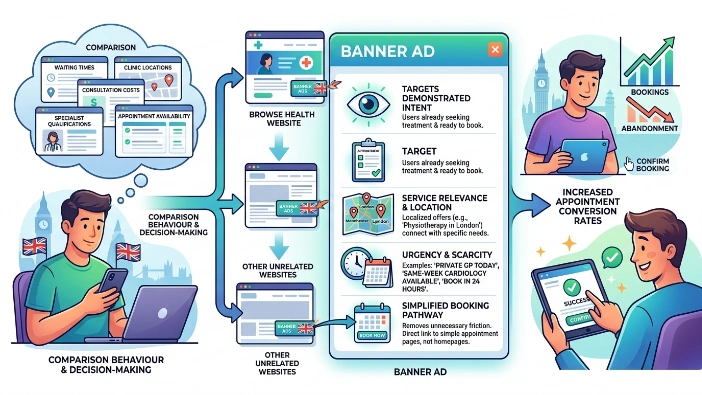
Healthcare decisions often involve comparison behaviour. Patients compare waiting times, clinic locations, consultation costs, specialist qualifications, and appointment availability before selecting a provider. Banner ads help healthcare brands remain visible during this decision-making process.
A patient searching cosmetic dentistry services in Manchester may visit three providers before choosing one. Banner ads allow a clinic to maintain visibility while the patient continues browsing other websites. This repeated exposure reinforces brand familiarity and appointment recall.
Businesses seeking broader appointment-intent nurturing strategies can explore:
How Healthcare Brands Improve Appointment Intent Using Retargeting Ads for mid-funnel healthcare retargeting approaches.
What types of healthcare banner ads generate the highest booking conversions?
Healthcare banner ads generate the highest booking conversions when they focus on appointment urgency, treatment availability, specialist expertise, patient convenience, and local healthcare access. Conversion-focused banners use direct calls-to-action, simplified messaging, and healthcare-specific intent signals that align with patient decision behaviour.
Different healthcare sectors require different booking-focused advertising strategies.
Private hospitals frequently use consultation booking banners. These campaigns highlight specialist access, reduced waiting times, and diagnostic availability. Examples include orthopaedic consultations, gastroenterology assessments, and cardiology screenings.
Dental clinics often use treatment reminder banners. Common examples include Invisalign consultations, emergency dental care, and implant treatment assessments. These campaigns focus on convenience and immediate booking access.
Mental health providers use discreet banner messaging with clear confidentiality positioning. Examples include online therapy consultations, anxiety treatment sessions, and psychiatric evaluations.
Fertility clinics use appointment-focused banners for IVF assessments, fertility testing, and specialist consultations. These campaigns typically target users who previously visited treatment information pages or cost calculators.
Healthcare brands also personalise banners based on service engagement. A patient who reviewed knee replacement services may later see orthopaedic consultation advertisements instead of general hospital branding.
How do retargeting audiences improve healthcare booking campaigns?
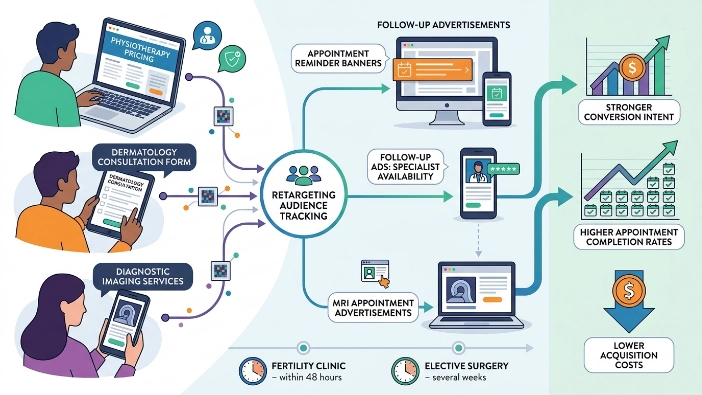
Retargeting audiences improve healthcare booking campaigns by targeting users who already interacted with healthcare websites, consultation forms, or treatment pages. These audiences demonstrate stronger conversion intent, lower acquisition costs, and higher appointment completion rates compared to first-time healthcare advertisement viewers across digital campaigns.
Healthcare retargeting operates through audience tracking systems that identify previous website interactions. Once users engage with healthcare content, they enter segmented advertising audiences.
A user visiting a physiotherapy pricing page can later receive appointment reminder banners. A visitor who begins a dermatology consultation form can receive follow-up advertisements promoting specialist availability. A patient reviewing diagnostic imaging services can see MRI appointment advertisements during future browsing sessions.
Retargeting campaigns also allow healthcare brands to personalise timing. A fertility clinic may display follow-up banners within 48 hours of website engagement, while elective surgery campaigns may continue for several weeks because treatment consideration periods remain longer.
In the United Kingdom healthcare advertising environment, retargeting campaigns often produce lower cost-per-booking metrics because the audience already understands the healthcare service before seeing the advertisement.
Explore More Expert Insights:
How Hospitals Drive Treatment Decisions Using High-Intent Display Campaigns
How Clinics Turn Service Awareness Into Confirmed Patient Visits Using Retargeting Ads
How do healthcare brands optimise banner ads for higher appointment bookings?
Healthcare brands optimise banner ads through audience segmentation, landing page alignment, mobile responsiveness, geographic targeting, appointment simplification, and performance measurement. These optimisation methods improve click-through rates, reduce booking abandonment, and increase healthcare consultation conversions across digital healthcare advertising campaigns.
Landing page alignment remains one of the most important optimisation factors. Banner messaging and booking pages must match exactly. If an advertisement promotes “same-day GP appointments,” the landing page must immediately support same-day booking access.
Healthcare providers also optimise campaigns through mobile-first design. Most healthcare searches in the United Kingdom now occur on mobile devices. Banner advertisements therefore require fast-loading visuals, readable text, and simplified appointment forms.
Location targeting improves conversion performance significantly. A healthcare provider in Leeds benefits more from showing appointment banners to local users than nationwide audiences. Geographic targeting reduces irrelevant traffic and increases booking efficiency.
Healthcare marketers also use frequency controls to prevent excessive ad repetition. Repeated exposure improves recall, but excessive repetition reduces engagement quality. Most healthcare campaigns therefore maintain controlled impression frequency across audience segments.
How do healthcare banner ads support private healthcare growth in the United Kingdom?
Healthcare banner ads support private healthcare growth in the United Kingdom by increasing patient acquisition, reducing unused appointment capacity, improving treatment visibility, and strengthening digital conversion efficiency. These campaigns help healthcare providers compete for high-intent patients across increasingly competitive medical advertising environments.
Private healthcare demand in the United Kingdom continues increasing across diagnostics, specialist consultations, elective surgery, mental health services, and dental care. Healthcare providers therefore compete aggressively for digital visibility.
Banner advertising supports this competition by allowing providers to maintain continuous exposure during patient research behaviour. A patient comparing multiple orthopaedic clinics may repeatedly encounter one provider’s booking advertisements, increasing familiarity and final conversion probability.
Healthcare brands also use banner campaigns to support underbooked services. A private imaging centre can promote MRI appointment availability during lower-demand periods. A dermatology clinic can increase consultation bookings for new specialists. A dental practice can promote emergency appointment access during weekends.
These campaigns also integrate with broader healthcare marketing systems including search advertising, CRM automation, patient remarketing, and conversion analytics.
Large healthcare providers frequently combine awareness advertising, retargeting campaigns, and booking-focused banner advertising into a full-funnel acquisition structure. Awareness campaigns introduce healthcare services.
Healthcare brands that align all funnel stages consistently often achieve stronger booking efficiency, improved patient acquisition costs, and higher long-term appointment conversion performance.