
Banner advertising in healthcare refers to digital display advertisements placed on websites, apps, and search networks that promote health-related information. These banners use images, text, and targeting systems to reach audiences based on demographics, interests, and browsing behavior online. data
Banner advertising in healthcare operates within digital display ecosystems where visual ad units appear across third-party platforms. These ad units are structured in fixed or responsive formats and are designed to transmit healthcare-related information at scale. The system relies on automated placement and audience matching technologies.
Healthcare banner ads function as communication layers between providers and online users. They appear in designated ad spaces on websites, mobile applications, and digital media platforms. The content inside these banners is optimized for clarity, short messaging, and visual recognition.
The healthcare context requires accurate representation of services, symptoms awareness, and informational clarity. Banner ads do not operate in isolation. They are integrated into larger digital advertising infrastructures that support audience segmentation and delivery optimization.
These systems also support repeated exposure across multiple digital environments. Users encounter similar informational banners across different platforms, which reinforces message visibility within regulated digital ecosystems.
How does banner advertising work for healthcare providers?
It works by displaying targeted digital ads across online platforms using cookies, audience segmentation, and real-time bidding systems. Healthcare providers define audience profiles and ad placements to reach specific users searching or browsing health-related content within regulated advertising networks ecosystems
Banner advertising works through automated digital distribution systems. These systems match healthcare-related ads with users based on predefined audience characteristics. The process begins with campaign setup, where audience parameters and message structures are defined.
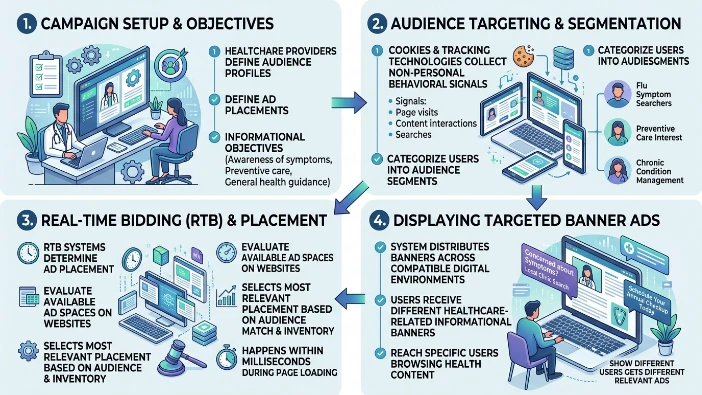
Cookies and tracking technologies collect non-personal behavioral signals such as page visits and content interactions. These signals allow advertising platforms to categorize users into audience segments. Each segment receives different healthcare-related informational banners.
Real-time bidding systems determine ad placement by evaluating available ad spaces across websites. The system selects the most relevant placement based on audience match and available inventory. This happens within milliseconds during page loading.
Healthcare providers structure campaigns around informational objectives such as awareness of symptoms, preventive care, or general health guidance. The system then distributes banners across compatible digital environments where target users are active.
This process ensures controlled exposure of healthcare messages without direct user interaction requirements. Delivery is fully automated and continuously adjusted based on engagement data.
Why do healthcare providers use banner advertising in the UK?
Healthcare providers use banner advertising in the UK to increase visibility and reach online audiences through digital platforms such as news websites and health portals. It supports targeted communication using demographic and behavioral audience segmentation within regulated online ecosystems channels
Healthcare providers in the UK use banner advertising to distribute structured health information across high-traffic digital environments. These environments include informational websites, mobile applications, and content platforms that support public health awareness communication.
The UK digital audience is highly active across online news and informational portals. Banner advertising allows healthcare-related messages to appear in these environments in a standardized visual format. This supports consistent exposure across multiple user touchpoints.
Targeting systems allow segmentation by age group, geographic region, and browsing behavior patterns. This ensures that healthcare information reaches relevant populations without requiring direct user search actions.
Banner advertising also supports repetitive exposure cycles. Users may see the same informational message multiple times across different platforms, which increases message retention within digital communication frameworks.
The system operates within structured advertising environments that manage compliance, content standards, and placement rules for healthcare-related messaging.
What types of banner ads are used in healthcare marketing?
Healthcare banner advertising includes static image banners, animated HTML5 banners, and responsive display ads designed for multiple screen sizes. These formats support informational messaging, awareness campaigns, and audience retargeting across digital healthcare platforms within structured online advertising environments systems networks
Healthcare marketing uses multiple banner formats to ensure compatibility across devices and platforms. Static image banners display fixed visual content with concise text. These banners are commonly used for simple informational messaging.
Animated HTML5 banners introduce motion-based elements such as transitions, icons, and sequential messaging. These formats present layered information within a limited screen space while maintaining clarity.
Responsive display ads adjust automatically to screen size variations. This ensures consistent display across desktops, tablets, and mobile devices without manual redesign requirements.
Each format serves a structured communication role. Static banners focus on direct messaging. Animated banners deliver sequential information. Responsive banners ensure accessibility across device ecosystems.
These formats operate within advertising systems that distribute content across healthcare-relevant digital environments. Each format supports different engagement conditions depending on user device type and platform context.
How do banner ads reach potential patients online?
Banner ads reach potential patients through programmatic advertising systems that automatically place ads on relevant websites based on user behavior and search intent. Data signals such as browsing history, geographic location, and content engagement determine ad delivery across digital networks
Banner ads reach online users through automated programmatic systems that match ad content with user profiles. These systems operate continuously and evaluate available ad spaces across multiple digital platforms.
User behavior data is collected through digital interactions such as page visits, content reading time, and topic engagement. These signals are processed to identify user interests related to healthcare information categories.
Geographic location data helps determine regional relevance for healthcare messaging. This ensures that users receive information aligned with their local healthcare context.
Search intent signals are also used to identify users actively seeking health-related information. These users are more likely to be served informational healthcare banners across websites and applications.
The distribution process occurs across multiple digital networks simultaneously. This creates repeated exposure opportunities where users encounter healthcare-related banners in different online environments.
Explore More Expert Insights:
How Education Providers Improve Enrollments Using Retargeting Ads
How Universities Boost Applications Using Digital Banner Advertising
What data supports effectiveness of banner advertising in healthcare?
Effectiveness of banner advertising in healthcare is supported by measurable data such as click-through rates, impressions, and conversion tracking across digital campaigns. Analytics systems evaluate user engagement, repeat exposure, and audience segmentation performance across platforms within digital measurement frameworks systems
The effectiveness of banner advertising is evaluated using structured performance metrics. Impressions measure how many times a banner is displayed across digital platforms. This metric reflects overall visibility within advertising networks.
Click-through rates measure the proportion of users who interact with banners after viewing them. This indicates engagement with the displayed healthcare information.
Conversion tracking measures defined user actions such as information requests or further content engagement. These actions provide structured insight into user response patterns.
Analytics systems aggregate behavioral data across multiple platforms. This includes repeat exposure frequency, time spent viewing content, and interaction patterns across different audience segments.
Audience segmentation performance evaluates how different demographic groups respond to banner messages. This helps determine which user categories engage more frequently with healthcare-related content.
What challenges exist in healthcare banner advertising?
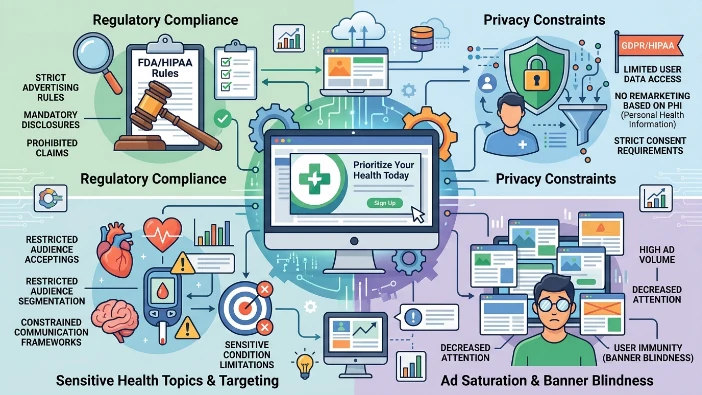
Challenges in healthcare banner advertising include strict regulatory compliance requirements, privacy constraints, and limitations in targeting sensitive health-related audiences. Performance issues also arise from ad saturation, banner blindness, and variable engagement across digital environments within evolving online advertising systems frameworks
Healthcare banner advertising operates under strict regulatory environments that govern the type of information displayed. Compliance requirements restrict how health-related messaging is structured and distributed across platforms.
Privacy constraints limit the use of personal data for targeting. This affects how audience segmentation systems operate within healthcare-related campaigns.
Sensitive health topics require controlled communication frameworks. This reduces the flexibility of targeting compared to other digital advertising categories.
Ad saturation occurs when users are exposed to a high volume of banners across multiple platforms. This reduces attention levels and decreases engagement rates.
Banner blindness develops when users unconsciously ignore display ads due to repeated exposure patterns. This affects visibility and interaction rates.
Engagement variability occurs across different platforms and user groups. Some audiences interact less frequently with banner formats, creating uneven performance distribution across campaigns.
Banner advertising in healthcare operates as a structured digital communication system that distributes informational content across online environments. It functions through automated targeting, data analysis, and visual display formats.
Read:
How Healthcare Providers Build Patient Trust Using Informational Banner Ads
Explore:
How Healthcare Providers Convert Patient Interest Into Appointment Bookings Using Banner Ads