
Retargeting ads help education providers reconnect with users who already visited a website, viewed a course page, or interacted with an application form. These ads increase visibility during the decision process and improve enrollment rates by keeping educational programs visible across digital platforms and devices.
Retargeting ads are digital advertisements shown to users after a previous interaction with an education-related website or platform. A user visits a university admissions page, leaves without applying, and later sees an advertisement related to the same course while browsing another website. This process is called retargeting.
Education providers use retargeting because student enrollment decisions involve long research cycles. Students compare tuition fees, course structures, scholarship availability, campus facilities, and career outcomes before completing an application. Retargeting keeps educational content visible during this evaluation period.
Retargeting ads operate through browser cookies, mobile identifiers, and audience tracking systems. These technologies identify previous visitors and display relevant advertisements on search engines, educational websites, video platforms, and social media applications.
In the United Kingdom, education providers frequently retarget users who visit undergraduate pages, postgraduate pages, distance learning portals, and scholarship sections. Institutions also retarget international students who check visa information or tuition details.
Students often require multiple interactions before enrollment. Retargeting supports repeated exposure without requiring a new search query from the user.
Readers exploring lead nurturing strategies can also read:
How EdTech Companies Nurture Leads Using Curriculum-Focused Display Ads for deeper insight into curriculum-focused engagement methods.
How do retargeting ads work in the education sector?
Retargeting ads track website interactions and display relevant educational advertisements to previous visitors across digital platforms. The process uses audience segmentation, behavioral tracking, and personalized messaging to reconnect prospective students during different enrollment research stages across devices and channels.
The process begins when a user visits an educational website. A tracking code stores anonymous interaction data. The system records actions such as course page visits, brochure downloads, scholarship searches, or incomplete applications.
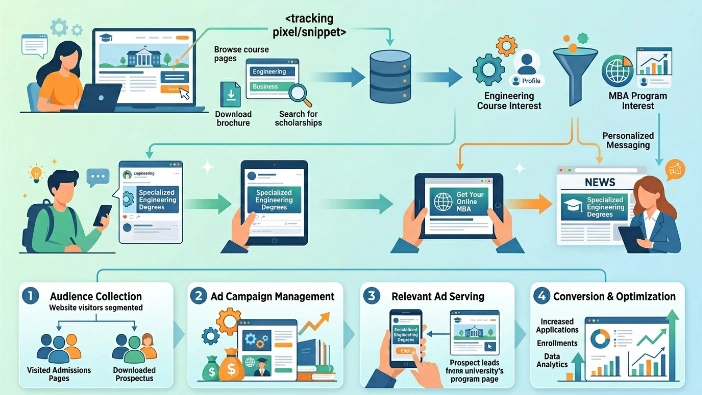
After the visit, advertising platforms categorize the user into a relevant audience group. A student who viewed engineering courses receives engineering-related advertisements. A student who viewed online MBA programs receives business education advertisements.
Educational retargeting campaigns often follow four operational stages. The first stage involves audience collection. Website visitors are grouped according to behavior. One audience includes users who visited admissions pages. Another includes users who downloaded a prospectus.
The second stage involves segmentation. Each audience receives separate messaging. Students researching undergraduate programs receive different advertisements than professionals researching executive education.
The third stage involves ad delivery. Advertisements appear across websites, search engines, mobile applications, and video platforms.
The fourth stage involves conversion tracking. Education providers measure actions such as application submissions, open day registrations, and inquiry form completions.
Retargeting systems also use frequency controls. These controls prevent excessive advertisement exposure. Balanced visibility improves engagement quality and reduces ad fatigue.
Educational institutions in the United Kingdom frequently align retargeting campaigns with seasonal admission periods, UCAS deadlines, scholarship announcements, and clearing cycles.
What types of retargeting ads are used by education providers?
Education providers use display retargeting, search retargeting, video retargeting, social media retargeting, and email retargeting. Each format reconnects prospective students through different digital environments while reinforcing course awareness, application deadlines, and educational information throughout the enrollment journey.
Display retargeting uses banner advertisements shown across websites and applications. These advertisements often promote degree programs, campus events, or admissions information.
Search retargeting targets users based on previous search activity. A user searching for data science courses later sees related educational advertisements while browsing online platforms.
Video retargeting reconnects audiences through educational videos. Institutions frequently use short informational videos explaining curriculum details, student support services, or learning environments.
Social media retargeting appears on platforms where users spend large amounts of time daily. Educational advertisements highlight course categories, learning formats, and application windows.
Email retargeting reconnects users after partial engagement. A student who begins an inquiry form but leaves before submission receives a reminder email containing course-related information.
Dynamic retargeting represents another important format. Dynamic systems automatically generate advertisements using previously viewed educational content. A student who viewed accounting courses receives advertisements specifically showing accounting-related programs instead of generic institutional messaging.
Education providers often combine multiple retargeting formats within one campaign. This improves message consistency across devices and channels.
Readers interested in enrollment-stage advertising strategies can explore:
How EdTech Companies Turn Qualified Leads Into Enrolled Students Using Final Stage Display Ads for information about conversion-focused display campaigns.
Why do retargeting ads increase student enrollment rates?
Retargeting ads improve enrollment rates because they maintain visibility during long decision cycles, reinforce educational interest, and encourage return visits. Repeated exposure increases familiarity with academic programs and supports completion of applications, inquiries, registrations, and enrollment-related actions.
Educational decisions involve extensive research behavior. Students compare institutions over several weeks or months. Many users leave websites without taking immediate action during their first visit.
Retargeting increases the probability of return engagement. Students who repeatedly encounter course-related messaging remember program names, deadlines, and academic offerings more effectively.
Enrollment improvement also comes from message relevance. Retargeting advertisements reflect earlier user interests. A student researching healthcare management receives healthcare-related advertisements instead of unrelated educational content.
Personalized relevance improves click-through rates and return visits.
Retargeting also supports application completion. Many students begin application processes but stop before submission. Reminder advertisements encourage users to return and complete unfinished forms.
Educational institutions also use retargeting to promote informational events such as webinars, virtual open days, and admissions sessions. These activities increase direct interaction between institutions and prospective students.
Data-driven optimization further improves enrollment outcomes. Institutions analyze audience performance, advertisement engagement, and conversion rates to refine targeting strategies continuously.
In the United Kingdom, enrollment cycles often include multiple research periods linked to examination schedules, UCAS timelines, and funding deadlines. Retargeting helps institutions remain visible throughout these extended timelines.
What information is commonly included in education retargeting ads?
Education retargeting ads commonly include course names, application deadlines, tuition details, learning formats, scholarship information, and admissions reminders. The content focuses on factual educational information that matches previous user interactions and supports continued research activity by prospective students.
Educational advertisements prioritize clarity and relevance. Users respond more effectively to direct information connected to earlier browsing behavior.
A retargeting advertisement for a postgraduate business course often includes program duration, study mode, and intake dates. A retargeting advertisement for an undergraduate science degree often highlights laboratory facilities, accreditation details, or subject specialization.
Admissions deadlines represent one of the most common advertisement elements. Time-sensitive messaging increases return visits during application periods.
Scholarship information also appears frequently in retargeting campaigns. Financial information influences student decision-making significantly, especially among international applicants.
Educational institutions also include virtual event invitations within retargeting advertisements. Open days, webinars, and online consultations create additional engagement opportunities.
Course-specific imagery supports contextual relevance. Nursing advertisements display healthcare learning environments. Engineering advertisements display laboratories or technical facilities.
Retargeting campaigns frequently adapt content according to audience behavior. A user who visited accommodation pages receives housing-related messaging. A user who viewed online learning sections receives distance education messaging.
Clear educational terminology improves communication accuracy. Terms such as “undergraduate degree,” “postgraduate diploma,” “distance learning,” and “foundation program” create structured audience understanding.
Explore More Expert Insights:
How Universities Boost Applications Using Digital Banner Advertising
How Institutes Increase Seasonal Admissions Using Banner Ads
How do education providers measure retargeting ad performance?
Education providers measure retargeting performance using enrollment-related metrics such as click-through rate, application completion rate, inquiry submissions, cost per enrollment, and return website visits. These measurements help institutions evaluate audience engagement and improve campaign efficiency over time.
Performance measurement begins with engagement tracking. Institutions monitor how many users click advertisements after viewing them.
Return traffic analysis measures how many users revisit educational websites after exposure to retargeting campaigns.
Application tracking represents another major measurement category. Institutions analyze how many users begin and complete enrollment forms after interacting with advertisements.
Cost-based metrics are also important. Cost per inquiry and cost per enrollment help institutions evaluate advertising efficiency.
Audience segmentation analysis improves optimization accuracy. Institutions compare results across undergraduate, postgraduate, domestic, and international student groups.
Device analysis measures performance differences between desktop and mobile users. Mobile optimization remains important because students frequently conduct educational research through smartphones.
Time-based reporting evaluates campaign performance during different admissions stages. Institutions often increase retargeting activity near application deadlines and clearing periods.
Attribution analysis identifies which advertisements contribute most effectively to enrollment-related actions. Some users convert after one advertisement exposure, while others require repeated interactions across multiple channels.
Continuous measurement supports strategic improvements in audience targeting, messaging relevance, and advertising placement.
What role do retargeting ads play in modern student recruitment?
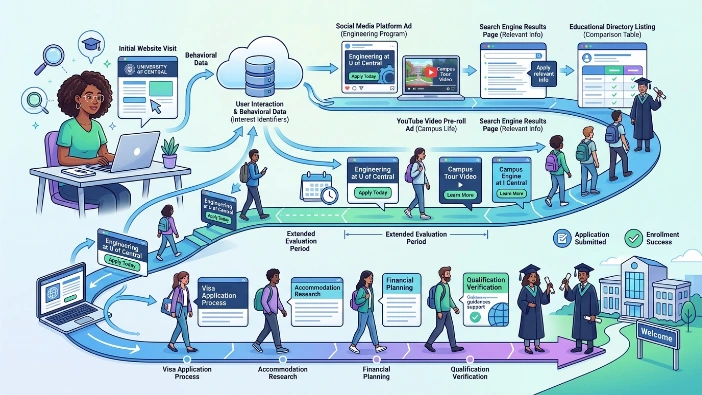
Retargeting ads play a central role in modern student recruitment by maintaining digital engagement after initial website visits. They support visibility, reinforce academic interest, and improve communication continuity throughout increasingly competitive and research-driven enrollment environments across the education sector.
Student recruitment now depends heavily on digital research behavior. Prospective students use search engines, comparison platforms, educational directories, video platforms, and social media applications during institution evaluation. Retargeting supports communication continuity across these platforms.
Modern recruitment systems rely on behavioral data instead of broad advertising exposure alone. Institutions identify user interests based on actual interactions with educational content.
This targeted approach improves advertising efficiency and information relevance.
Retargeting also supports international recruitment. International students often research institutions across long decision timelines involving visa planning, accommodation research, financial preparation, and qualification verification.
Educational institutions use retargeting to maintain visibility throughout these extended evaluation periods.
Mobile learning growth also increases the importance of retargeting. Students frequently move between devices during research sessions. Cross-device retargeting helps institutions maintain consistent communication.
Retargeting contributes to data-informed recruitment planning. Institutions analyze user behavior trends, campaign engagement patterns, and enrollment outcomes to improve future recruitment cycles.
As digital competition increases across the United Kingdom education sector, retargeting remains an important method for reconnecting with interested students and supporting enrollment-focused communication strategies.