
Final stage display ads are conversion-focused digital advertisements shown to high-intent EdTech leads who have already evaluated courses and are ready for enrollment decisions. These ads emphasize deadlines, application status, and enrollment confirmation to complete the student acquisition process.
Final stage display ads operate in the decision phase of the EdTech enrollment funnel. A qualified lead is a user who has already interacted with course pages, reviewed curriculum details, and compared educational options.
At this stage, the objective is conversion into enrollment rather than awareness or education. Final stage ads focus on decisive information such as application completion, course start dates, and admission requirements.
These ads are delivered through programmatic advertising networks across websites, mobile applications, and digital learning platforms. They target users based on behavioral signals such as repeated course visits, form initiation, and syllabus downloads.
In the United Kingdom education market, final stage ads are commonly aligned with admission cycles, application deadlines, and cohort start dates for online and hybrid learning programs.
Final stage messaging uses structured conversion signals. These signals include “application pending,” “seat availability,” and “enrollment closing timeline.”
Users who previously engaged with informational content receive highly specific conversion-focused messaging at this stage.
Readers exploring earlier funnel stages can continue with:
How Education Providers Improve Enrollments Using Retargeting Ads
How do final stage display ads convert qualified leads into enrolled students?
Final stage display ads convert qualified leads by delivering high-intent messaging, reinforcing application urgency, and presenting structured enrollment pathways to users who have already demonstrated strong academic interest and repeated engagement with EdTech course content.
Conversion begins after a user completes multiple engagement actions. These actions include viewing full course structures, revisiting pricing pages, or initiating application forms.
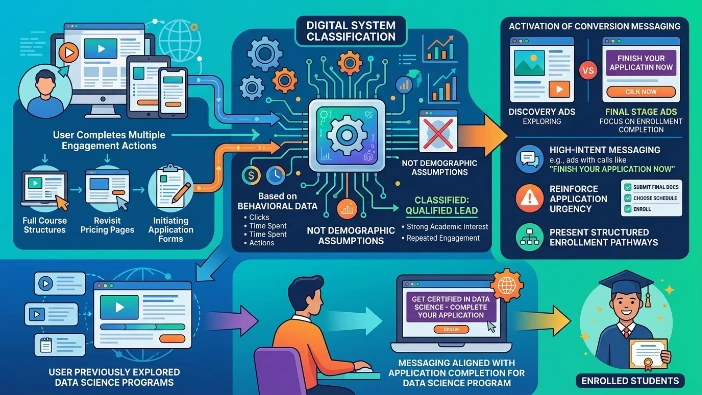
At this stage, digital systems classify the user as a qualified lead. This classification is based on behavioral data rather than demographic assumptions.
Final stage ads then activate conversion messaging. These messages focus on enrollment completion rather than discovery.
A user who previously explored data science programs receives messaging aligned with application completion steps for that same program category.
These ads operate through programmatic platforms that track user behavior across devices. A user who researches on mobile later sees conversion ads on desktop environments.
Final stage conversion systems also use sequential messaging. The first message confirms interest, the second highlights enrollment status, and the third reinforces application completion.
Conversion efficiency increases when messaging aligns with prior engagement history.
Educational institutions in the United Kingdom use final stage display ads to support structured enrollment cycles tied to academic intake periods.
Users exploring structured lead development can review:
How EdTech Companies Nurture Leads Using Curriculum-Focused Display Ads
What elements are included in final stage EdTech display ads?
Final stage EdTech display ads include enrollment deadlines, application status indicators, course start dates, tuition summaries, and direct enrollment instructions designed to convert high-intent leads into confirmed student registrations.
Final stage advertisements are structured using precise conversion elements. These elements support decision completion.
Enrollment deadlines represent a primary component. These deadlines specify the final date for application submission.
Application status indicators show progress stages such as “application in review,” “documents pending,” or “seat reserved.”
Course start dates define the exact beginning of academic sessions. These dates align with academic calendars in the United Kingdom.
Tuition summaries provide financial clarity. These summaries display total program cost, installment structure, or funding options.
Direct enrollment instructions explain how to complete application steps. These instructions include form submission sequences and required document uploads.
Program confirmation details appear in some final stage ads. These details reinforce course selection before enrollment completion.
Visual consistency plays a role in final stage messaging. Ads use structured layouts that prioritize clarity over exploration.
Final stage content avoids broad educational explanations and focuses entirely on completion actions.
These structured elements reduce uncertainty during the final decision phase.
Why are final stage display ads important in EdTech enrollment funnels?
Final stage display ads are important because they convert high-intent educational leads into enrolled students by reducing decision friction, reinforcing urgency, and providing clear enrollment pathways during the final stage of the EdTech decision journey.
Enrollment funnels in EdTech consist of multiple stages. Users begin with awareness, progress through evaluation, and reach final decision stages.
Final stage ads operate exclusively at the decision stage. They target users who have already completed detailed research.
At this point, users require clarity rather than information expansion. Final stage ads provide structured conversion details.
These ads reduce decision friction. Users receive clear instructions instead of additional course comparisons.
Urgency reinforcement improves conversion rates. Messages often align with intake deadlines and application closure timelines.
In the United Kingdom, education providers align final stage campaigns with UCAS deadlines, postgraduate intake periods, and online learning cohort schedules.
Final stage ads also improve application completion rates. Many users abandon application forms before submission. Conversion messaging encourages return completion.
Behavioral targeting ensures only high-intent users receive these ads. This increases relevance and reduces unnecessary exposure.
Final stage advertising supports structured enrollment completion across digital platforms.
How do EdTech companies structure final stage conversion messaging?
EdTech companies structure final stage conversion messaging using urgency signals, enrollment status updates, tuition clarity, and step-based application instructions designed to guide qualified leads toward immediate enrollment completion actions.
Final stage messaging is structured around four core communication layers.
The first layer includes urgency signals. These signals communicate limited intake capacity or approaching deadlines.
The second layer includes enrollment status updates. These updates show whether a user’s application is incomplete, pending, or ready for submission.
The third layer includes financial clarity. Tuition breakdowns or installment structures are included to reduce financial uncertainty.
The fourth layer includes step-based instructions. These instructions guide users through final enrollment actions.
For example, a user interested in cybersecurity programs receives structured messaging showing application deadline timelines, document submission requirements, and enrollment confirmation steps.
Messaging consistency across platforms improves user recognition of enrollment progress.
Final stage communication avoids broad educational explanations. It focuses on completion readiness.
EdTech systems in the United Kingdom often synchronize messaging with academic calendars and institutional intake cycles.
Structured messaging improves final stage engagement efficiency.
What technologies support final stage display ad targeting in EdTech?
Final stage display ad targeting uses programmatic advertising systems, behavioral tracking tools, audience segmentation engines, and conversion attribution models to identify high-intent users and deliver enrollment-focused messaging across digital platforms.
Programmatic advertising systems automate ad delivery based on user behavior signals. These systems analyze engagement history across educational platforms.
Behavioral tracking tools record user interactions such as repeated course visits, application form initiation, and pricing page views.
Audience segmentation engines categorize users into conversion-ready groups. These groups include high-intent leads, returning applicants, and incomplete application users.
Conversion attribution models identify which interactions lead to enrollment completion. This includes multiple touchpoints across devices and platforms.
Cross-device tracking ensures consistent messaging. A user who views a course on mobile later receives conversion messaging on desktop platforms.
Data synchronization ensures real-time updates. If a user completes an application, final stage ads are automatically removed or adjusted.
In the United Kingdom, EdTech platforms integrate these technologies with academic intake schedules and enrollment databases.
These systems improve targeting precision and reduce irrelevant ad exposure.
Explore More Expert Insights:
How Education Providers Convert Success Story Engagement Into Enrollments Using Banner Ads
How Institutes Close Admission Leads Using High-Intent Retargeting Campaigns
How do final stage display ads differ from earlier EdTech funnel stages?
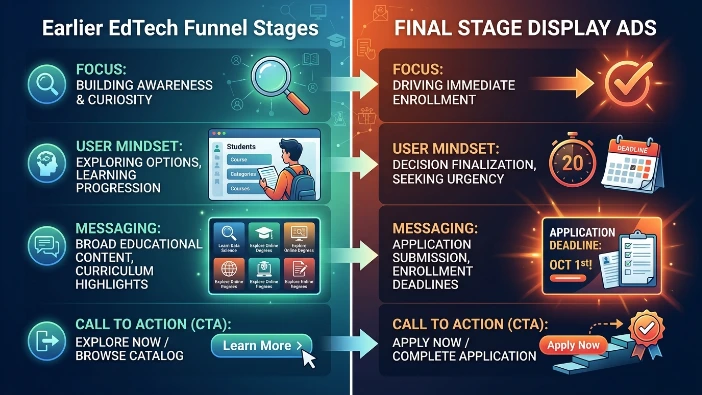
Final stage display ads differ from earlier funnel stages by focusing exclusively on enrollment completion, while earlier stages emphasize awareness and learning progression. Final stage messaging prioritizes urgency, clarity, and direct application conversion actions.
Earlier funnel stages focus on awareness and evaluation. Users receive broad educational content and curriculum structures.
Final stage ads focus on decision completion. Users already understand course content and academic pathways.
Top-of-funnel messaging introduces programs. Mid-funnel messaging explains curriculum structures. Final stage messaging completes enrollment action.
Earlier ads focus on discovery and comparison. Final stage ads focus on application submission.
For example, early-stage ads may highlight course categories. Mid-stage ads may present curriculum modules. Final stage ads show enrollment deadlines and application completion instructions.
This progression reflects user readiness levels.
Final stage messaging avoids educational exploration. It focuses on structured conversion steps.
EdTech companies maintain all three stages in coordinated funnel systems.
What impact do final stage display ads have on EdTech enrollment performance?
Final stage display ads significantly improve EdTech enrollment performance by increasing application completion rates, reducing abandonment, and converting high-intent leads into enrolled students through structured, behavior-based conversion messaging systems.
Enrollment performance improves when high-intent users receive targeted conversion messaging.
Final stage ads reduce application abandonment rates. Users who start applications but do not finish receive structured reminders.
Completion rates increase due to clarity in instructions. Users understand exactly what steps remain.
Conversion timing improves. Users complete enrollment actions closer to decision readiness periods.
Final stage campaigns also improve return visit frequency. Users re-engage with application systems after exposure to conversion messaging.
Performance measurement includes enrollment completion rate, cost per enrollment, and application-to-enrollment ratio.
In the United Kingdom, EdTech institutions often observe performance improvements during intake deadlines when final stage campaigns are active.
Conversion-focused messaging improves overall funnel efficiency.
Final stage display ads complete the EdTech enrollment journey by transforming qualified leads into confirmed student registrations through structured and behavior-driven communication systems.