Converting success story engagement into enrollments means using learner-focused banner advertisements, retargeting systems, and outcome-driven messaging to move prospective students from trust-building interactions toward completed applications, admissions decisions, and confirmed course enrollments within structured digital recruitment campaigns.
Education providers use success story engagement as a conversion-stage marketing asset. Prospective students who previously interacted with graduate testimonials, employment outcomes, or learner achievements already demonstrate educational interest. Banner advertising focuses on turning this interest into measurable enrollment actions.
At this stage, students actively compare institutions, course value, tuition costs, learning flexibility, and career outcomes. Education providers present enrollment-focused advertisements containing direct application messaging, intake reminders, scholarship deadlines, and consultation opportunities.
A university promoting postgraduate healthcare programs may retarget users who viewed nursing graduate success stories with banners stating “September Intake Closing Soon” or “Complete Your MSc Nursing Application Today.” An online training provider may display certification-focused banners offering direct enrollment pathways after users engage with career-transition testimonials.
Banner campaigns prioritize action-oriented communication supported by previous trust-building engagement. Students already understand the provider’s educational value. The campaign objective shifts toward enrollment completion.
Why do success story banner ads improve student enrollment rates?
Success story banner ads improve student enrollment rates because they reinforce trust, reduce decision uncertainty, strengthen institutional credibility, and guide engaged prospective students toward final admissions actions through repeated exposure to measurable educational outcomes and enrollment-focused messaging.
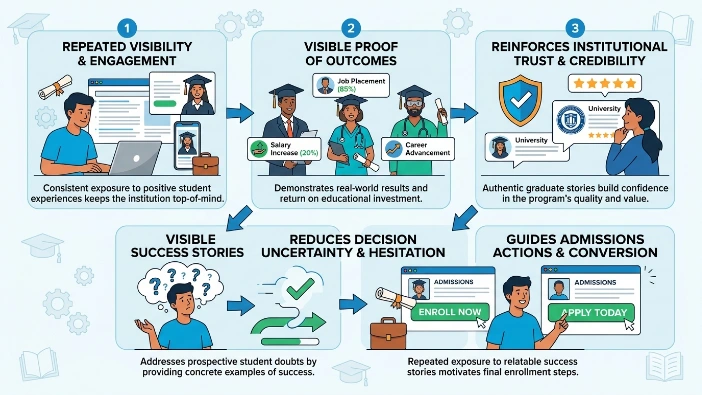
Students evaluating educational investment seek evidence before committing to applications. Success story advertisements provide visible proof that previous learners achieved academic progression, employment outcomes, and career advancement after course completion.
This evidence reduces hesitation during final decision stages. Prospective learners exposed to verified graduate outcomes often demonstrate higher engagement with application systems, virtual consultations, and admissions pages.
Repeated exposure also increases conversion consistency. A student researching digital marketing qualifications who repeatedly encounters graduate employment success stories remains connected to the provider during the evaluation process.
Enrollment-focused messaging strengthens urgency. Education providers combine success stories with application deadlines, limited intake announcements, or scholarship reminders to encourage faster decision-making.
Retargeting technology improves relevance. Students who previously interacted with business management success stories later receive MBA application advertisements rather than generic awareness campaigns. This personalised communication improves enrollment efficiency.
Institutions also use performance analytics to identify high-converting audience segments. Students engaging with employability-focused banners often progress toward inquiries and completed applications at higher rates than general awareness audiences.
How do education providers use retargeting to convert engaged students?
Education providers use retargeting to convert engaged students by displaying personalized banner advertisements to users who previously interacted with course pages, student testimonials, inquiry forms, or success story campaigns during earlier stages of the digital admissions journey.
Retargeting systems track behavioural engagement signals across websites and advertising networks. When a prospective student visits a course page or engages with a graduate success story, advertising platforms record that interaction for future campaign delivery.
Education providers then display conversion-focused advertisements during later browsing sessions. A student researching engineering qualifications may later encounter banners promoting final application deadlines, tuition support information, or direct admissions consultations.
This process maintains communication continuity throughout the decision cycle. Many students require multiple interactions before completing enrollment actions. Retargeting ensures providers remain visible during this evaluation period.
Segmented retargeting improves advertisement accuracy. Undergraduate applicants receive different campaigns than postgraduate learners or professional certification candidates. A healthcare diploma campaign targets different audiences than executive business education promotions.
Dynamic retargeting also supports course-specific engagement. Students interacting with cybersecurity success stories later receive banners featuring technology program application opportunities rather than unrelated academic advertisements.
Frequency management prevents overexposure. Providers balance advertisement repetition to maintain visibility without reducing engagement quality.
What types of enrollment-focused banner ads perform best after success story engagement?
Enrollment-focused banner ads perform best when they combine authentic student outcomes, direct application messaging, measurable career statistics, urgency-based enrollment reminders, and course-specific calls to action aligned with previously demonstrated learner interests.
Application-deadline banners generate strong engagement during final admissions periods. These advertisements contain concise statements such as “Apply Before 31 August” or “January Intake Applications Closing Soon.”
Scholarship-focused banners also perform effectively. Education providers use financial support messaging alongside graduate success outcomes to strengthen enrollment interest among cost-sensitive learners.
Career-outcome banners remain highly effective in professional sectors. Technology providers often highlight employment statistics such as “89% of Graduates Entered Tech Roles Within Six Months.” Healthcare campaigns frequently emphasize NHS placements and clinical employment progression.
Consultation-based banners increase inquiry conversions. Institutions promote advisor sessions, virtual consultations, and course guidance meetings after users engage with learner testimonials or student outcome campaigns.
Program-specific retargeting advertisements improve relevance. A user researching law qualifications receives legal education application messaging rather than general university advertisements.
Mobile-optimized banner formats support enrollment accessibility. Many students complete inquiries and applications through smartphones. Responsive design improves usability during final conversion stages.
Institutions also test multiple advertisement versions to measure performance differences. Data analysis identifies which messages, visuals, and enrollment prompts generate the highest conversion activity.
How do landing pages support banner ad enrollment conversions?
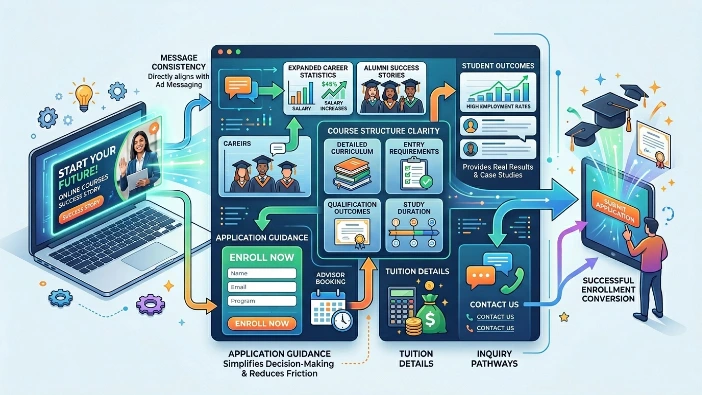
Landing pages support banner ad enrollment conversions by providing structured course information, application guidance, student outcomes, tuition details, and inquiry pathways that align directly with the messaging and expectations created by success story advertisements.
A banner advertisement alone rarely completes the enrollment process. Students require additional information before submitting applications or tuition deposits. Landing pages function as the continuation of the advertisement experience.
Message consistency strengthens conversion performance. A banner featuring graduate employment outcomes should direct users toward a landing page containing expanded career statistics, alumni case studies, and program-specific employability information.
Course structure clarity also improves enrollment confidence. Students expect detailed curriculum information, entry requirements, qualification outcomes, and study-duration explanations after engaging with banner advertisements.
Application-focused landing pages simplify decision-making. Education providers use direct enrollment forms, advisor booking systems, and step-by-step admissions guidance to reduce user friction.
Trust indicators remain important during stages. Providers include accreditation details, learner testimonials, graduate outcomes, and employer partnerships within landing-page environments to reinforce credibility.
Mobile responsiveness improves accessibility. Many prospective learners transition from banner advertisements to enrollment pages using smartphones. Fast-loading pages and simplified forms increase completion rates.
Analytics tracking allows institutions to measure landing-page effectiveness. Providers monitor bounce rates, form completions, consultation requests, and application submissions linked to specific banner campaigns.
Explore More Expert Insights:
How Institutes Close Admission Leads Using High-Intent Retargeting Campaigns
How Online Learning Platforms Turn Course Viewers Into Paying Students Using Banner Ads
Why are measurable outcomes important in education advertising?
Measurable outcomes are important in education advertising because prospective students evaluate educational investment using employment statistics, qualification completion rates, salary progression data, and graduate achievements before making final enrollment decisions.
Outcome-based communication provides concrete evidence of educational value. Students compare providers based on employability, academic progression, certification recognition, and industry relevance.
Employment-focused statistics strongly influence conversion behaviour. Advertisements stating “91% Graduate Employment Within Nine Months” provide clearer value indicators than broad institutional claims.
Professional qualification sectors depend heavily on measurable outcomes. Accounting certifications, healthcare diplomas, coding bootcamps, and project management programs frequently use exam-pass percentages and employment placement statistics within conversion-stage campaigns.
Salary progression metrics also support enrollment decisions. Business schools promoting executive education often highlight career advancement statistics linked to alumni progression.
Student-completion rates strengthen trust. Prospective learners interpret high completion percentages as indicators of academic support quality and program structure effectiveness.
Institutions also use outcome data to personalise advertising strategies. Campaigns targeting mature learners often emphasize career-transition success rates, while undergraduate campaigns focus on graduate employability and further education progression.
Performance reporting systems measure which outcome categories produce the highest enrollment activity. Providers refine future campaigns using conversion-focused behavioural analytics.
Readers exploring how educational awareness campaigns attract prospective students can revisit:
How Universities Boost Applications Using Digital Banner Advertising
Readers examining trust-building strategies using learner achievements can continue to:
How Education Providers Build Trust Using Success Story Banner Ads
Why are success story banner ads essential in modern enrollment campaigns?
Success story banner ads are essential in modern enrollment campaigns because they connect trust-building engagement with action-oriented admissions messaging, allowing education providers to guide prospective students from evaluation stages into measurable application and enrollment outcomes.
Modern education recruitment operates within highly competitive digital environments. Students compare multiple institutions, course structures, tuition models, and career outcomes before selecting programs.
Success story banner advertisements provide evidence-driven communication throughout this process. Providers use real learner achievements to strengthen institutional trust and maintain engagement across long decision cycles.
Advertising focuses on conversion efficiency. Institutions use retargeting systems, personalized course messaging, and enrollment-focused banner campaigns to encourage final admissions actions from already engaged audiences.
Digital advertising platforms also provide measurable performance tracking. Providers analyze click-through rates, landing-page engagement, inquiry submissions, and completed applications connected to success story campaigns.
Automation technology improves scalability. Institutions distribute personalized advertisements across websites, mobile applications, social platforms, and video networks simultaneously while maintaining audience segmentation accuracy.
Success story banner advertising now functions as a core enrollment-generation strategy within modern education marketing systems. It transforms student engagement into structured admissions outcomes using data-driven communication, verified learner achievements, and conversion-focused digital advertising campaigns.