
Conversion in online learning banner advertising refers to the process where a user transitions from viewing educational course content through banner ads into completing a paid enrollment action, supported by structured targeting, repeated exposure, and intent-based digital signals.
Conversion represents the final stage of the digital learning funnel. In this stage, users already know the course category and have evaluated multiple options. Banner ads function as reinforcement systems that maintain visibility until a decision is completed.
In the United Kingdom digital education ecosystem, conversion depends on structured interaction history. Users typically interact with multiple educational touchpoints before making enrollment decisions. Banner ads contribute by reinforcing course relevance at every digital visit.
Conversion is measured through completed actions such as registration, payment initiation, or confirmed enrollment. These actions are triggered after multiple exposures to structured course messaging across different platforms.
Banner systems ensure conversion readiness by maintaining consistent visibility of course value signals, structured outcomes, and learning pathways.
How do banner ads influence final enrollment decisions?
Banner ads influence final enrollment decisions by reinforcing course relevance through repeated exposure, structured messaging, and behavioral targeting that aligns user interest patterns with final-stage decision triggers in online learning environments.
Banner ads operate as reinforcement tools at the decision stage. Users at this stage already compare course providers, pricing structures, and learning outcomes.
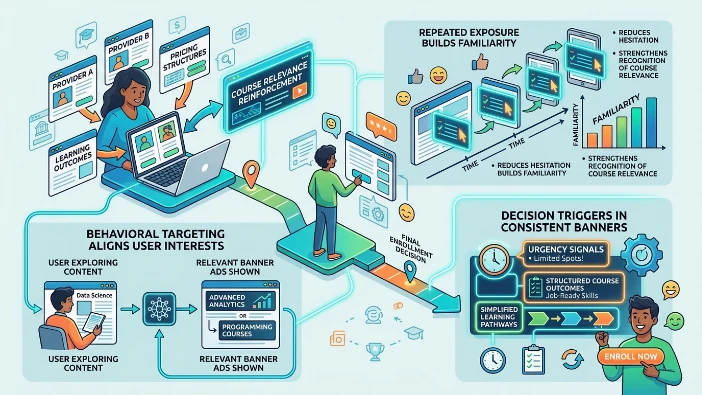
Repeated exposure increases familiarity with course structures. Familiarity reduces hesitation during decision-making processes. Each banner impression strengthens recognition of course relevance.
Behavioral targeting ensures users see banners aligned with their previous interactions. Users who explored data science content receive repeated exposure to analytics or programming courses.
Decision triggers include urgency signals, structured course outcomes, and simplified learning pathways. These elements appear consistently across banner placements.
Read:
How Education Brands Promote Courses Using Banner Campaigns
What types of banner ads are used at the conversion stage?
Banner ads used at the conversion stage include retargeting banners, dynamic product banners, personalized course banners, and urgency-based banners designed to deliver final-stage enrollment messaging through structured digital reinforcement.
Retargeting banners focus on users who previously visited course pages. These banners reappear across websites to maintain engagement continuity.
Dynamic product banners adjust course details in real time. They display updated information such as course duration, certification type, and enrollment availability.
Personalized course banners use user behavior data. They present courses aligned with previously viewed subjects such as business analytics, web development, or cybersecurity.
Urgency-based banners communicate structured time-sensitive enrollment information. These banners highlight limited intake cycles or fixed academic start dates.
Each banner type contributes to conversion acceleration through structured reinforcement.
How does retargeting increase course completion rates?
Retargeting increases course completion rates by repeatedly displaying course advertisements to users who previously interacted with educational content, reinforcing decision-making signals and maintaining consistent visibility across multiple digital platforms.
Retargeting tracks user interaction history using digital identifiers such as cookies or logged-in session data. These identifiers connect users to previously viewed course pages.
Once a user exits a course page without enrolling, retargeting systems reintroduce structured course banners across other websites. This creates continuous visibility.
Repeated exposure reduces decision drop-off. Users are reminded of course options during unrelated browsing sessions.
Retargeting also supports multi-session decision cycles. Users often require multiple visits before completing enrollment.
In the United Kingdom education sector, retargeting is widely used for structured conversion optimisation.
What role does personalization play in banner-based conversions?
Personalization plays a central role in banner-based conversions by tailoring course advertisements based on user behavior, interest signals, and engagement history to deliver highly relevant educational messaging aligned with final enrollment decisions.
Personalization systems analyze user interaction data. This includes pages viewed, time spent on course descriptions, and subject categories explored.
Based on this data, banner ads display specific course recommendations. Users interested in business courses receive banners focused on management or finance programs.
Personalization increases message relevance. Relevant messaging reduces cognitive effort during decision-making.
Personalized banners also improve engagement consistency. Users see aligned course options across multiple platforms and sessions.
This structured relevance increases likelihood of enrollment completion.
How do urgency signals affect student enrollment behavior?
Urgency signals affect student enrollment behavior by introducing time-bound course availability indicators, structured intake deadlines, and enrollment cycle constraints that encourage faster decision completion in digital learning environments.
Urgency signals operate through structured timing information. These include course start dates, enrollment closing periods, and cohort limitations.
Banner ads display urgency through simplified visual indicators. These indicators communicate limited availability or fixed academic schedules.
Users exposed to urgency signals tend to finalize decisions faster. Structured deadlines reduce extended comparison cycles.
Urgency-based messaging is most effective at the conversion stage. Users already familiar with course details respond to time-sensitive enrollment cues.
In UK online education systems, structured intake cycles make urgency a standard conversion factor.
How does dynamic content improve banner conversion performance?
Dynamic content improves banner conversion performance by automatically updating course information such as pricing structures, availability status, and program details in real time to ensure accurate and relevant enrollment messaging across digital advertising platforms.
Dynamic banners use automated data feeds. These feeds update course information continuously.
If course availability changes, banner content reflects updated enrollment status immediately. This ensures accuracy across all impressions.
Dynamic content also adjusts based on user interaction history. Users who viewed specific modules receive updated banners aligned with those modules.
Real-time updates reduce informational inconsistency. Users receive synchronized course information across multiple platforms.
This improves trust in course accuracy and supports final enrollment decisions.
What metrics define successful conversions in banner campaigns?
Successful conversions in banner campaigns are defined by enrollment completion rate, cost per acquisition, retargeting response rate, click-to-enroll ratio, and multi-touch engagement frequency across educational advertising ecosystems.
Enrollment completion rate measures total users who finish registration after banner interaction.
Cost per acquisition calculates the financial efficiency of converting users into paying students.
Retargeting response rate measures how often users re-engage after repeated banner exposure.
Click-to-enroll ratio tracks how many users move from banner clicks to final enrollment pages.
Multi-touch engagement frequency measures how many banner interactions occur before conversion.
These metrics collectively define final-stage campaign performance.
Explore More Expert Insights:
How Coaching Centers Turn Exam Prep Interest Into Paid Registrations Using Conversion Ads
How Universities Convert Program Awareness Into Final Enrollments Using Display Retargeting Ads
How do banner ads connect consideration to final enrollment?
Banner ads connect consideration to final enrollment by reinforcing previously evaluated course options, maintaining structured visibility across multiple platforms, and guiding users through repeated exposure until final decision thresholds are reached in online learning environments.
At the consideration stage, users compare multiple course options. Banner ads maintain structured visibility during this comparison process.
As users progress toward decision-making, banner frequency increases for relevant courses. This ensures continuous exposure to selected learning pathways.
Final enrollment occurs after multiple reinforcement cycles. Each cycle strengthens recognition of course relevance.
Banner systems ensure continuity between evaluation and decision stages without introducing new informational complexity.
How banner ads complete the conversion journey
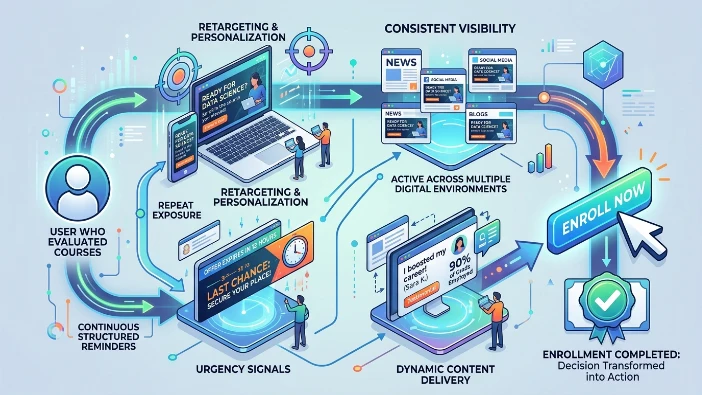
Banner ads complete the conversion journey by transforming repeated course exposure into structured enrollment decisions through personalization, retargeting, urgency signals, and dynamic content delivery systems. These systems operate across multiple digital environments to maintain consistent visibility of educational opportunities.
The conversion stage depends on reinforcement rather than introduction. Banner campaigns ensure that users who already evaluated courses receive continuous structured reminders until enrollment is completed.
Explore:
How Online Learning Platforms Increase Course Consideration Using Banner Ads