

SaaS businesses use retargeting banner ads to reconnect with website visitors who leave without signing up or purchasing. These ads display across websites, mobile apps, and digital platforms to maintain visibility, increase return visits, improve conversion rates, and support long SaaS decision-making cycles through repeated exposure.
Retargeting banner ads are digital display advertisements shown to users after they visit a website. A tracking script records visitor activity and enables ad platforms to display relevant ads later. SaaS businesses use this process because software buyers rarely convert during a first visit.
A visitor often compares pricing, reviews, integrations, security standards, and feature depth before taking action. Retargeting keeps the SaaS product visible during that evaluation process.
SaaS retargeting campaigns commonly focus on visitors who viewed pricing pages, product comparison pages, feature pages, or signup forms. These visitors show measurable interest because they interact with high-intent sections of the website.
Retargeting banner ads appear on news websites, blogs, forums, mobile applications, and video platforms. The ad content usually highlights product benefits, feature categories, trial reminders, or educational resources.
Read more about mid-funnel engagement in:
How SaaS Businesses Strengthen Consideration Using Retargeting Banner Ads
How does SaaS website retargeting work?
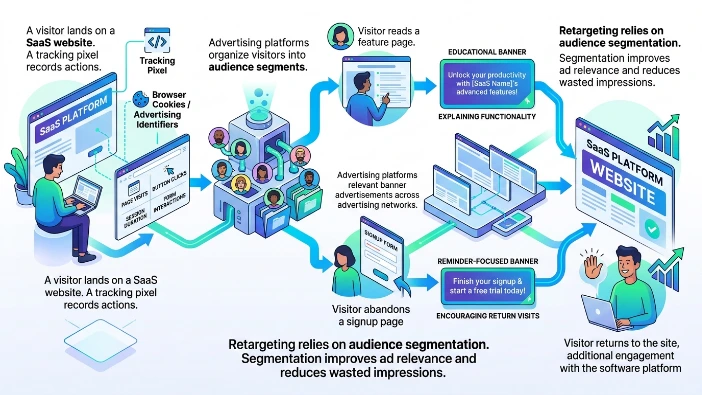
SaaS website retargeting works by tracking visitor behavior through browser cookies or advertising identifiers. The system segments visitors into audiences based on actions, then delivers relevant banner advertisements across advertising networks to encourage return visits and additional engagement with the software platform.
The process starts when a visitor lands on a SaaS website. A tracking pixel records actions such as page visits, button clicks, session duration, and form interactions.
Advertising platforms then organize visitors into audience segments. Each segment receives different banner ads based on user behavior.
For example, a visitor who reads a feature page receives educational banners explaining functionality. A visitor who abandons a signup page receives reminder-focused banners encouraging return visits.
The retargeting system relies on audience segmentation. Segmentation improves ad relevance and reduces wasted impressions.
Common SaaS retargeting segments include:
Visitors who viewed pricing pages.
Visitors who started free trials.
Visitors who downloaded product documents.
Visitors who visited integration pages.
Visitors who returned multiple times within 30 days.
Banner ads then follow these audiences across websites participating in display advertising networks.
The tracking period usually ranges from 7 days to 90 days depending on the SaaS sales cycle. Shorter sales cycles use shorter retargeting windows. Enterprise SaaS products often use longer audience durations because purchasing decisions involve multiple stakeholders.
What components are included in SaaS retargeting banner campaigns?
SaaS retargeting banner campaigns include audience tracking systems, advertising platforms, visual banner creatives, segmentation rules, conversion goals, frequency controls, landing pages, and analytics reporting. Each component supports audience targeting, engagement measurement, and conversion optimization throughout the campaign lifecycle.
Audience tracking forms the foundation of retargeting. Tracking pixels collect behavioral data from website visitors. These pixels connect website activity with advertising platforms.
Advertising platforms distribute the banners. These systems manage bidding, placement delivery, targeting settings, and performance reporting.
Banner creatives contain the visual advertisement. SaaS banner ads commonly include product dashboards, feature highlights, value statements, and onboarding messages.
Landing pages support post-click engagement. A banner promoting workflow automation leads users to a workflow-related landing page instead of a generic homepage.
Frequency controls manage how often users see advertisements. Excessive repetition increases ad fatigue and reduces click-through performance. Most SaaS campaigns limit impressions per user each day.
Analytics systems measure campaign performance. Important metrics include click-through rate, return visits, signup completion rate, cost per acquisition, and assisted conversions.
Retargeting campaigns also depend on audience exclusions. Existing customers, unsubscribed users, and converted trial users are often removed from educational campaigns to prevent irrelevant ad delivery.
Why are retargeting banner ads important for SaaS marketing funnels?
Retargeting banner ads are important for SaaS marketing funnels because they reconnect inactive visitors, extend brand visibility, support long evaluation cycles, improve return traffic, and increase conversion efficiency. These campaigns maintain engagement between initial awareness and final software adoption decisions.
SaaS purchasing decisions involve research stages. Buyers compare features, integrations, pricing structures, and implementation requirements before committing to subscriptions.
Website visitors frequently leave without converting because they require additional information. Retargeting maintains communication after the initial session ends.
Awareness-stage retargeting focuses on education. These ads explain software categories, operational problems, and workflow improvements. Consideration-stage campaigns focus on features, integrations, or use cases. Decision-stage campaigns focus on activation, onboarding, and subscription upgrades.
Retargeting also improves traffic efficiency. A SaaS business already invested resources to attract visitors through search engines, social media, referrals, or content marketing. Retargeting increases the value of that existing traffic.
Display retargeting supports multi-session conversion behavior. Many SaaS users complete conversions after multiple website visits instead of a single interaction.
Studies across digital advertising consistently show higher engagement rates among retargeted audiences compared with first-time cold audiences because prior website interaction signals intent.
For deeper funnel conversion strategies, continue with:
How SaaS Businesses Close Trial Users Into Paid Subscriptions Using Retargeting Funnels
What types of visitors do SaaS businesses retarget?
SaaS businesses retarget visitors based on behavioral intent, engagement level, and funnel position. Different visitor groups receive different banner messages to increase relevance, improve click-through rates, and support progression from awareness to product evaluation and subscription consideration.
Pricing page visitors represent high-intent audiences. These users actively review costs and subscription structures.
Feature-page visitors show interest in product capabilities. Banner ads targeting these audiences often highlight operational benefits or feature demonstrations.
Free resource visitors include users who downloaded guides, templates, webinars, or documentation. These audiences often receive educational banners connected to related content.
Abandoned signup visitors form another important segment. These users start but do not complete registration flows.
Repeat visitors receive specialized campaigns because repeated sessions indicate ongoing interest.
Integration-page visitors are valuable in SaaS environments because integration compatibility strongly influences software selection. Banner ads targeting these users often focus on ecosystem connectivity.
Mobile visitors also receive separate treatment. Mobile browsing behavior differs from desktop behavior, so campaigns frequently use device-specific banner formats and landing experiences.
Audience segmentation improves personalization without requiring direct sales interaction.
How do SaaS banner ads improve visitor engagement?
SaaS banner ads improve visitor engagement by increasing repeat exposure, reinforcing product relevance, directing users toward educational content, and encouraging additional website sessions. Repeated visibility strengthens recall and keeps the software solution active within the buyer’s evaluation process.
Banner ads increase familiarity through repeated impressions. A visitor who sees consistent messaging across multiple websites remembers the software category and associated product more easily.
Engagement also increases when ads align with previous browsing behavior. A visitor who explored automation features responds more effectively to automation-focused banners than generic advertisements.
Educational banner ads improve informational engagement. Instead of immediately pushing subscriptions, TOFU campaigns often direct users toward articles, guides, product explainers, or industry insights.
Retargeting also supports sequential messaging. One banner introduces a software category. Another explains workflow functionality. A later banner highlights onboarding simplicity or reporting capabilities.
Sequential engagement improves message clarity because users receive information gradually instead of all at once.
Banner ads also encourage return visits from undecided users. SaaS decision cycles frequently extend across several days or weeks. Continuous visibility helps maintain engagement during that period.
What challenges affect SaaS retargeting banner campaigns?
SaaS retargeting banner campaigns face challenges related to privacy restrictions, audience fatigue, tracking limitations, low-quality segmentation, and inconsistent messaging. Effective campaign management requires accurate audience organization, controlled ad frequency, and relevant banner content throughout the funnel journey.
Privacy regulations affect tracking systems. Browser restrictions and cookie limitations reduce audience visibility across some environments.
Audience fatigue also affects performance. Users repeatedly exposed to identical banners gradually ignore advertisements. Creative rotation reduces this issue.
Poor segmentation creates irrelevant ad experiences. A visitor researching integrations responds differently from a visitor reviewing pricing details. Generic campaigns reduce engagement efficiency.
Landing page inconsistency also impacts results. Banner messaging and landing page content must align clearly. A mismatch reduces trust and increases bounce rates.
Attribution complexity presents another challenge. SaaS conversions often involve multiple traffic sources, including search, referrals, webinars, and direct visits. Measuring retargeting influence requires multi-touch attribution analysis.
Ad placement quality also matters. Low-quality placements reduce visibility and engagement performance. SaaS campaigns often use placement exclusions to maintain advertising quality standards.
Explore More Expert Insights:
How SaaS Platforms Increase Demo Requests Using Banner Ad Campaigns
How Tech Companies Promote Product Launches Using Banner Advertising
How do SaaS businesses measure retargeting banner performance?
SaaS businesses measure retargeting banner performance using engagement metrics, conversion tracking, return traffic analysis, and funnel progression data. Performance evaluation focuses on how retargeted audiences interact with banners and whether those interactions lead to measurable business outcomes.
Click-through rate measures how often users click banner ads after viewing them. Higher click-through rates indicate stronger message relevance.
Return visit tracking measures how many users revisit the website after seeing retargeting advertisements.
Time-on-site metrics evaluate post-click engagement quality. Longer sessions often indicate stronger content relevance and higher intent.
Signup completion tracking measures conversion performance. SaaS businesses monitor whether retargeted visitors create accounts, activate trials, or begin onboarding processes.
View-through conversions also matter. Some users see ads but return later without directly clicking the banner. Attribution systems measure these assisted conversions.
Frequency analysis measures exposure levels. High frequency with low engagement signals creative fatigue or poor audience targeting.
Campaign reporting also compares audience segments. Pricing-page visitors often produce different engagement patterns than educational-content visitors.
What role do retargeting banner ads play in SaaS growth?
Retargeting banner ads support SaaS growth by improving conversion efficiency, increasing repeat engagement, extending audience reach, and reinforcing software visibility across long research cycles. These campaigns connect awareness-stage visitors with future evaluation and subscription opportunities through continuous digital exposure.
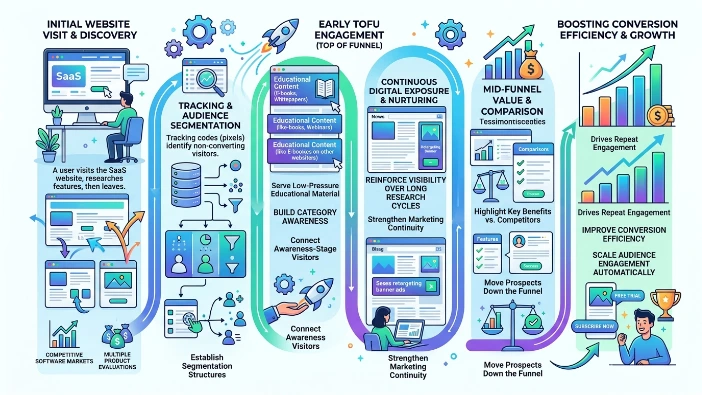
SaaS businesses operate within competitive software markets. Buyers evaluate multiple products before making purchasing decisions. Retargeting helps maintain product visibility throughout that process.
These campaigns strengthen marketing continuity between traffic acquisition and subscription conversion. Without retargeting, many website visitors leave permanently after a single session.
Retargeting also supports scalable audience engagement. Once tracking systems and segmentation structures are established, campaigns continue operating across large visitor groups automatically.
Educational TOFU retargeting builds category awareness and maintains engagement without direct sales pressure. This structure aligns with long SaaS evaluation timelines and information-heavy buying behavior.
As visitors progress deeper into the funnel, retargeting campaigns transition from informational messaging toward comparison, onboarding, and conversion-focused communication.



