Demo engagement measures how actively potential buyers interact with software demonstrations after clicking digital advertisements. Software companies use banner campaigns to increase webinar attendance, product walkthrough participation, feature exploration, and demo completion rates through targeted messaging and audience-focused advertising strategies.
Demo engagement represents the middle stage of the software buying journey. At this stage, users already know the product category and begin evaluating operational value, usability, and business relevance.
Software companies use banner campaigns to guide interested audiences toward interactive product experiences. These experiences include live demonstrations, recorded walkthroughs, onboarding previews, and feature-specific sessions.
A customer relationship management platform, for example, uses banners promoting reporting dashboards to attract sales managers. A workflow automation system targets operations teams with banners focused on approval processes and task tracking visibility.
Banner campaigns improve engagement by keeping software products visible across professional websites, industry publications, and digital research environments. Consistent exposure increases familiarity before users attend demonstrations.
Readers who want foundational educational context can explore:
How SaaS Platforms Increase Demo Requests Using Banner Ad Campaigns
How do banner campaigns improve software demo engagement?
Banner campaigns improve software demo engagement by targeting users already researching operational tools, business systems, or digital solutions. These campaigns connect audience intent with interactive product experiences, increasing attendance rates, demo session duration, and feature exploration activity across software evaluation stages.
Banner campaigns work effectively because software buyers conduct extensive online research before direct vendor communication. Users often compare multiple software platforms before scheduling meetings or requesting consultations.
Banner ads maintain product visibility during this evaluation process. Repeated exposure reinforces product recognition and encourages users to revisit demonstration pages.
Software companies also use segmented messaging to improve relevance. A cloud accounting platform displays different banners to finance directors than to small business owners because operational priorities differ significantly.
Retargeting campaigns strengthen engagement further. A visitor who watched 30 seconds of a product demo later sees banners promoting advanced features, industry use cases, or implementation workflows.
Engagement improves when banner advertisements align with specific operational challenges. A cybersecurity platform targeting IT teams uses messaging focused on incident response speed and monitoring visibility instead of general software awareness.
MOFU readers exploring advanced conversion strategies can continue with:
How Software Companies Convert Demo Visitors Into Active Sales Calls Using Banner Campaigns
Why do software buyers respond to banner-driven demo campaigns?
Software buyers respond to banner-driven demo campaigns because the advertisements provide contextual visibility during active product research. Buyers encounter targeted messaging while comparing tools, reviewing operational challenges, and evaluating digital systems, which increases familiarity and encourages deeper product interaction.
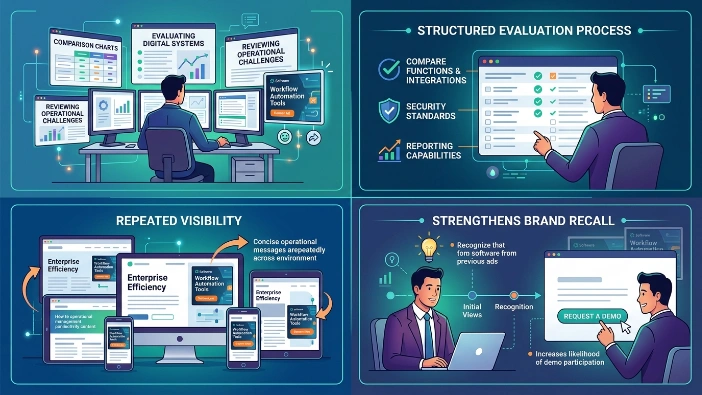
Software purchasing decisions involve structured evaluation processes. Buyers compare functions, integrations, security standards, and reporting capabilities before selecting platforms.
Banner campaigns support this research cycle by presenting concise operational messages repeatedly across digital environments. A procurement manager researching workflow tools sees relevant software banners while reviewing productivity content or operational management articles.
This repeated visibility strengthens brand recall. Buyers recognize previously viewed software during later research stages, increasing the likelihood of demo participation.
Another factor involves informational consistency. Effective banner campaigns present focused operational outcomes instead of broad promotional language. Software buyers prefer measurable business functions such as reporting speed, automation accuracy, or task visibility.
Interactive demonstrations also provide direct product understanding. Buyers gain clearer insight into workflows, dashboards, user interfaces, and integration capabilities during live or recorded demos.
Banner campaigns act as connectors between early awareness and direct software evaluation.
What types of banner campaigns increase demo engagement most effectively?
Software companies use retargeting banners, feature-focused campaigns, industry-specific ads, and account-based advertising to increase demo engagement. Each campaign type targets different stages of software evaluation, helping companies reconnect with interested users and guide them toward deeper product exploration activities.
Retargeting campaigns generate strong engagement because they target users who already visited software-related pages. A user who explored pricing information later sees banners promoting demo sessions or feature walkthroughs.
Feature-focused campaigns highlight one operational function at a time. A project management platform promotes reporting dashboards separately from task automation systems because focused messaging improves user understanding.
Industry-specific banner campaigns improve contextual relevance. Human resources software targeting healthcare organizations uses different messaging than software targeting retail businesses.
Account-based advertising focuses on selected organizations or enterprise segments. These campaigns align banner messaging with company size, operational structure, and industry workflows.
Interactive banner formats also improve engagement. Some software companies use expandable banners containing short interface previews, workflow demonstrations, or onboarding snapshots.
Each campaign structure supports different stages of buyer evaluation and engagement progression.
How do software companies personalise banner campaigns for better engagement?
Software companies personalise banner campaigns by adjusting messaging, visuals, and landing-page experiences according to audience behavior, industry category, and software research activity. Personalisation improves relevance, increases user attention, and strengthens demo participation across different business decision-making groups and operational sectors.
Audience segmentation forms the foundation of personalisation. Marketing teams divide audiences based on company size, operational role, software interest, and business sector.
A logistics management platform uses different banner messaging for warehouse managers than for transportation coordinators because operational priorities differ.
Behavioral targeting also supports personalisation. Users researching analytics systems receive banners focused on reporting functions, while users reading automation content receive workflow-focused advertisements.
Geographic personalisation remains important for United Kingdom campaigns. Software companies align language, compliance references, and operational terminology with UK business environments.
Dynamic banner technology increases relevance further. Banner visuals and messaging automatically adjust according to user behavior or browsing context.
Landing-page consistency also supports engagement. A banner focused on automation reporting directs users toward reporting demonstrations instead of unrelated software sections.
Personalised banner experiences reduce friction during the evaluation process and improve demo interaction quality.
What role do landing pages play in demo engagement campaigns?
Landing pages support demo engagement campaigns by providing focused software explanations, clear operational outcomes, and structured user journeys after banner interactions. Effective landing pages increase demo attendance, improve session completion rates, and help software buyers evaluate relevant product capabilities more efficiently online.
A landing page is a standalone webpage connected directly to a digital advertisement. Software companies design these pages around one engagement objective instead of broad website navigation.
Demo-focused landing pages explain software workflows, interface structures, integration functions, and operational outcomes using concise layouts.
A business analytics platform, for example, uses landing pages containing dashboard previews, reporting examples, and scheduling forms for live demonstrations.
Message consistency improves engagement quality. Users expect the landing-page content to match the banner advertisement they clicked previously.
Interactive elements also increase participation. Companies include short preview videos, interface simulations, or feature tours before demo registration forms.
Form simplicity remains important. Short registration forms improve completion rates because business users avoid lengthy submission processes during research sessions.
Landing pages also support audience qualification. Software companies gather information such as company size, operational role, and business requirements before scheduling demonstrations.
How do software companies measure demo engagement from banner campaigns?
Software companies measure demo engagement using attendance rates, interaction duration, feature exploration metrics, and conversion tracking systems. These measurements help marketing teams understand user behavior, campaign quality, and the relationship between banner visibility and software evaluation performance.
Engagement measurement begins with advertisement performance tracking. Marketing teams monitor impressions, click-through rates, and landing-page visits.
Demo participation metrics provide deeper evaluation insight. Companies track registration completion, live attendance, replay views, and average session duration.
Feature interaction data also matters. Software platforms analyze which workflows, dashboards, or operational tools receive the highest engagement during demonstrations.
A customer support platform, for example, measures how frequently viewers interact with ticket automation features during live walkthroughs.
Lead quality evaluation strengthens campaign analysis further. Companies compare engagement patterns against company size, industry relevance, and purchasing authority.
Attribution systems help identify which banner campaigns generate stronger demo participation. Some campaigns produce high traffic but low engagement, while others generate fewer visitors with higher interaction quality.
Continuous optimization improves long-term results. Software companies test visuals, audience segments, and messaging structures to identify stronger engagement patterns.
Explore More Expert Insights:
How SaaS Platforms Move Users From Awareness to Trial Using Display Ads
How Tech Firms Build Product Interest Using Feature-Focused Banner Ads
Which industries use banner campaigns to increase software demo engagement?
Industries with complex operational systems frequently use banner campaigns to increase software demo engagement. These industries include finance, cybersecurity, healthcare, logistics, education, manufacturing, and human resources because buyers require detailed product evaluation before software adoption decisions.
Finance software providers use banner campaigns to promote accounting systems, reporting dashboards, and compliance automation tools.
Cybersecurity companies rely heavily on demonstration engagement because IT teams evaluate monitoring systems, detection workflows, and incident response functions before procurement decisions.
Healthcare software providers promote scheduling systems, patient management tools, and workflow automation platforms through targeted digital campaigns.
Logistics technology companies use banners to attract warehouse managers, fleet coordinators, and supply chain operators interested in operational visibility.
Education technology platforms advertise learning management systems, assessment dashboards, and remote collaboration tools to academic administrators.
Manufacturing software providers target production managers with banners focused on operational tracking, predictive maintenance, and reporting automation.
These industries depend on demonstrations because software evaluation requires direct visibility into workflows, interface structures, and operational integrations.
How do banner campaigns support the software sales funnel?
Banner campaigns support the software sales funnel by connecting awareness, evaluation, and conversion stages through repeated digital visibility. These campaigns guide users from early product discovery toward active software demonstrations, deeper feature engagement, and later-stage sales interactions within structured buyer journeys.
At the awareness stage, banner campaigns introduce software functions and operational outcomes to targeted audiences. Users discover relevant tools while researching business challenges or digital solutions.
During the evaluation stage, banner advertisements encourage users to engage with demos, webinars, or product walkthroughs. This interaction helps buyers compare operational capabilities directly.
At the engagement stage, software companies use retargeting banners to reconnect with users who previously visited demonstration pages or interacted with product content.
Banner campaigns also improve alignment between marketing and sales teams. Marketing systems collect engagement data before transferring qualified leads into sales pipelines.
A workforce management platform, for example, identifies users who watched full demonstrations and revisited pricing sections before scheduling sales consultations.
This structured progression improves software evaluation efficiency while supporting informed purchasing decisions across business sectors.