

Banner ads in SaaS user acquisition are graphical display advertisements placed across websites and apps to introduce software products to targeted audiences. They deliver visual messages, drive awareness, and generate traffic that feeds structured acquisition funnels for scalable user growth.
Banner ads represent a digital advertising format that combines text, visuals, and interactive design elements. In SaaS environments, these ads appear on third-party websites, mobile apps, and digital platforms where potential users already consume content.
The purpose of banner ads is to capture attention during browsing behaviour. SaaS companies use them at the top stage of marketing funnels to introduce software solutions without requiring prior engagement.
These ads function through programmatic systems that place visuals in high-traffic digital environments. The exposure creates repeated visibility, which builds recognition over time.
Banner ads in SaaS acquisition are not limited to direct conversions. They serve as structured entry points into wider marketing systems where users progress through deeper engagement stages.
Why do SaaS companies rely on banner ads for scalability?
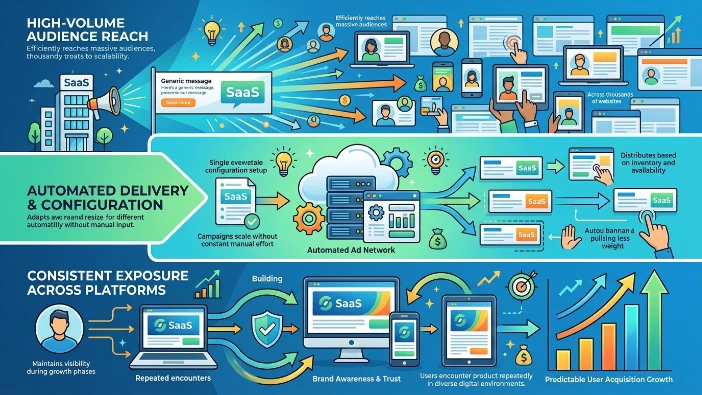
SaaS companies rely on banner ads for scalability because they enable high-volume audience reach, automated delivery, and consistent exposure across multiple platforms. This supports predictable user acquisition growth without proportional increases in manual marketing effort or operational complexity.
Scalability in SaaS depends on the ability to reach large audiences efficiently. Banner ads support this by operating across networks that distribute content to thousands of websites simultaneously.
The automation behind banner ad systems allows campaigns to scale without manual placement. Once configured, ads adjust distribution based on audience availability and platform inventory.
SaaS companies use banner ads to maintain consistent visibility during growth phases. This consistency ensures that potential users encounter the product repeatedly across different digital environments.
Scalability also comes from flexible budget allocation. Campaigns can expand or contract based on performance data, allowing controlled growth.
Banner ads also support geographic scaling, including markets such as the United Kingdom, where SaaS competition requires continuous exposure across professional and consumer digital channels.
How do banner ads support user acquisition funnels in SaaS?
Banner ads support SaaS user acquisition funnels by generating initial awareness, driving traffic to landing environments, and feeding structured engagement systems that move users from discovery to consideration within a measurable conversion pathway.
User acquisition funnels in SaaS consist of sequential stages that guide individuals from awareness to eventual product interaction. Banner ads operate primarily at the awareness stage.
When users encounter banner ads, they are introduced to a SaaS concept without requiring prior intent. This creates the first measurable interaction in the funnel.
After exposure, users may engage by clicking through to informational pages or product descriptions. This transition moves them from passive viewers to active explorers.
Banner ads also contribute to retargeting systems. Users who do not convert initially are re-exposed to refined messaging later in their journey.
Read:
How SaaS Companies Nurture Leads Using Educational Banner Advertising
The funnel structure depends on repeated exposure cycles. Banner ads ensure that SaaS offerings remain visible throughout these cycles, increasing the probability of progression to deeper engagement stages.
What targeting methods make banner ads effective for SaaS growth?
Banner ad effectiveness in SaaS growth depends on targeting methods such as behavioural segmentation, contextual placement, demographic filtering, and intent-based distribution that align ad delivery with audiences most likely to engage with software solutions.
Targeting determines which users see SaaS banner ads. Behavioural segmentation uses browsing history patterns to identify individuals interested in related tools or digital solutions.
Contextual placement aligns ads with content categories. SaaS ads appear alongside business, productivity, or technology-related articles where user relevance is higher.
Demographic filtering uses structured data such as age, profession, and industry. This ensures SaaS products reach decision-makers or professionals within relevant sectors.
Intent-based targeting identifies users actively researching software solutions. This increases the probability of engagement due to existing interest.
These targeting systems operate through automated bidding platforms that evaluate user profiles in real time. The result is efficient allocation of impressions toward higher-value audiences.
SaaS companies combine multiple targeting layers to refine reach precision. This reduces irrelevant impressions and improves acquisition efficiency across large-scale campaigns.
How do banner ads integrate with SaaS marketing systems?
Banner ads integrate with SaaS marketing systems by connecting awareness campaigns with analytics platforms, automation tools, and conversion tracking mechanisms that measure user behaviour and guide optimisation across the entire acquisition lifecycle.
Integration begins with data tracking. Banner ads generate engagement signals such as impressions, clicks, and session duration after interaction.
These signals are transferred into analytics systems that map user journeys. SaaS companies use this data to understand how audiences progress through acquisition stages.
Automation tools then adjust campaign delivery based on performance outcomes. High-performing segments receive increased exposure while low-performing placements are reduced.
Banner ads also connect with email capture systems and onboarding workflows. Once users enter the funnel, additional systems manage their progression toward product usage.
Explore:
How SaaS Companies Convert Warm Leads Into Paid Users Using Retargeting Banner Ads
This integration ensures that banner ads are not isolated marketing elements. They function as part of a connected system where each interaction contributes to structured user lifecycle management.
The result is a unified acquisition architecture that links awareness generation with measurable product engagement outcomes.
Explore More Expert Insights:
How E-commerce Businesses Drive Flash Sale Traffic Using Banner Ads
How E-commerce Brands Boost Checkout Conversions Using Banner Retargeting
What metrics define success in SaaS banner ad acquisition?
Success in SaaS banner ad acquisition is measured through metrics such as impression volume, click-through rate, cost per acquisition, conversion rate, and user activation rate, which collectively indicate campaign efficiency and downstream engagement quality.
Impression volume measures how frequently banner ads are displayed. This metric indicates reach and visibility across digital environments.
Click-through rate measures the percentage of users who interact with ads after viewing them. It reflects message relevance and visual effectiveness.
Cost per acquisition calculates the financial efficiency of converting a user into a defined action. Lower values indicate more efficient scaling.
Conversion rate measures how many users complete desired actions after clicking. This includes sign-ups, trials, or onboarding completions.
User activation rate evaluates how many acquired users engage with core SaaS functionality after entry.
These metrics operate together within performance dashboards. SaaS companies continuously adjust targeting, design, and placement strategies based on these indicators.
The combination of these metrics provides a structured evaluation framework for scalable acquisition performance across banner ad campaigns.
How does SaaS banner advertising evolve with digital ecosystems?
SaaS banner advertising evolves through increased automation, data-driven optimisation, cross-device delivery, and adaptive creative systems that respond dynamically to user behaviour patterns within expanding digital ecosystems.
Modern digital ecosystems include mobile applications, desktop platforms, and integrated web environments. Banner ads now operate seamlessly across all of these channels.
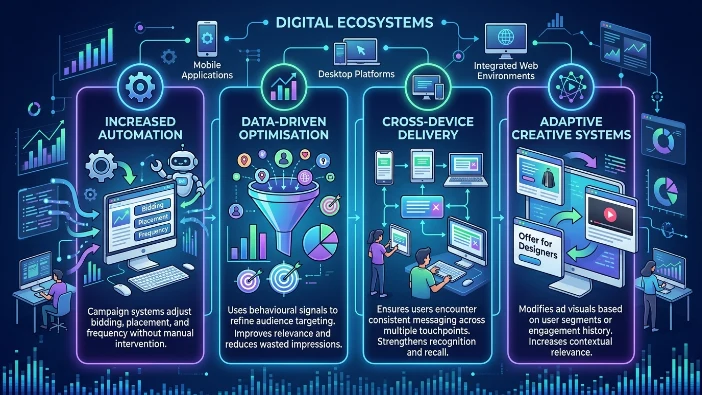
Automation plays a central role in evolution. Campaign systems adjust bidding, placement, and frequency without manual intervention.
Data-driven optimisation uses behavioural signals to refine audience targeting. This improves relevance over time and reduces wasted impressions.
Cross-device delivery ensures that users encounter consistent messaging across multiple touchpoints. This strengthens recognition and recall.
Adaptive creative systems modify ad visuals based on user segments or engagement history. This increases contextual relevance.
These developments transform banner advertising from static exposure tools into dynamic acquisition systems. SaaS companies use this evolution to maintain competitive scalability in crowded digital markets.



