

Repeat purchase banner advertising in e-commerce is a structured digital marketing method where online stores display visual banner messages to existing customers across websites and apps, encouraging them to return and buy again through reminders, product relevance signals, and behavior-based promotional communication strategies.
Repeat purchase banner advertising is a form of digital display communication designed specifically for customers who have already interacted with an e-commerce store. These banners appear on websites, mobile apps, and digital platforms where advertising space is available. The central purpose is to increase the frequency of purchases from users who have already completed at least one transaction.
This system relies on customer data collected during previous interactions. The data includes browsing history, product views, purchase records, and engagement behavior. These signals define what type of products a customer prefers and how often they interact with specific categories.
E-commerce stores use this structured approach to maintain visibility after the initial purchase. Instead of targeting new audiences, the focus remains on existing users who already understand the brand and product quality level. This improves the likelihood of repeated transactions because recognition already exists in the customer’s decision process.
Banner advertising in this context functions as a visual reminder system. It keeps relevant products and categories active in the customer’s awareness cycle. This continuous visibility increases the probability of return visits and additional purchases.
How do banner ads increase repeat purchases in online stores?
Banner ads increase repeat purchases by repeatedly exposing customers to personalized product visuals, triggering recognition memory, reinforcing prior buying behavior, and guiding users back to previously viewed or related products through structured placement across high-traffic digital environments.
Banner advertising influences repeat purchase behavior through consistent exposure. When a customer views a product or completes a purchase, that interaction creates a digital footprint. Banner systems use this footprint to display relevant visuals across different websites and platforms.
This repeated exposure strengthens memory association. When customers see familiar products, the cognitive recall process activates prior interest. This reduces decision time during future shopping sessions because the product already exists in the user’s mental reference framework.
E-commerce systems structure banners based on behavioral segmentation. Customers who purchased electronics see accessory-related banners. Customers who bought clothing see complementary fashion items. This structured alignment between past behavior and new visuals increases relevance.
Another mechanism involves product lifecycle timing. Some banners display replenishment reminders for consumable goods. For example, products with fixed usage durations are reintroduced after expected consumption periods. This creates a natural return cycle.
Banner placement across multiple platforms increases exposure frequency. Customers encounter the same or related product visuals in different browsing environments. This repetition builds familiarity, which strengthens trust in the product category.
The combined effect of memory reinforcement, relevance matching, and repeated exposure forms a behavioral loop that increases repeat purchase probability without requiring active search from the customer.
Read & explore:
How Retailers Educate Customers Using Comparison Banner Advertising
What components make banner advertising effective for repeat buying behavior?
Effective banner advertising for repeat purchases depends on structured audience segmentation, behavioral tracking systems, visual consistency, timing precision, and product relevance mapping that aligns previously purchased items with logically connected future purchase opportunities in a unified data-driven display ecosystem.
Repeat purchase banner effectiveness depends on multiple coordinated components working together within a digital advertising system.
The first component is audience segmentation. Customers are grouped based on purchase frequency, product categories, and engagement levels. Each segment receives different banner content aligned with their buying behavior patterns.
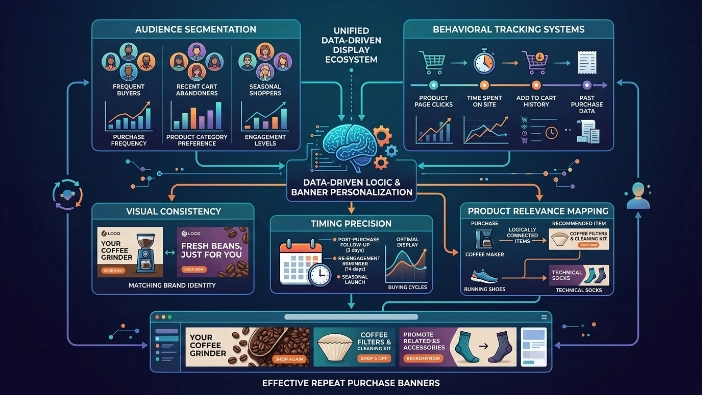
The second component is behavioral tracking. E-commerce platforms collect interaction data such as click activity, time spent on product pages, and cart history. This data defines the type of banner content displayed to each user.
The third component is visual consistency. Banner designs maintain recognizable product imagery, color schemes, and layout structures. Consistency strengthens brand recall and ensures that users immediately associate banners with previous interactions.
The fourth component is timing precision. Banner displays are triggered based on defined behavioral intervals. For example, a product reminder appears after a set period following a purchase or product view event. Timing ensures relevance remains high.
The fifth component is product relationship mapping. Systems connect products that naturally complement each other. If a customer buys a primary product, related items are mapped for future banner exposure. This structured relationship increases logical buying continuation.
These components operate within automated systems that continuously update based on user interaction data. The result is a dynamic advertising environment that adjusts in real time to customer behavior patterns.
Why do repeat purchase banner strategies matter for e-commerce in the United Kingdom?
Repeat purchase banner strategies matter in the United Kingdom because they increase customer retention rates, reduce dependency on new customer acquisition, stabilize revenue cycles, and align with high digital shopping penetration across UK consumers who engage frequently with online retail platforms.
In the United Kingdom, e-commerce markets operate with high competition and strong consumer choice availability. Repeat purchase strategies create stability within this environment by focusing on existing customers rather than continuous acquisition of new users.
Customer retention directly influences revenue consistency. When customers return for additional purchases, sales patterns become more predictable. Banner advertising supports this by maintaining ongoing engagement between purchase cycles.
UK consumers show high digital platform usage across retail categories including fashion, electronics, groceries, and home goods. This creates a large data environment where banner systems operate effectively through behavioral tracking and targeted display logic.
Repeat purchase banner strategies also reduce marketing cost inefficiencies. Acquiring new customers typically requires higher investment compared to re-engaging existing ones. Banner systems use existing data infrastructure to reduce unnecessary exposure to irrelevant audiences.
Another factor involves shopping frequency behavior in UK digital markets. Many customers revisit platforms multiple times before making new purchases. Banner exposure during this period influences final purchase decisions by maintaining product visibility.
E-commerce ecosystems in the UK rely heavily on structured digital advertising flows. Banner systems integrate into this ecosystem by acting as continuous engagement tools rather than one-time promotional displays.
This creates a stable cycle where customer interaction continues beyond the first purchase, forming a repeat behavior loop that strengthens long-term platform performance.
Read & explore:
How Retailers Increase Final Purchase Rates Using Time-Sensitive Banner Campaigns
How does banner advertising shape long-term repeat purchase behavior patterns?
Banner advertising shapes long-term repeat purchase behavior by continuously reinforcing product familiarity, building structured recall pathways, and aligning future product exposure with past transaction history, resulting in predictable and sustained purchasing cycles across digital retail environments.
Long-term behavior formation depends on repeated exposure to consistent product signals. Banner advertising provides this exposure through automated systems that track and respond to user actions over time.
When customers see related products repeatedly, recognition strengthens. This reduces the cognitive effort required to evaluate similar items in future shopping sessions. Familiarity becomes a key driver of decision-making.
Banner systems also create structured recall pathways. These pathways connect previous purchases with future product suggestions. Over time, customers begin associating specific product categories with recurring needs.
The accumulation of exposure events builds purchasing patterns. Each interaction reinforces previous behavior, making repeat purchases more likely. This process operates continuously without requiring direct customer action.
In digital retail environments, this structured exposure system becomes part of the overall customer experience architecture. It ensures that engagement continues beyond the initial transaction phase.
Explore More Expert Insights:
How E-commerce Platforms Scale Revenue Using High-Performance Banner Ads
How E-commerce Companies Increase Seasonal Sales Using Banner Ads
How do e-commerce banner systems integrate across digital platforms?
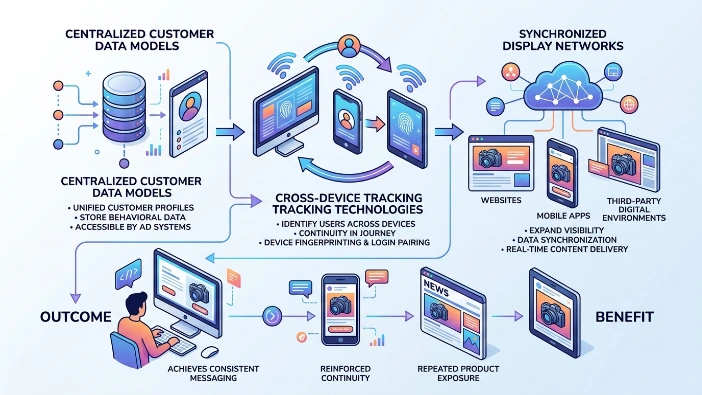
E-commerce banner systems integrate across digital platforms by using centralized customer data models, cross-device tracking technologies, and synchronized display networks that distribute consistent product messaging across websites, applications, and third-party digital environments.
Integration across platforms ensures that customers receive consistent messaging regardless of where they browse. Centralized data models store user behavior in unified profiles that can be accessed by multiple advertising systems.
Cross-device tracking allows banner systems to identify users across mobile phones, desktops, and tablets. This ensures continuity in product exposure regardless of device changes.
Display networks distribute banner content across multiple websites and applications. This expands visibility beyond the original e-commerce platform while maintaining relevance through data synchronization.
The system ensures that repeat purchase messaging remains consistent. A customer who views a product on one device encounters related banners on another, reinforcing continuity.
This integration strengthens the repeat purchase cycle by maintaining uninterrupted exposure across digital environments.
Where does repeat purchase banner advertising fit in the e-commerce customer journey?
Repeat purchase banner advertising fits into the post-purchase and retention phase of the e-commerce customer journey, where it maintains engagement, reinforces product awareness, and directs customers back into the consideration stage for additional purchases based on previous buying behavior signals.
The customer journey in e-commerce consists of multiple phases including awareness, consideration, purchase, and retention. Banner advertising plays a key role after the initial purchase.
In the retention phase, customers are no longer actively searching but remain open to relevant product suggestions. Banner systems operate within this phase by displaying targeted visual content.
These banners reintroduce product categories related to previous purchases. This movement brings customers back into the consideration phase without requiring new search behavior.
Over time, this cycle repeats, creating a structured loop between retention and consideration. This loop defines the repeat purchase structure in digital commerce environments.



