
Remarketing ads influence buying decisions by reconnecting e-commerce platforms with users who previously interacted with products, categories, or websites. These ads reinforce product awareness, increase familiarity, and guide users toward purchase completion through repeated, behavior-based advertising exposure across digital platforms.
Remarketing ads are digital advertisements shown to users after a previous online interaction. These interactions include viewing product pages, adding items to carts, searching categories, or visiting checkout pages.
E-commerce platforms use remarketing systems to track user activity through cookies, audience pixels, and behavioral identifiers. This data allows advertisers to display relevant ads after users leave the original website.
In the United Kingdom, remarketing campaigns commonly appear across search engines, news websites, video platforms, and mobile applications. This repeated visibility maintains product awareness during the decision-making process.
Buying decisions are influenced through familiarity and repeated exposure. Users who repeatedly encounter relevant products are more likely to revisit the platform and continue the purchasing journey.
That article explains how display banner campaigns support traffic quality and ROAS improvement before remarketing begins.
How does the remarketing process work in e-commerce advertising systems?
The remarketing process works by collecting user interaction data, segmenting audiences based on behavior, and serving personalized advertisements across digital channels. This structured advertising cycle reconnects e-commerce platforms with users who already demonstrated measurable purchase interest through prior engagement activities.
The process begins when a user visits an e-commerce website. Tracking technologies record actions such as product views, search queries, and checkout abandonment.
This behavioral data enters an audience management system. Users are then grouped into segments based on interaction type and engagement depth.
A user who viewed running shoes enters a different audience segment than a user who abandoned a furniture checkout page. Each segment receives different remarketing messages.
Ads are distributed through automated advertising exchanges. Platforms purchase ad impressions in real time to display products previously viewed by users.
Remarketing systems operate across desktop devices, mobile applications, and connected browsers. This cross-device visibility increases continuity throughout the customer journey.
Why do repeated product exposures affect online purchasing behaviour?
Repeated product exposures affect online purchasing behaviour because they strengthen product recognition, maintain commercial relevance, and reinforce previous browsing intent. Continuous visibility reduces decision interruption and increases the likelihood of users returning to complete unfinished transactions on e-commerce platforms.
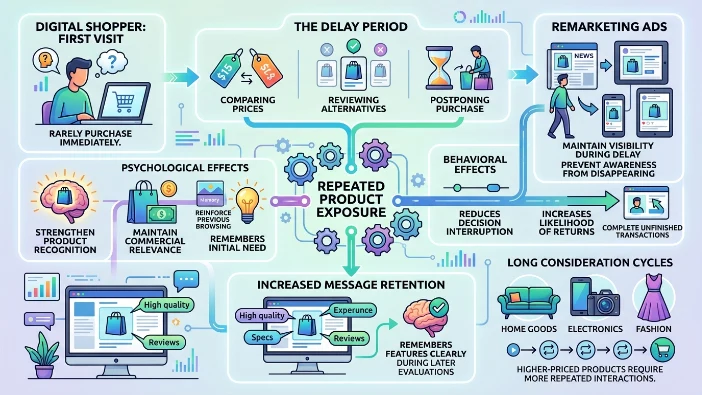
Digital shoppers rarely purchase during their first website visit. Many users compare prices, review alternatives, or postpone purchases before making a final decision.
Remarketing ads maintain visibility during this delay period. They prevent product awareness from disappearing after users leave the website.
Repeated exposure also increases message retention. A user who sees the same product multiple times remembers its features more clearly during later purchase evaluations.
In UK e-commerce sectors such as fashion, electronics, and home goods, remarketing often supports long consideration cycles. Higher-priced products usually require more repeated interactions before purchase completion occurs.
Consistent visibility across websites and mobile apps keeps products within the consumer decision environment. This sustained presence directly influences buying continuity.
How does display remarketing support buyer engagement?
Display remarketing uses visual banner advertisements to reconnect with previous website visitors across external websites and digital platforms. These ads increase visibility and maintain product awareness after users leave the original e-commerce environment.
Display remarketing focuses on visual reinforcement. Ads appear on publisher websites, blogs, news portals, and mobile apps.
These advertisements commonly contain product images, promotional messaging, and category reminders linked to prior browsing behavior.
Display remarketing is widely used for apparel products, home accessories, and seasonal retail campaigns in the UK digital commerce market.
How does dynamic remarketing personalize buying experiences?
Dynamic remarketing personalizes buying experiences by automatically generating advertisements based on exact products users previously viewed. This personalization increases relevance and improves the connection between browsing intent and advertising exposure.
Dynamic remarketing systems pull product data directly from inventory feeds. The advertisement changes according to user activity.
A user who viewed black trainers sees those same trainers in future advertisements instead of unrelated products. This direct relevance improves engagement consistency.
Dynamic campaigns are common in electronics, beauty products, and travel-related e-commerce categories where product comparison behavior is frequent.
How does search remarketing influence purchase intent?
Search remarketing targets users through paid search advertisements after previous website interactions. It aligns advertising exposure with active search intent, increasing the probability of returning visits and transaction completion.
Search remarketing activates when users perform related searches after leaving a website.
For example, a user who searched “wireless headphones UK” and previously visited an electronics store may later see paid search advertisements from that same retailer.
This strategy combines browsing history with active search intent signals, creating stronger commercial relevance.
How do audience segmentation strategies improve remarketing performance?
Audience segmentation improves remarketing performance by organizing users according to behavior patterns, purchase intent, and engagement depth. Segmented advertising increases relevance, improves click-through rates, and strengthens conversion efficiency across e-commerce marketing campaigns.
Segmentation divides audiences into structured behavioral groups. Each group receives different advertising messages based on user activity.
Users who abandoned checkout pages represent high-intent segments. Users who viewed category pages without deeper engagement represent lower-intent segments.
Remarketing systems also segment by time duration. A user who visited within the last 24 hours receives different ad frequency compared to a user inactive for 30 days.
In UK e-commerce advertising, segmentation frequently includes mobile shoppers, repeat visitors, seasonal buyers, and cart abandoners.
This structured targeting improves ad relevance because users receive advertisements aligned with their stage in the purchasing journey.
For readers exploring how returning visitors convert into completed transactions, explore [Insert Link to BOFU Article]. That article explains how remarketing campaigns support final-stage customer conversion strategies.
What role does personalisation play in influencing customer decisions?
Personalization influences customer decisions by aligning advertisements with individual browsing activity, purchase interest, and product preferences. Personalized remarketing increases relevance, improves engagement accuracy, and strengthens the relationship between advertising exposure and user intent in e-commerce systems.
Personalized advertising adapts creative elements according to user behavior. This includes product images, pricing displays, category suggestions, and promotional messaging.
A customer browsing winter jackets receives different advertisements than a customer browsing kitchen appliances. This behavioral alignment improves contextual accuracy.
Personalization also affects timing. Ads displayed shortly after website visits generally produce higher engagement rates because product interest remains active.
In UK online retail markets, personalization is widely integrated into mobile commerce campaigns where browsing sessions are shorter but more frequent.
Higher personalization levels increase engagement consistency because users interact with advertisements that reflect previously demonstrated interests.
Explore More Expert Insights:
How Retailers Increase Product Consideration Using Banner Advertising Funnels
How E-commerce Businesses Warm Up Leads Through Dynamic Display Ads
How do remarketing ads support multi-stage e-commerce conversion journeys?
Remarketing ads support multi-stage e-commerce conversion journeys by reconnecting with users during awareness, consideration, and purchase phases. They maintain communication continuity across fragmented browsing sessions and reduce customer drop-off throughout digital buying processes.
The modern e-commerce journey involves multiple sessions across different devices. A customer often begins browsing on mobile devices and completes purchases later on desktop platforms.
Remarketing bridges these fragmented interactions. It keeps products visible during transitions between sessions and devices.
At the awareness stage, remarketing reinforces category visibility. During consideration, it highlights viewed products and pricing relevance. At the purchase stage, it encourages return visits and checkout completion.
This structured communication flow improves continuity across the entire buying process.
For users researching foundational awareness strategies, read:
How E-commerce Businesses Improve ROAS Using Display Banner Campaigns
For users evaluating final-stage conversion tactics, explore:
How E-commerce Platforms Turn Returning Visitors Into Paying Customers Using Remarketing Campaigns.
This progression creates a complete funnel understanding from traffic acquisition to purchase conversion.
Why are remarketing ads important for modern UK e-commerce platforms?
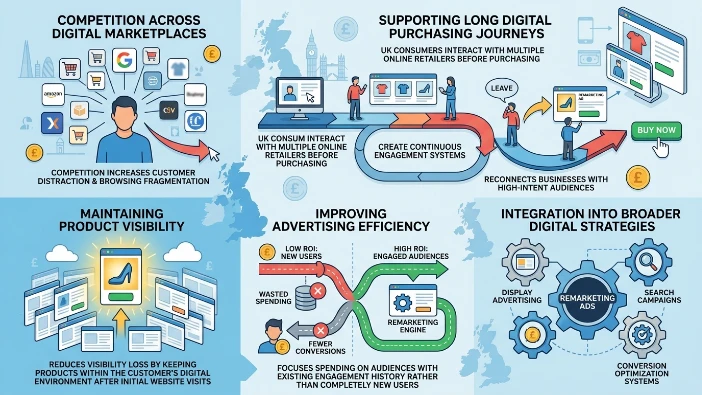
Remarketing ads are important for modern UK e-commerce platforms because they improve customer retention, maintain product visibility, and support long digital purchasing journeys. They create continuous engagement systems that reconnect businesses with high-intent audiences across competitive online retail environments.
UK consumers interact with multiple online retailers before purchasing. Competition across digital marketplaces increases customer distraction and browsing fragmentation.
Remarketing reduces visibility loss by keeping products within the customer’s digital environment after initial website visits.
These campaigns also improve advertising efficiency. Platforms focus spending on audiences with existing engagement history rather than completely new users.
Modern e-commerce platforms integrate remarketing into broader digital strategies that include display advertising, search campaigns, and conversion optimization systems.
This integration supports stronger customer retention and improved purchase continuity across competitive retail ecosystems.