

Cart abandonment is the process where online shoppers add products to a digital shopping cart but leave the website without completing the purchase. It occurs due to price comparison, delivery concerns, payment friction, and delayed purchase decisions during checkout processes.
Cart abandonment is a critical stage in e-commerce conversion systems. A shopping cart represents intent. It contains selected products, quantities, and planned purchases. When users exit before checkout completion, the transaction remains incomplete.
E-commerce platforms in the United Kingdom experience cart abandonment rates between 60 percent and 75 percent depending on industry category. Fashion, electronics, and home goods sectors show higher abandonment due to comparison-driven behaviour.
Shoppers often leave carts because they evaluate alternative retailers, review shipping costs, or postpone purchase decisions. This creates a conversion gap between product selection and final payment.
Urgency-based banner advertising targets this gap directly through time-sensitive messaging and behavioural re-engagement.
Readers can review early funnel strategies to understand:
How Retailers Increase Product Consideration Using Banner Advertising Funnels
How do urgency-based banner ads work for cart recovery?
Urgency-based banner ads work by re-engaging users who abandoned their shopping carts through time-sensitive messages, limited availability signals, and reminder-based display advertising. These ads create immediate purchase motivation by reintroducing incomplete transactions across digital platforms.
Urgency-based banner advertising belongs to the BOFU stage of the e-commerce funnel. BOFU stands for Bottom of Funnel. It focuses on conversion completion.
The system activates when a user exits a checkout process without purchasing. Advertising platforms then display personalised banner ads across websites, mobile apps, and digital networks.
These banners often include:
- Cart product reminders
- Limited stock alerts
- Delivery deadline messaging
- Price stability notifications
- Checkout continuation prompts
A user who added running shoes to a cart, for example, later sees banner ads showing the exact shoes with a message indicating remaining stock availability or delivery timing.
This direct connection between product and message reduces decision delay and increases return visits to checkout pages.
Urgency-based messaging creates a structured push toward immediate transaction completion.
What types of urgency signals are used in banner ads?
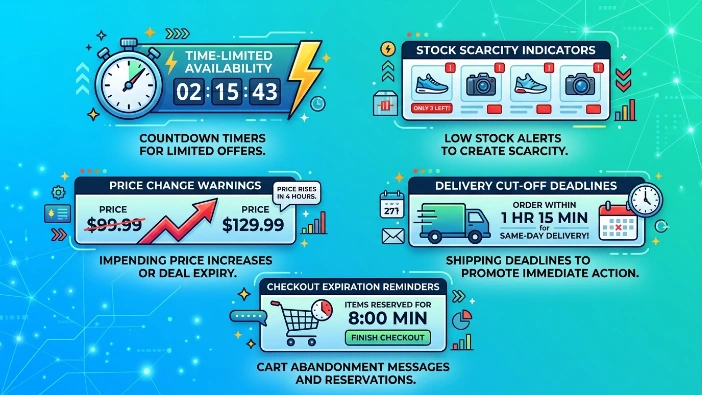
Urgency signals in banner ads include time-limited availability, stock scarcity indicators, price change warnings, delivery cut-off deadlines, and checkout expiration reminders. These signals create structured time pressure that influences abandoned cart recovery behaviour in e-commerce systems.
Urgency signals operate through informational triggers rather than promotional language.
Common urgency categories include:
- Stock-based urgency
- Time-based urgency
- Price-based urgency
- Checkout session reminders
- Delivery deadline urgency
Stock-based urgency displays remaining product quantity. A banner may show that only a limited number of items remain in inventory.
Time-based urgency highlights countdown periods such as same-day dispatch cut-offs or limited promotional windows.
Price-based urgency informs users about upcoming price changes or temporary price locks associated with abandoned carts.
Delivery urgency highlights shipping deadlines such as next-day delivery availability for completed purchases.
These signals guide users back into the purchase process with clear temporal constraints.
How do retargeting systems support cart abandonment recovery?
Retargeting systems support cart abandonment recovery by tracking user activity on e-commerce websites and displaying personalised banner ads across external platforms. These systems reconnect users with previously viewed or selected products to encourage checkout completion.
Retargeting uses tracking identifiers such as cookies or device signals to monitor user behaviour.
When a user adds products to a cart and exits the website, the system records this action. Later, the user encounters banner advertisements featuring the same products.
This process ensures continuity between browsing behaviour and advertising exposure.
A shopper browsing smartphones, for example, sees banner ads displaying the same device along with purchase reminders while visiting news websites or entertainment platforms.
Retargeting systems also support cross-device advertising. A user browsing on mobile may later see banner ads on desktop devices.
This multi-device consistency increases cart recovery probability.
Why do urgency-based banner ads increase checkout completion rates?
Urgency-based banner ads increase checkout completion rates by reducing decision delays, reinforcing purchase intent, and re-establishing product relevance during post-abandonment browsing sessions. These ads shorten the time between cart exit and return to checkout pages.
Cart abandonment often results from delayed decision-making. Users pause purchases to compare prices, review reviews, or consider alternatives.
Urgency messaging reduces this delay.
When users receive repeated reminders that a cart is incomplete or time-sensitive, cognitive focus returns to the product.
A fashion retailer, for example, uses urgency banners displaying limited stock availability for selected clothing items. Users return to checkout pages at higher frequency after repeated exposure.
The urgency effect operates through structured repetition across multiple browsing sessions.
Banner frequency also influences outcomes. Multiple exposures across different websites strengthen recall and increase likelihood of return visits.
What role does behavioural data play in banner campaigns?
Behavioural data determines how urgency-based banner ads are triggered and displayed. It includes cart activity, product interaction patterns, session duration, and checkout progression signals that define when a user qualifies for BOFU retargeting campaigns.
Behavioural data reflects real-time user actions.
Key behavioural indicators include:
- Add-to-cart events
- Checkout initiation
- Product page revisits
- Cart value size
- Exit points during checkout
A user who reaches payment selection but exits the page triggers a high-intent signal. This signal activates BOFU banner campaigns.
A user who only browses product pages without cart activity receives MOFU-level advertising instead.
BOFU targeting ensures urgency messaging is applied only when purchase intent is already established.
This improves advertising efficiency and reduces irrelevant exposure.
Retailers in the United Kingdom use behavioural segmentation to separate high-intent users from general browsers.
How do different industries use urgency-based cart recovery banners?
Industries with high purchase comparison behaviour use urgency-based banner ads extensively for cart recovery. Fashion, electronics, travel services, home goods, and subscription-based e-commerce platforms rely on urgency messaging to recover incomplete transactions.
Fashion retailers use urgency banners to highlight limited-size availability and seasonal stock constraints.
Electronics retailers display urgency messages based on high-demand product availability and price fluctuation cycles.
Travel platforms use urgency banners showing limited seat availability or booking expiration timelines.
Home goods retailers display reminders for abandoned furniture or appliance purchases with delivery scheduling constraints.
Subscription platforms use urgency messaging based on trial expiration or incomplete signup processes.
Each industry applies urgency differently based on product lifecycle and purchase behaviour.
These systems operate within structured e-commerce funnel models.
How does banner design influence cart abandonment recovery?
Banner design influences cart abandonment recovery by structuring visual hierarchy, product visibility, urgency clarity, and mobile responsiveness. Effective design ensures abandoned cart messages are immediately recognisable and easy to interpret across multiple digital platforms.
Design determines how quickly users understand urgency messaging.
Effective urgency-based banners include:
- Clear product image repetition
- Prominent cart reminder text
- High contrast urgency indicators
- Simplified layout structure
- Mobile-first formatting
A cluttered design reduces message clarity and lowers re-engagement rates.
Mobile optimisation is critical because a large portion of cart abandonment occurs on smartphones. Banner ads must display product details clearly on small screens.
A consistent design structure across multiple ad placements improves recognition and recall during repeated exposure.
Explore More Expert Insights:
How E-commerce Businesses Drive Instant Purchase Decisions Using High-Intent Display Retargeting
How Online Stores Turn Product Viewers Into Checkout Customers Using Dynamic Banner Ads
How do timing and frequency affect cart recovery performance?
Timing and frequency control how often and when urgency-based banner ads appear after cart abandonment. Early re-engagement within 24 hours and structured frequency intervals increase return visits to checkout pages and improve conversion completion rates.
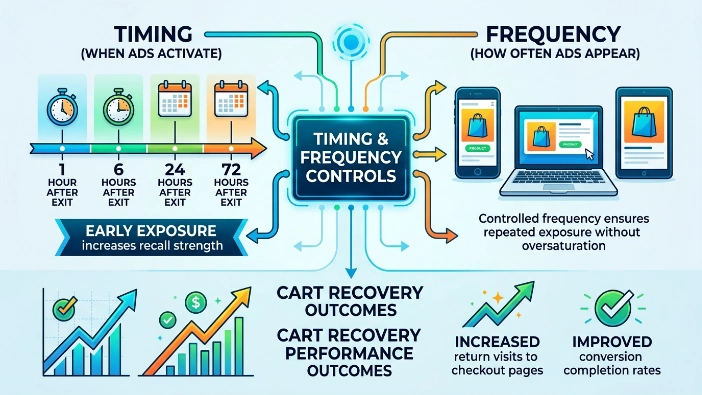
Timing defines when ads activate after cart abandonment.
Common activation windows include:
- 1 hour after exit
- 6 hours after exit
- 24 hours after exit
- 72 hours after exit
Early exposure increases recall strength.
Frequency defines how many times a user sees the same banner across different platforms. Controlled frequency ensures repeated exposure without oversaturation.
A user seeing the same product reminder across three separate websites within 48 hours demonstrates stronger re-engagement probability than a single exposure.
Timing and frequency are managed through automated advertising systems that adjust exposure based on user response behaviour.
Readers can explore to understand:
How E-commerce Brands Drive Product Page Traffic with Banner Ads
What metrics measure urgency-based banner ad success?
Urgency-based banner ad success is measured using cart recovery rate, conversion rate after click, return-to-checkout frequency, impression-to-click ratio, and revenue recovered per abandoned cart segment in e-commerce tracking systems.
Key performance metrics include:
- Cart recovery rate
- Click-through rate
- Conversion rate after retargeting
- Return visit frequency
- Revenue per recovered user
Cart recovery rate measures how many abandoned carts result in completed purchases after retargeting exposure.



