

Dynamic banner ads are personalised display advertisements that automatically show products a user previously viewed, including live pricing, images, and availability, across websites and apps. They support checkout optimisation by maintaining product visibility and reinforcing purchase intent across digital touchpoints.
Dynamic banner ads operate through automated advertising systems integrated with e-commerce product catalogues. Each product in the catalogue contains structured data such as title, image, price, and stock status. This data feeds directly into banner templates that render personalised creatives in real time.
These ads differ from static display ads because content updates automatically. When a product price changes or stock updates, the banner reflects the new information instantly. This ensures accuracy across all advertising placements.
Checkout optimisation occurs when these ads reduce the gap between product discovery and purchase completion. Users who leave a product page continue to see the same item across external platforms, maintaining continuity in the buying process.
Dynamic banners function across programmatic advertising networks, including websites, mobile apps, and content platforms. This distributed delivery ensures product visibility beyond the original e-commerce session.
How do dynamic banner ads convert product viewers into buyers?
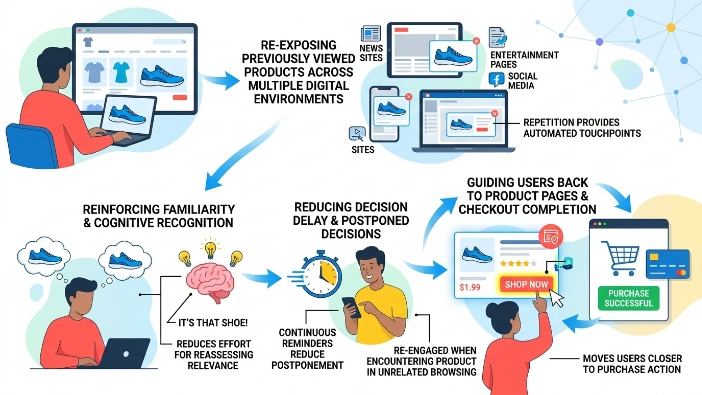
Dynamic banner ads convert viewers into buyers by re-exposing previously viewed products during browsing sessions, reinforcing familiarity, reducing decision delay, and guiding users back to product pages where checkout completion occurs through repeated exposure and structured purchase signals. flow optimization
Conversion occurs through repetition of product exposure across multiple digital environments. Users who interact with a product once often require multiple touchpoints before purchase. Dynamic banners provide these touchpoints automatically.
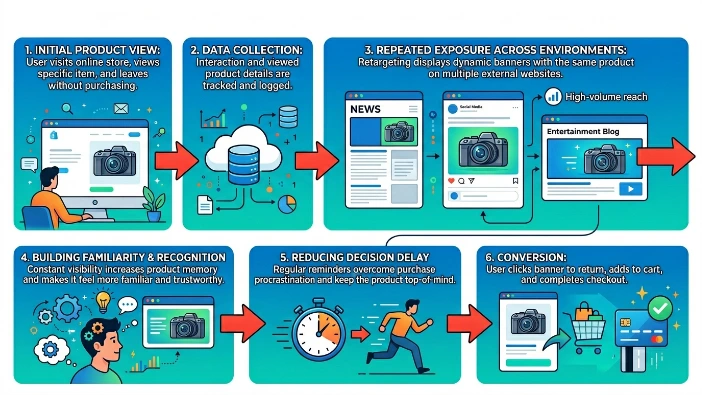
Familiarity plays a central role. When users repeatedly see the same product, cognitive recognition increases. This reduces the effort required to reassess product relevance and moves users closer to purchase action.
Decision delay is reduced through continuous reminders. Users who postpone checkout decisions are re-engaged when they encounter the same product in unrelated browsing sessions such as news or entertainment websites.
These ads also act as structured navigation signals. Each banner click returns users directly to the original product page, removing friction in the journey from interest to checkout completion.
Explore:
How E-commerce Stores Boost Sales Using Retargeting Banner Ads
What data powers dynamic banner ad personalisation?
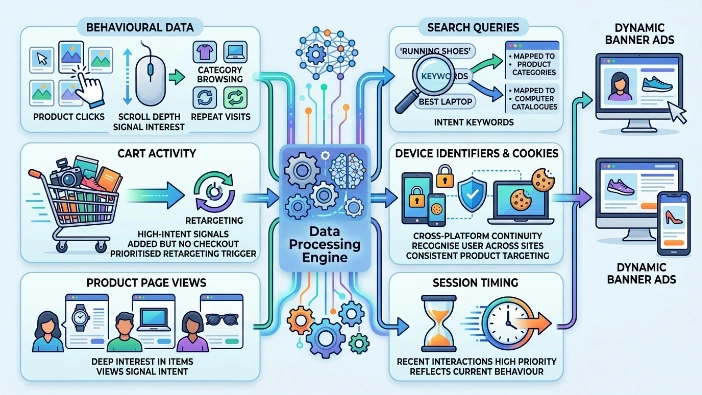
Dynamic banner ad personalization uses behavioural data, cart activity, product page views, search queries, device identifiers, and session timing to match users with relevant products. This structured data enables precise targeting and ensures ads reflect real-time user engagement patterns accurately.
Behavioural data includes all interactions users perform on an e-commerce platform. Product clicks, scroll depth, category browsing, and repeat visits signal interest levels for specific items.
Cart activity provides high-intent signals. When users add products to carts but do not complete checkout, this behaviour triggers prioritised retargeting within dynamic banner systems.
Search queries are mapped to product categories. For example, searches for “running shoes” are matched with footwear catalogues, enabling relevant banner generation based on intent keywords.
Device identifiers and cookies ensure continuity across platforms. This allows systems to recognise users across multiple websites and maintain consistent product targeting throughout their browsing journey.
Session timing also influences ad delivery. Recent interactions receive higher priority, ensuring that product relevance reflects current user behaviour patterns.
How does real-time product syncing improve checkout conversions?
Real-time product syncing updates dynamic banners instantly with current product prices, stock levels, and availability. This ensures users see accurate purchase information, reduces checkout friction, and improves conversion rates by maintaining consistency between displayed ads and live e-commerce inventory systems.
Real-time syncing connects product databases directly to advertising platforms. Any change in product data is reflected immediately across all active banner placements.
Price updates are critical for conversion accuracy. Users often abandon purchases when they encounter mismatched pricing. Real-time syncing eliminates this inconsistency by ensuring uniform pricing across all channels.
Stock level integration prevents wasted clicks. If an item becomes unavailable, banners stop displaying or switch to similar products, maintaining relevance and reducing user frustration.
Inventory consistency strengthens trust in the purchase process. Users who click on banners expect identical product conditions on landing pages, and real-time syncing ensures this alignment.
This system reduces drop-off between ad exposure and checkout completion by maintaining accurate product representation throughout the user journey.
What role does cart behavior play in dynamic banner targeting?
Cart behaviour signals high purchase intent in e-commerce systems. Dynamic banner targeting uses cart additions, removals, and abandonment events to trigger personalised ads that display exact products left in carts, encouraging users to return and complete checkout processes efficiently targeted
Cart behaviour is one of the strongest predictors of purchase intent. When users place items in carts, they demonstrate clear transactional interest.
Cart abandonment triggers automated banner campaigns. These campaigns display the exact products left in the cart, reinforcing memory of incomplete actions and encouraging return visits.
Removals and modifications also provide behavioural signals. When users adjust cart contents, dynamic systems update banner content to reflect the most relevant remaining items.
This targeting ensures that ads remain aligned with current user intent rather than outdated browsing behaviour. It increases precision in product messaging across advertising networks.
Cart-based targeting also supports multi-device continuity. Users who abandon carts on mobile devices receive reminders on desktop platforms, maintaining consistent product exposure.
Read:
How Online Stores Nurture Shoppers Using Product-Focused Banner Campaigns
How do dynamic banner ads reduce checkout abandonment?
Dynamic banner ads reduce checkout abandonment by reminding users of incomplete purchases through repeated exposure to viewed products, cart items, and pricing updates. This maintains purchase intent visibility and encourages users to resume checkout processes across multiple browsing sessions continuously
Checkout abandonment occurs when users leave during payment or cart review stages. Dynamic banners re-engage these users by displaying exact products associated with abandoned sessions.
Repeated exposure increases return probability. Users encounter the same products across different platforms, which keeps purchase intent active over time.
Pricing updates also play a role. When users see consistent or improved pricing conditions, hesitation decreases and return visits increase.
These ads act as structured reminders that reconnect users with incomplete transactions. Each impression reinforces the existence of unfinished checkout activity.
This mechanism reduces time between abandonment and return, increasing the likelihood of completed transactions in subsequent sessions.
Explore More Expert Insights:
Get High-Converting Animated Banner Ads on UK News Sites
How E-commerce Brands Convert High-Intent Shoppers Into Immediate Buyers Using Retargeting Ads
What metrics measure success of dynamic banner ads?
Success of dynamic banner ads is measured using click-through rate, conversion rate, return visits, cart recovery rate, impression frequency, and post-click engagement. These metrics evaluate how effectively personalised ads drive users from product viewing to completed checkout actions outcomes reliably
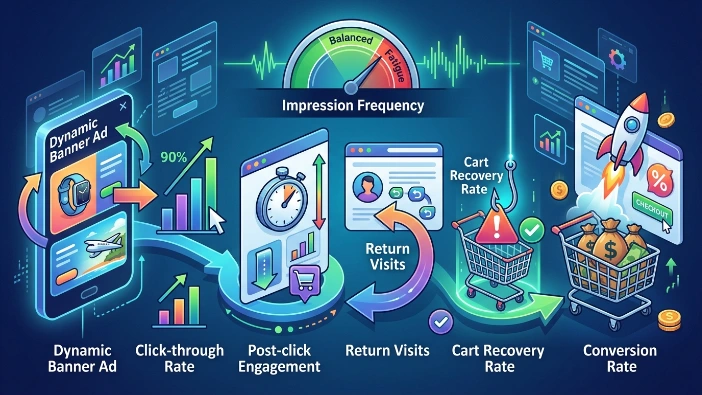
Click-through rate measures how often users interact with banner ads after exposure. Higher rates indicate stronger product relevance.
Conversion rate tracks completed purchases after ad engagement. This metric directly connects banner exposure to revenue outcomes.
Return visits measure how often users revisit product pages after seeing dynamic ads. This reflects effectiveness in re-engagement.
Cart recovery rate evaluates how many abandoned carts are completed after banner exposure. This is a key metric for checkout optimisation.
Post-click engagement includes time spent on product pages and additional browsing activity, showing depth of user interest after interaction.
Impression frequency ensures controlled exposure levels. Balanced frequency improves engagement without causing ad fatigue.
Why are dynamic banner ads critical in UK e-commerce growth?
Dynamic banner ads are critical in UK e-commerce growth because they increase conversion efficiency, improve product recall, reduce abandonment rates, and support multi-device shopping journeys. They align real-time inventory with user behaviour across large-scale digital retail environments effectively at scale
UK e-commerce platforms operate across multiple devices and high traffic volumes. Dynamic banner ads maintain product visibility across this fragmented environment.
Conversion efficiency improves when users receive repeated exposure to relevant products across external platforms. This increases the probability of purchase completion.
Product recall strengthens when users encounter consistent product messaging across multiple websites. This reduces decision delays in competitive retail categories.
Abandonment rates decrease when users are reminded of incomplete purchases through structured banner campaigns. These reminders reconnect users with previously viewed products.
Multi-device behaviour is common in UK digital retail. Users often switch between mobile, desktop, and tablet devices before completing purchases. Dynamic banners maintain continuity across these transitions.



