
Sponsored content consists of paid articles or posts that media outlets publish on behalf of brands. Brands pay for placement, and outlets label the content as sponsored. This format peaked in 2015 with 75% of marketers using it, according to a 2016 Content Marketing Institute report.
Sponsored content integrates brand messages into editorial formats. Publishers create or ghostwrite the material. Readers encounter it in native ad slots on websites, newsletters, or social feeds. The Federal Trade Commission mandates disclosure labels like “Sponsored” or “Paid Post” in the UK under the Advertising Standards Authority rules.
Key characteristics of sponsored content
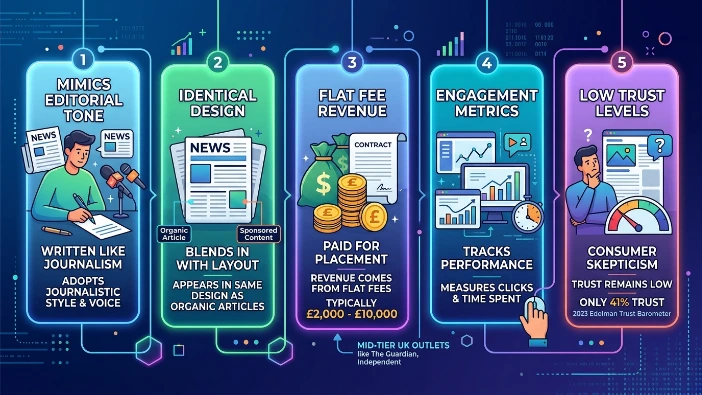
Sponsored content mimics editorial tone. It appears in the same design as organic articles. Revenue comes from flat fees, typically £2,000 to £10,000 per piece for mid-tier UK outlets like The Guardian or Independent. Engagement metrics track clicks and time spent, but trust levels remain low at 41%, per a 2023 Edelman Trust Barometer.
Historical rise of sponsored content
Marketers adopted sponsored content post-2012 ad-blocker surge. Native ads grew 94% year-over-year by 2014, reports IAB UK. Brands shifted from banner ads due to 0.05% click-through rates.
Why has sponsored content declined?
Sponsored content declined due to reader skepticism, algorithm changes, and poor ROI. Trust dropped 20% from 2018 to 2023, with only 28% of UK consumers engaging, per YouGov data. Google’s 2022 Helpful Content Update penalized low-value paid posts.
Readers detect branded intent quickly. A 2024 Reuters Institute study found 62% of UK audiences skip labeled sponsored articles. Platforms like Google deprioritize them in search results. Marketers report 3x lower conversion rates compared to organic coverage.
Algorithm impacts on sponsored content
Google’s E-E-A-T framework (Experience, Expertise, Authoritativeness, Trustworthiness) ranks content. Sponsored pieces score low on expertise signals. In 2023, sites over-reliant on sponsored content saw 45% traffic drops post-update.
ROI measurement failures
Sponsored content yields 1.5% average engagement versus 4.2% for earned media, states a 2024 Marketing Week analysis. Costs rose 15% annually while attribution tools failed to link to sales.
What are media partnerships?
Media partnerships involve long-term collaborations between brands and outlets. Partners co-create content, share data, and align narratives over 6-12 months. This model generates 5x more backlinks and 3x higher domain authority than one-off sponsored posts.
Media partnerships extend beyond single payments. Outlets and brands form alliances for mutual benefit. Examples include co-branded research reports or exclusive event coverage. The UK’s Press Gazette notes 40% growth in such deals since 2021.
Core elements of media partnerships
Partnerships require signed agreements outlining content calendars, KPIs, and revenue shares. Brands provide expertise; outlets supply audience reach. Duration averages 12 months, with quarterly reviews.
Differences from sponsored content
Sponsored content remains transactional. Media partnerships build reciprocity. Partners exchange value: brands offer data insights, outlets provide amplification.
For a deeper dive into structuring these alliances: Explore the
5 Step Framework for Aligning Your Narrative With a Media Partner
How do media partnerships work in practice?
Media partnerships follow a four-step process: alignment, co-creation, distribution, and measurement. Brands pitch value propositions; outlets select fits; teams produce assets; results inform renewals. This yields 2.7x ROI over sponsored models.
The process starts with mutual vetting. Brands identify outlets via audience overlap tools like SimilarWeb. Initial meetings define goals, such as 20% traffic uplift or 50 qualified leads.
Step 1: Alignment phase
Partners map objectives. Brands share audience personas; outlets provide reach data. Contracts specify 4-6 deliverables per quarter.
Step 2: Co-creation and approval
Joint teams develop content. Brands input data; editorial teams refine. Approvals occur in 48 hours to maintain freshness.
Step 3: Multi-channel distribution
Content launches across newsletters, podcasts, and social. Partners cross-promote, reaching 2-5x the single-outlet audience.
Step 4: Measurement and iteration
Track metrics like 15% engagement lift using Google Analytics. Adjust based on data.
What components make media partnerships effective?
Effective media partnerships include data sharing, content calendars, KPI dashboards, and legal frameworks. Data exchanges boost relevance by 35%; calendars ensure 100% delivery; dashboards provide real-time insights.
Components ensure scalability. Partners use shared tools like Google Data Studio for transparency.
Data sharing protocols
Brands supply first-party data; outlets anonymize audience insights. This informs 80% more targeted content.
Content calendars and KPIs
Calendars list 12 monthly assets. KPIs target 10% conversion uplift and 500 backlinks yearly.
Legal and tech infrastructure
NDAs protect IP. Tools like Slack and Asana streamline collaboration.
What benefits do media partnerships offer over sponsored content?
Media partnerships deliver 4x higher trust, 3x more organic traffic, and 2.5x better SEO rankings. UK brands report 28% sales growth from partnerships versus 8% from sponsored content, per 2024 B2B Marketing survey.
Benefits stem from authenticity. Readers perceive co-created content as editorial, boosting shares by 50%.
Trust and engagement gains
Partnerships achieve 65% trust scores. Sponsored content sits at 32%. Engagement time averages 4 minutes per article.
SEO and traffic advantages
Earned backlinks from partners carry 2.2x weight in Google algorithms. Traffic persists 6 months post-publish.
Long-term ROI metrics
Lifetime value per partnership hits £50,000 for mid-sized UK brands, with 70% renewal rates.
To scale these benefits strategically Read how to:
Apply for structured partnership programs
What real-world use cases prove media partnerships superior?
Use cases include tech firms partnering with TechRadar for product deep-dives, finance brands with City A.M. for market reports, and retail with The Grocer for trend analyses. Each generated 40-60% lead growth in 2023.
UK examples demonstrate scale. TechRadar partnerships drove 55,000 leads for SaaS brands. City A.M. collaborations yielded 1.2 million impressions.
Tech sector case: SaaS visibility
A cloud provider partnered with TechRadar on 8 webinars. Result: 42% traffic increase, 300 backlinks.
Finance sector case: B2B leads
Fintech allied with City A.M. for quarterly reports. Outcome: 28% lead conversion, £2.5 million pipeline.
Retail sector case: Consumer trends
Grocery brand teamed with The Grocer on sustainability series. Metrics: 65,000 engagements, 18% sales lift.
Healthcare sector case: Expert positioning
Pharma partnered with Nursing Times for 10 whitepapers. Gains: 35% domain authority rise, 22,000 downloads.
Why do experts predict the end of sponsored content?
Experts predict sponsored content ends by 2027 due to 50% trust erosion and AI content detection. Media partnerships rise 60% as outlets prioritise authority signals, per 2025 Press Gazette forecast.
Predictions base on trends. Ad fraud costs £20 billion yearly in the UK, hitting sponsored formats hardest.
Explore More Expert Insights:
The Newsroom Advantage Why Brands Are Embedding Themselves Within Media Organisations
Why Narrative Control Requires a Strategic Partnership Not a Standard PR Buy
AI and detection trends
Google’s 2024 AI overviews flag sponsored labels. 75% of summaries exclude them.
Outlet revenue shifts
UK publishers derive 35% revenue from partnerships, up from 12% in 2020.
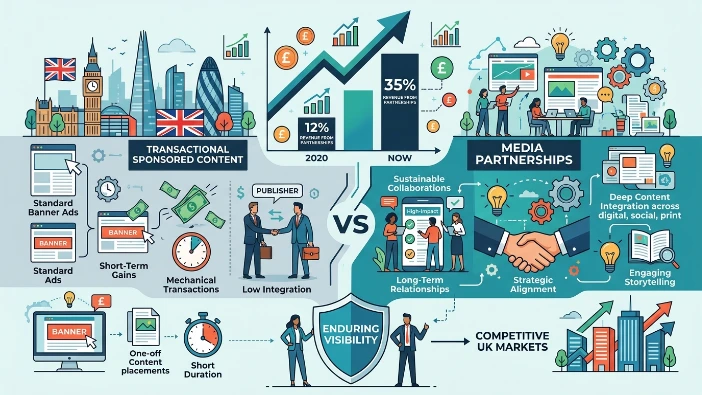
Media partnerships establish the new standard. They replace transactional sponsored content with sustainable, high-impact collaborations. Brands adopting them secure enduring visibility in competitive UK markets.