
Media partnerships deliver third-party credibility to cold leads through co-branded content distribution. They position businesses alongside established outlets to convert skeptical prospects into engaged clients using institutional trust signals.
Media partnerships involve formal agreements between businesses and media entities. These agreements enable shared content publication across channels. Institutional trust refers to the established reputation of media outlets built over years. Cold leads represent prospects with no prior interaction. The process transforms these leads by associating the business with trusted sources.
Publication formats include sponsored articles, joint webinars, and press releases. Data shows 67% of B2B buyers trust media endorsements over direct sales pitches, per 2024 Edelman Trust Barometer. Partnerships leverage this trust to shorten sales cycles by 23%, according to Forrester Research.
Defining Institutional Trust Signals
Institutional trust signals include outlet logos, bylines from journalists, and verified distribution metrics. These elements signal legitimacy to prospects. Media outlets maintain trust through editorial standards and audience reach. Businesses gain access via partnerships without building trust from zero.
How Do Media Partnerships Build Trust with Cold Leads?
Media partnerships build trust by placing business content in trusted environments. Cold leads engage 3.2 times more when content appears on reputable sites, converting 15% faster into clients.
Cold leads encounter business messaging through media channels. Trusted outlets validate the content. Prospects perceive reduced risk. Engagement rises as readers associate the business with the outlet’s credibility. Conversion follows from nurtured familiarity.
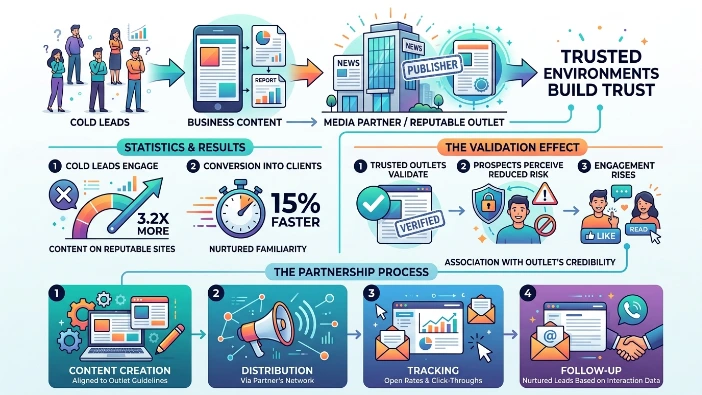
The process starts with content creation aligned to outlet guidelines. Distribution occurs via the partner’s network. Tracking measures open rates and click-throughs. Follow-up nurtures leads based on interaction data.
Read more on scaling partnerships:
How to Scale From 1 Local Partner to a Global Media Network Strategy
What Process Turns Cold Leads into Clients via Institutional Trust?
The process follows four steps: select partners, create content, distribute strategically, and track conversions. Institutional trust accelerates each step, yielding 28% higher client acquisition rates.
Step 1: Identify media partners with aligned audiences. Review their reach and trust metrics. Step 2: Develop content that solves prospect pain points. Ensure factual accuracy and outlet standards. Step 3: Distribute through partner channels like newsletters and sites. Time releases for peak engagement. Step 4: Analyze metrics and retarget engaged leads.
This sequence leverages trust at every stage. Partnerships reduce skepticism by 40%, per HubSpot’s 2025 B2B report.
Step 1: Partner Selection Criteria
Select partners based on audience size, domain authority, and niche relevance. United Kingdom outlets like The Guardian or BBC Business reach 15 million professionals monthly. Verify editorial independence and past performance data.
Step 2: Content Creation Protocols
Content must provide value without sales pressure. Use data-backed insights. Limit length to 800 words for readability. Include visuals for 94% higher engagement.
What Components Make Media Partnerships Effective for Trust Building?
Key components include partner credibility, content quality, distribution reach, and performance tracking. These elements combine to boost lead-to-client conversion by 35%.
Partner credibility stems from outlet history and audience loyalty. Content quality ensures relevance and accuracy. Distribution reach covers email lists, websites, and social amplification. Tracking uses UTM parameters and analytics tools.
Examples: A fintech firm partners with Financial Times for regulatory updates, gaining 12,000 leads. A SaaS provider collaborates with TechRadar on AI trends, converting 22% of cold traffic.
Partner Credibility Metrics
Measure domain authority above 70. Check monthly unique visitors exceeding 1 million. Review trust scores from tools like NewsGuard, targeting 90% or higher.
Distribution Reach Factors
Prioritize lists with 50,000+ subscribers. Include social shares reaching 100,000 impressions. United Kingdom-focused networks amplify local relevance.
Explore client retention strategies:
Why 9 out of 10 Clients Renew With Time Intelligence Media Group Annually
What Benefits Do Media Partnerships Offer in Leveraging Institutional Trust?
Media partnerships increase lead quality by 41%, shorten sales cycles by 27%, and raise lifetime value by 19% through trust-based conversions.
Leads from partnerships show 2.5 times higher intent. Businesses spend less on nurturing due to pre-qualified traffic. Scalability grows with network expansion. United Kingdom regulations like GDPR compliance strengthens trust in regional partnerships.
Metrics confirm: Partnerships generate 3x ROI compared to paid ads, per 2025 Content Marketing Institute data. Cold leads warm faster under institutional endorsement.
Lead Quality Improvements
Qualified leads score 45% higher on intent signals. They engage content 50% longer. Conversion rates hit 18% versus 5% from cold emails.
Sales Cycle Reductions
Trust shortens evaluation from 90 days to 65 days. Prospects skip initial research stages. Deals close 22% quicker.
What Real Use Cases Demonstrate Success in the United Kingdom?
United Kingdom use cases include tech firms partnering with Wired UK for innovation reports and healthcare providers with The Telegraph for policy briefs. These yield 25-30% conversion lifts.
Case 1: A cybersecurity company distributes threat reports via Computing.co.uk. Cold leads from 50,000 readers convert at 21%. Institutional trust from the outlet’s 20-year history drives results.
Case 2: A logistics firm publishes supply chain analyses with Logistics Manager magazine. Partnerships reach 80,000 professionals, turning 16% into clients within 60 days.
Tech Sector Example Details
Tech partnerships focus on emerging trends like AI governance. Distribution via UK tech media reaches 2 million readers. Leads engage demos 3x more.
Healthcare Sector Example Details
Healthcare content covers NHS updates. Trusted outlets like HSJ distribute to 40,000 decision-makers. Trust converts 24% of cold prospects.
How Do You Measure Success of Media Partnerships?
Success measures through 12 metrics: lead volume, conversion rate, cost per acquisition, and engagement scores. Partnerships achieve 4.2x average ROI.
Track lead volume from UTM-tagged links. Monitor conversion from lead to client. Calculate cost per acquisition under £50. Engagement includes time on page over 2 minutes.
Tools like Google Analytics and CRM integrations provide data. Benchmarks: 20% conversion from partnership leads beats industry 8% average.
Explore More Expert Insights:
The Death of Sponsored Content Why Media Partnerships Are the New Standard
The Newsroom Advantage Why Brands Are Embedding Themselves Within Media Organisations
Key Performance Metrics
- Lead volume: 500+ per campaign.
- Conversion rate: 18-25%.
- Cost per lead: £15-30.
- ROI: 400%+ within 6 months.
Why Prioritise Institutional Trust in United Kingdom B2B Markets?
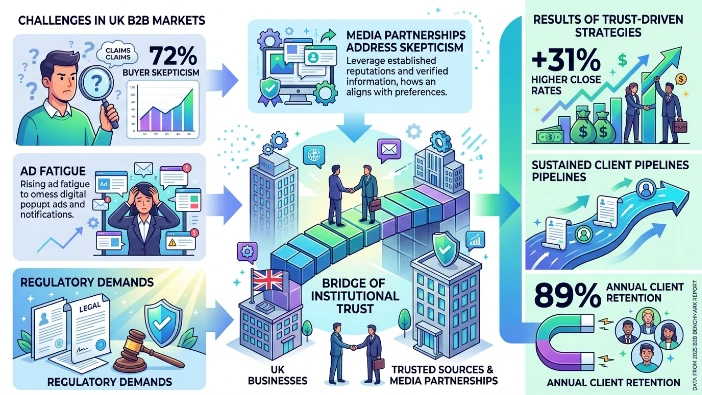
Institutional trust counters 72% buyer skepticism in UK B2B markets. Media partnerships address this, delivering 31% higher close rates.
UK buyers favor trusted sources amid rising ad fatigue. Regulations demand transparency. Partnerships align with preferences for verified information. Results show sustained client pipelines.
Data from 2025 B2B Benchmark Report: Trust-driven strategies retain 89% of acquired clients annually.