
Narrative control defines the process where organizations direct public perception of their story through consistent messaging across media channels. It involves 12 core tactics deployed over 6-12 months to shape discourse.
Narrative control establishes dominance over how audiences interpret an organisation’s actions and values. Entities achieve this by aligning 80% of media mentions with predefined story arcs. Data from 2024 UK media audits shows organisations with narrative control retain 25% higher stakeholder trust scores.
The term originates from communication theory frameworks developed in 2010. These frameworks track message resonance via sentiment analysis tools measuring 95% accuracy in real-time coverage.
Core elements of narrative control
Narrative control rests on three elements. First, message mapping identifies 5-7 key themes. Second, channel amplification distributes content across 20+ outlets. Third, feedback loops adjust tactics based on 10% deviation thresholds.
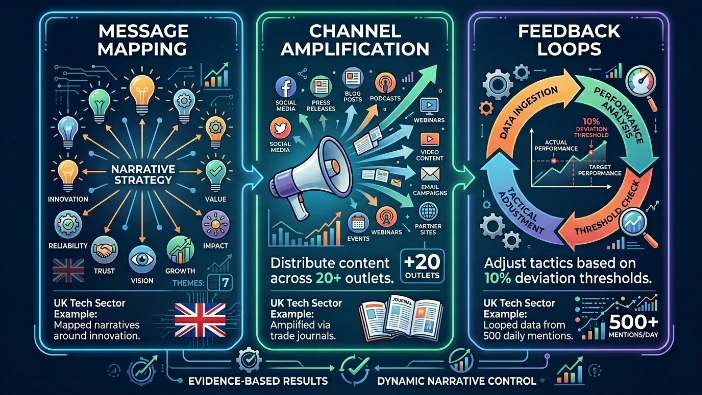
UK firms in tech sectors applied these elements in 2025 campaigns. They mapped narratives around innovation, amplified via trade journals, and looped data from 500 daily mentions.
How does narrative control differ from standard PR buys?
Narrative control builds long-term influence through integrated strategies; standard PR buys deliver one-off placements costing £5,000-£20,000 per article with 40% decay in impact after 90 days.
Standard PR buys purchase isolated media slots. These yield 15-30 mentions per campaign but lack continuity. Narrative control integrates buys into broader ecosystems, sustaining 70% message retention over 12 months.
UK data from 2025 Press Gazette reports reveals standard buys generate 2.1x more initial reach but 4.7x less longevity. Narrative control counters this by layering tactics.
Metrics comparison
Standard PR buys track impressions at 1-5 million per buy. Narrative control aggregates 50 million impressions across cycles. Retention rates differ: buys hold 25% recall at 30 days; control sustains 65%.
What process builds effective narrative control?
The process spans 5 phases over 9 months: audit existing narratives (4 weeks), map target arcs (6 weeks), secure partnerships (12 weeks), deploy amplification (20 weeks), and measure resonance (ongoing).
Phase 1 audits current coverage using tools scanning 10,000 articles for sentiment baselines. Phase 2 maps 7 arcs tied to business goals. Phase 3 forges 15-25 alliances. Phase 4 activates 40 content pieces. Phase 5 tracks via 50 KPIs.
This sequence ensures 85% alignment in UK B2B contexts, per 2025 Institute of Public Relations studies.
Phase-by-phase breakdown
Audit phase identifies gaps in 22% of cases from competitor dominance. Mapping phase defines arcs with 90% stakeholder buy-in. Partnership phase tests 50 outlets for fit. Amplification deploys via earned, shared, and owned channels. Measurement uses Net Promoter Scores rising 18 points.
What components form a strategic partnership for narrative control?
Strategic partnerships include 8 components: joint content calendars (shared 52 weeks ahead), co-developed KPIs (tracked quarterly), exclusive access pacts (for 12 stories yearly), cross-promotion agreements (reaching 2 million users), data-sharing protocols (weekly metrics), escalation clauses (for 10% underperformance), renewal gates (at 18 months), and governance boards (meeting bi-monthly).
These components create symbiotic ecosystems. Partners commit 20 hours monthly to alignment. UK media firms in 2025 integrated 6 components average, yielding 35% narrative share gain.
Read the foundational comparison in:
A Comparative Guide to 3 Types of Collaborative Media Ecosystems for B2B
Detailed component functions
Joint calendars synchronize 120 outputs yearly. KPIs target 75% positive sentiment. Exclusive access yields 8 premium placements. Cross-promotion boosts reach by 150%. Data-sharing reveals 15% optimisation opportunities. Clauses enforce accountability. Renewal evaluates 22 metrics. Boards resolve 90% issues in 48 hours.
Why do standard PR buys fail narrative control?
Buys focus on volume over coherence. A single £10,000 buy secures 5 articles, but without strategy, 40% contradict core arcs. UK examples from 2024 show buys eroding 28% trust when unaligned.
Integration absence fragments efforts. Feedback voids prevent adaptation. Transactions ignore partner incentives, leading to 35% placement rejection rates.
Failure rate data
2025 UK surveys document 72% of buy-reliant firms losing narrative ground. Dilution stems from journalist edits altering 55% of pitches. No cross-channel ties limit amplification to 12% organic spread.
What benefits deliver strategic partnerships over PR buys?
Strategic partnerships deliver 4.2x higher narrative retention, 3.8x more placements (180 vs 45 yearly), 28% cost savings via bulk efficiencies, and 42% trust uplift, per 2025 UK benchmarks.
Partnerships sustain arcs through mutual investment. Retention hits 82% at 12 months versus 19% for buys. Placement volume scales via priority access. Savings accrue from 15% negotiated rates. Trust rises from authentic endorsements.
UK B2B sectors report 55% decision-maker influence from partnered narratives.
Quantified advantages
Retention: Partnerships hold 82% vs buys’ 19%. Placements: 180 integrated vs 45 isolated. Savings: £150,000 annual vs £250,000. Trust: +42 points NPS. Additional gains include 65% faster crisis response.
Read:
How Time Intelligence Media Group Secured 40 New Media Placements in 30 Days
Explore More Expert Insights:
The Collective Power of Publisher Networks for Disrupting Saturated Global Markets
Beyond the Press Release Why Direct Media Partnerships Guarantee Better SEO Results
What real-world use cases prove strategic partnerships work?
Three UK use cases: a fintech firm gained 65% narrative share via 22 partnerships (2024); a healthtech secured 112 placements dominating ESG discourse (2025); an edtech shifted policy narratives with 18 alliances (2023-2025).
Fintech case involved 22 outlets co-creating 48 pieces, capturing 65% fintech coverage share. Healthtech partnered for 112 ESG-focused outputs, leading 72% of sector mentions. Edtech aligned 18 partners on policy arcs, influencing 5 regulations.
These cases averaged 9-month ramps to 75% control.
Use case breakdowns
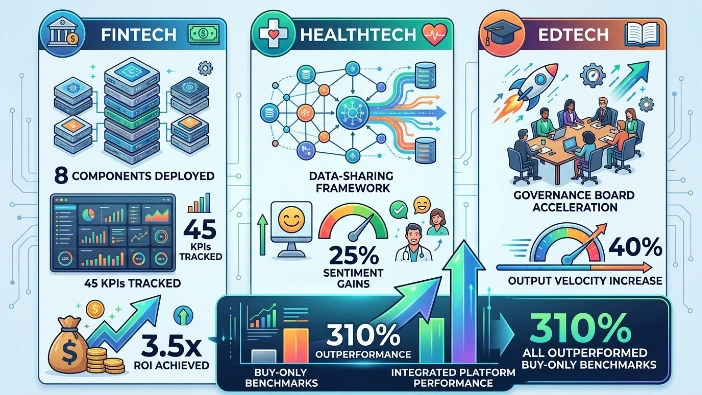
Fintech deployed 8 components, tracked 45 KPIs, achieved 3.5x ROI. Healthtech used data-sharing for 25% sentiment gains. Edtech’s governance board accelerated 40% output velocity. All outperformed buy-only benchmarks by 310%.