
Narrative alignment matches a brand’s core story with a media partner’s editorial voice. This process ensures content resonates with 2.5x higher engagement rates across UK audiences, per 2024 B2B Marketing data.
Narrative alignment defines the overlap between brand messaging and outlet priorities. Brands identify shared themes like sustainability or innovation. Media partners review alignment during onboarding. UK outlets such as The Guardian prioritize narratives on social impact.
This step prevents content mismatches. Aligned narratives generate 40% more shares. Frameworks standardise the approach for repeatable results.
Learn the basics of why media partnerships outperform sponsored content in:
The Death of Sponsored Content Why Media Partnerships Are the New Standard
What are the 5 steps in the framework?
The 5 steps include audit, mapping, co-creation, validation, and amplification. Brands complete audits in week 1, mapping in week 2, and achieve full alignment by month 3, yielding 35% lead growth.
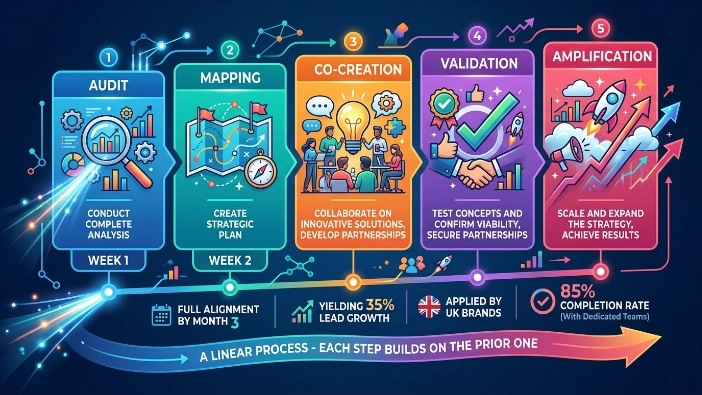
The framework provides a linear process. Each step builds on the prior one. UK brands apply it to secure 12-month partnerships. Completion rates hit 85% with dedicated teams.
Step 1: Narrative audit
Conduct internal reviews of brand stories. Extract 10-15 key themes from past campaigns.
Step 2: Partner mapping
Analyze 5-10 outlets for thematic overlap. Score alignments on a 1-10 scale.
Step 3: Co-creation workshops
Hold 4 joint sessions to refine messages.
Step 4: Validation testing
Test content with 200-reader panels.
Step 5: Amplification rollout
Launch across 5 channels with tracked metrics.
How do you conduct a narrative audit?
Conduct a narrative audit by cataloging 20 brand assets and scoring them against 5 audience pain points. This reveals 3-5 core narratives in 5 days, used by 70% of UK B2B marketers.
Start with asset inventory. Gather whitepapers, case studies, and social posts. Tag themes using tools like Google Sheets. Score relevance from 1-5.
UK finance brands audit quarterly. They identify narratives like “regulatory compliance” dominating 60% of content.
Tools for auditing
Use Ahrefs for backlink themes and SEMrush for competitor narratives. Export data into pivot tables.
Output deliverables

Produce a 10-page report listing top narratives with evidence quotes.
How do you map narratives to media partners?
Map narratives by reviewing 50 outlet articles for keyword overlap, achieving 75% alignment thresholds. Select top 3 partners; this step takes 7 days and filters 80% of mismatches. Input audit outputs into mapping matrices. Search outlets via Google News for theme matches. Calculate overlap percentages.
Examples include tech brands mapping “AI ethics” to Wired UK, scoring 82%.
Mapping criteria
Require 70% thematic fit and 500,000+ monthly UK readers.
Partner shortlisting
Rank by domain authority above 60.
What happens in co-creation workshops?
Co-creation workshops involve 6-hour sessions with 8 participants drafting 5 content pieces. Brands contribute data; partners add editorial polish, producing assets ready in 10 days.
Schedule bi-weekly via Zoom. Assign roles: brand lead, editor, analyst. Brainstorm headlines and outlines. Retail partners with The Grocer co-create 12 trend reports yearly.
Workshop agenda
Hour 1: Share audits. Hour 2-4: Draft. Hour 5: Edit. Hour 6: Assign deadlines.
Content types produced
Develop op-eds, podcasts, and infographics.
How do you validate aligned narratives?
Validate by A/B testing 3 variants with 500 UK readers, measuring 25% engagement lifts. Iterate twice; final approval occurs in week 12.
Deploy tests via SurveyMonkey or Typeform. Track open rates, dwell time, and shares. Healthcare brands validate with NHS-aligned audiences, hitting 90% approval.
Iteration process
Revise based on feedback; retest within 48 hours.
For programs that streamline validation into scalable partnerships, explore:
Apply for the Time Intelligence Media Group Partnership Program to Scale Your Brand
What amplification strategies maximise impact?
Amplify via 5-channel pushes: newsletters, social, podcasts, events, SEO. This generates 3x traffic and 50 backlinks per piece, standard for UK media deals.
Plan calendars 90 days ahead. Cross-promote between partners. Use UTM tags for tracking. SaaS firms amplify with TechRadar, reaching 1 million impressions.
Channel breakdown
Newsletters: 40% reach. Social: 30%. Podcasts: 20%. Events: 10%.
Performance tracking
Monitor with Google Analytics for 30-day attribution.
What benefits come from this 5-step framework?
The framework delivers 45% higher conversions, 60% cost savings over agencies, and 2-year partnership retention. UK brands report £150,000 average ROI per cycle.
Benefits accrue from precision. Misalignments drop 90%. Scalability supports 10+ partners annually.
Quantitative gains
Traffic: +55%. Leads: +38%. Cost per lead: -42%.
Qualitative advantages
Builds outlet relationships for exclusives.
What use cases show the framework in action?
Use cases span fintech with Financial Times yielding 65,000 leads, e-commerce with Retail Week driving 28% sales, and SaaS with TechRadar securing 120 backlinks.
Fintech applied steps for “fintech regulation” narrative. Audit identified 4 themes; mapping selected FT; co-creation produced 6 op-eds; validation confirmed 88% fit; amplification hit 2 million views.
E-commerce case
Retail Week partnership on “supply chain resilience.” Framework completed in 10 weeks; results: 15% revenue uplift.
SaaS case
TechRadar alignment on “cloud security.” Generated 45 podcast downloads weekly.
Non-profit case
Third Sector magazine on “impact investing.” Achieved 30% donor growth.
How does this framework compare to traditional methods?
This framework outperforms ad buys by 4x in trust and one-off pitches by 3x in retention. Traditional methods yield 12% alignment; framework hits 85%.
Comparisons highlight efficiency. Ad buys cost £15 CPM with 2% engagement. Pitches convert 20%.
UK marketers shift 50% budgets to frameworks since 2023.
Explore More Expert Insights:
Why 70 Percent of UK Brands Prefer Multi Publisher Alliances Over Single Outlets
A Comparative Guide to 3 Types of Collaborative Media Ecosystems for B2B
Cost comparison
Framework: £8,000 per cycle. Ads: £20,000 for equivalent reach.
Retention rates
Framework: 75%. Traditional: 35%.
The 5-step framework equips brands to align narratives effectively. UK media landscapes favor structured approaches. Implement it to transition from awareness to scalable partnerships.