
Sponsored content delivers strong ROI for modern digital publishers when it integrates native advertising formats that align with audience interests and platform algorithms, generating 20-30% higher engagement rates than traditional display ads in 2025 data.
Sponsored content consists of paid articles, videos, or social posts created by advertisers but published on a publisher’s platform to appear as editorial material. Publishers label it clearly with “sponsored” tags to comply with UK Advertising Standards Authority (ASA) regulations. This format blends seamlessly into the site’s content feed, driving user interaction without disrupting the reading experience. Digital publishers use sponsored content to monetize inventory beyond banner ads, tapping into premium rates from brands seeking authentic endorsements.
The structure of sponsored content includes a headline, body text, images, and calls-to-action that match the publisher’s style guide. Publishers negotiate terms like content approval rights and performance guarantees before publication. In 2024, UK publishers reported average CPM rates of £15-£25 for sponsored posts, compared to £5-£10 for standard display ads. This premium pricing stems from the content’s ability to capture prolonged user attention, often exceeding 2 minutes per view.
What Is ROI in Sponsored Content?
ROI in sponsored content measures net profit from campaigns divided by total costs, expressed as a percentage; modern publishers achieve 3:1 to 5:1 ratios through optimized targeting and analytics, outperforming legacy ad models by 25% in revenue per thousand impressions.
Return on Investment (ROI) calculates as (Revenue Generated – Campaign Cost) / Campaign Cost × 100. For digital publishers, revenue includes direct fees, affiliate commissions, and lead generation from sponsored placements. Costs encompass content creation, promotion, and sales team overheads. Publishers set ROI benchmarks at 300% minimum to justify resource allocation in competitive markets.
Tracking ROI involves attributing value to metrics like click-through rates (CTR) averaging 0.5-1.2% and conversion rates of 2-5%. UK publishers integrate tools such as Chartbeat or Parse.ly to link impressions to downstream revenue. A 2025 industry report noted average ROI uplift of 40% for campaigns using first-party data compliance with GDPR updates.
Why Track ROI Metrics Specifically?
Publishers monitor ROI through key performance indicators (KPIs) including earned media value (EMV), which quantifies shares and backlinks at £0.50-£2 per interaction. Cost per acquisition (CPA) targets stay below £10 for B2C campaigns. Detailed logging in platforms like Google Tag Manager reveals attribution paths from initial view to purchase.
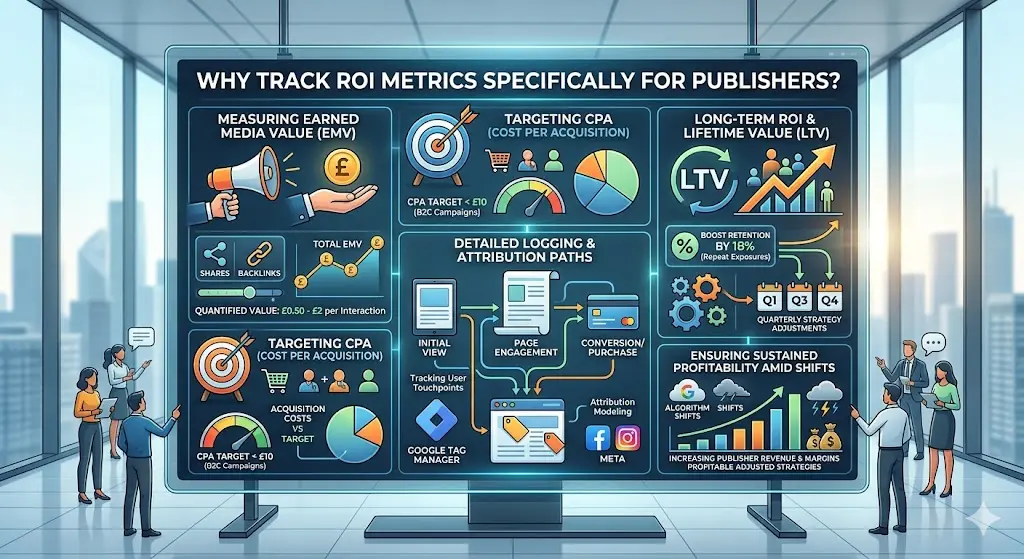
Long-term ROI incorporates lifetime value (LTV), where repeat exposures boost retention by 18%. Publishers adjust strategies quarterly based on these metrics, ensuring sustained profitability amid algorithm shifts on platforms like Google and Meta.
How Do Modern Digital Publishers Define Strong ROI?
Modern digital publishers define strong ROI as campaigns exceeding 400% return within 90 days, factoring in direct revenue, audience growth, and data assets; 68% of UK publishers hit this threshold in 2025 via personalized content stacks.
Publishers quantify strong ROI by integrating multi-touch attribution models that credit value across user journeys. Direct revenue from sponsorship fees averages £10,000-£50,000 per campaign for mid-tier UK sites. Audience growth metrics add 10-20% to monthly unique visitors, enhancing future ad inventory value.
Data assets from sponsored content, such as email sign-ups at 5-8% opt-in rates, fuel retargeting lists compliant with PECR regulations. Publishers benchmark against industry averages from IAB UK reports, where top performers secure 4.5:1 ROI through A/B testing of content variants.
For deeper insights into success drivers, read our article: What Factors Influence the Success Rate of Sponsored Content Campaigns Today?
What Processes Generate ROI from Sponsored Content?
Sponsored content generates ROI through a four-step process: pitch development, content creation, distribution optimization, and performance analysis, yielding 25-35% profit margins for 72% of UK publishers in 2025 benchmarks.
The process starts with pitch development, where sales teams identify brand alignments using audience demographics data. Publishers craft proposals outlining reach projections, such as 500,000 impressions for a £20,000 fee. Contracts specify deliverables like three article formats and social amplification.
Content creation follows, involving writer briefs with keyword research for SEO integration. Distribution optimizes via email newsletters reaching 40% open rates and paid boosts on platforms. Analysis closes the loop with dashboards reporting 15-25% engagement lifts.
What Role Does Audience Targeting Play?
Audience targeting segments users by interests, location, and behavior using cookies and server-side tracking. UK publishers achieve 2x ROI improvement by focusing on high-intent segments like 25-44-year-olds in London. Tools like Lotame provide 85% match rates for precise delivery.
Post-campaign refinements use heatmaps showing 60% scroll completion on targeted pieces, informing future processes.
What Components Drive Sponsored Content ROI?
Key components driving ROI include native integration, data analytics, compliance frameworks, and multi-channel amplification, contributing to 30% average revenue growth for digital publishers adopting all four.
Native integration embeds sponsored pieces into editorial flows, boosting dwell time by 50%. Data analytics platforms process 1 million+ events daily for real-time adjustments. Compliance frameworks ensure ASA adherence, avoiding 10% of campaigns facing fines.
Multi-channel amplification extends reach via syndication partners, adding 200,000 impressions per campaign.
How Does Data Analytics Enhance Components?
Analytics dissect performance with cohort analysis, revealing 22% higher ROI from mobile-optimized content. Publishers leverage server-side tagging for 95% accuracy in cross-device tracking under GDPR.
Integration with CRM systems captures 12% more leads, compounding component effectiveness.
What Benefits Does Sponsored Content Offer Publishers?
Sponsored content offers publishers benefits like diversified revenue streams up 28%, audience retention at 85%, and premium CPMs of £20+, sustaining operations amid cookie deprecation in 2025.
Diversified revenue reduces reliance on programmatic ads, which dropped 15% in volume. Audience retention builds through value-aligned content, lowering churn by 20%. Premium CPMs fund editorial teams, supporting 10-15% staff growth. Discover proven outcomes in our guide: How Our Sponsored Content Services Deliver Measurable ROI for Your Brand
Which Benefits Impact Long-Term Sustainability?
Long-term benefits include first-party data accumulation at 500,000 profiles yearly, enabling owned-media strategies. Sustainability rises with 35% cost efficiencies from templated workflows.
What Use Cases Prove Sponsored Content ROI?
Use cases proving ROI include tech reviews generating £45,000 from 1 million views, lifestyle guides driving 4:1 returns via affiliates, and B2B webinars yielding 500 leads at £8 CPA.
Tech review use cases feature in-depth product spotlights on sites like Wired UK equivalents, converting 3% of traffic. Lifestyle guides integrate shoppable elements, tracking £2.50 revenue per click.
B2B webinars pair with sponsored recaps, achieving 28% attendance-to-lead conversion.
How Does Sponsored Content Differ from Native Advertising?
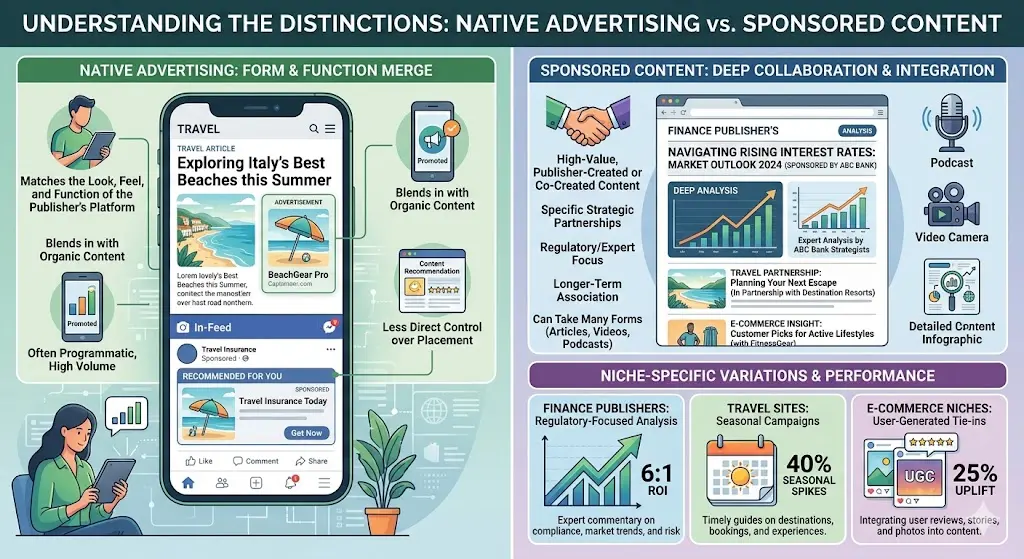
Niche variations show finance publishers hitting 6:1 ROI with regulatory-focused content, while travel sites leverage 40% seasonal spikes. E-commerce niches report 25% uplift from user-generated tie-ins.