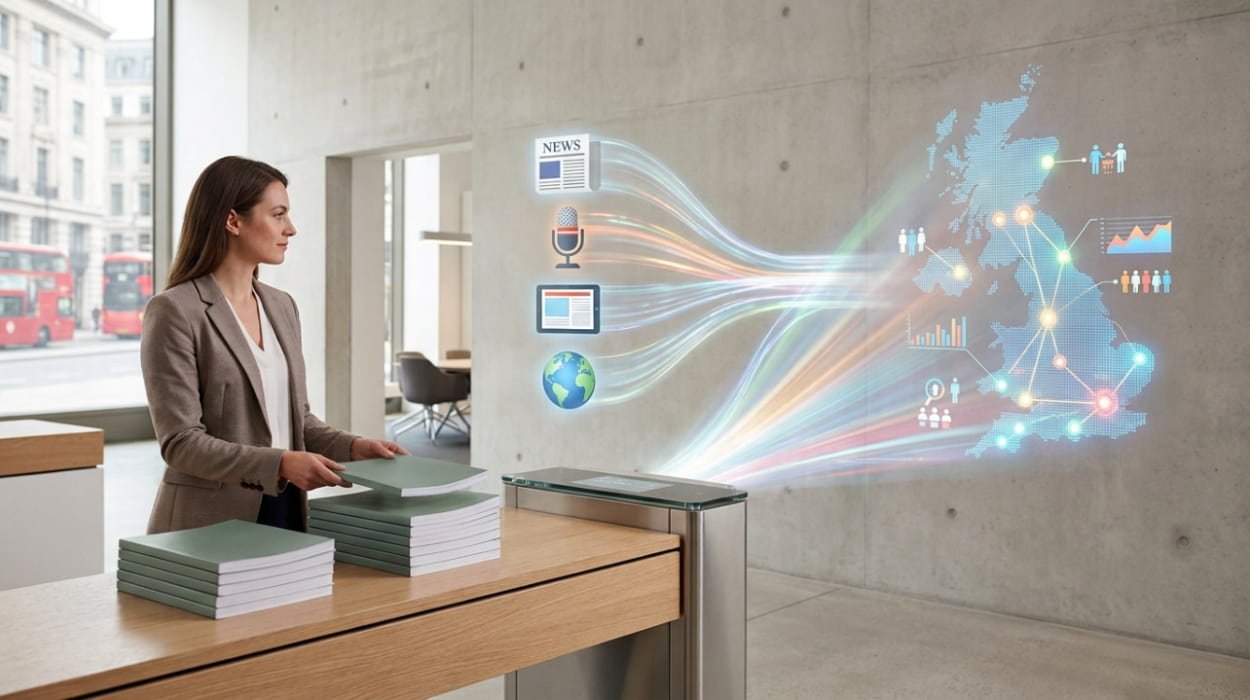
A banner advertising campaign deploys multiple rectangular display ads (e.g., 300×250 pixels) across UK websites for 30-90 days, targeting specific audiences to achieve 1-5 million impressions and 0.2-0.5% CTR.
Banner advertising campaigns coordinate creative assets, media buys, and tracking across direct sales or programmatic platforms. Standard IAB sizes include leaderboard (728×90 pixels) and skyscraper (160×600 pixels). Campaigns run in phases: awareness (first 30 days), consideration (next 30), conversion (final 30). UK regulations require GDPR-compliant consent for cookies. Budgets range £10,000-£100,000 monthly.
Creative production uses HTML5 for animations under 200KB, ensuring 2-second load times. Platforms like Google Display Network or The Trade Desk facilitate buying. Success hinges on 70% viewability and frequency caps at 5-7 exposures per user weekly.
How do audience targeting options impact banner campaign planning?
Audience targeting options include demographic (age 25-44), behavioral (past purchases), and contextual (finance keywords), with lookalike audiences expanding reach by 3x while maintaining 90% match accuracy.
Demographic targeting segments UK users by age, gender, income (£30k+), and location (London postcodes). Behavioral data from DMPs profiles interests like travel or tech. Contextual placement matches ads to page content, achieving 80% relevance. Lookalikes build from seed lists of 1,000 customers, scaling to 500,000 similars.
Retargeting warms site visitors with dynamic product ads, boosting CTR 2x. Cross-device graphs link mobile (60% traffic) to desktop. Platforms offer 50+ segments; test 3-5 combinations pre-launch for 15% performance uplift. For foundational benefits, What Are the Key Benefits of Banner Advertising for Online Brand Growth?.
What budget considerations apply to banner advertising campaigns?
Budget considerations allocate 50% to media (£5-£20 CPM), 25% to creative, 15% to tech fees, and 10% to testing, totaling £20,000 minimum for 2 million UK impressions.
Media costs follow CPM for impressions or CPC (£4-£12 per click). Programmatic direct deals average £8 CPM versus £15 open auction. Creative budgets cover 5-10 HTML5 variants at £2,000-£5,000. Tech stacks like DSPs charge 15-20% fees.
Reserve 10% for A/B tests and optimization. Scale budgets 20% quarterly based on 3:1 ROAS thresholds. UK VAT adds 20% to totals. Pacing tools distribute spend evenly across 30 days.
What creative strategies optimize banner advertising performance?
Creative strategies feature bold headlines (6-8 words), high-contrast CTAs, and 3-5 rotating variants, tested for 20-30% CTR lifts via dynamic optimization.
Headlines quantify benefits: “Save 30% Now.” Images use 1200×628 resolution, optimized to 100KB. CTAs like “Shop Now” in red buttons drive 15% higher clicks. Carousel formats cycle messages every 4 seconds.
A/B testing compares layouts: static versus animated yields 25% gains. Personalization inserts user names or locations, increasing engagement 40%. Compliance ensures no flashing over 3Hz. Refresh creatives bi-weekly to combat 50% fatigue drop.
How does platform selection affect banner campaign outcomes?
Platform selection prioritizes DSPs like The Trade Desk for programmatic access to 90% UK inventory, Google DV360 for integration, or direct publisher deals for premium placements at 20% lower CPM.
DSPs aggregate 5,000+ sites, enabling real-time bidding (RTB) at £6-£10 CPM. SSPs from publishers optimize yield. Direct deals secure exclusive inventory on high-traffic domains.
Comparisons: programmatic offers scale (10 million impressions daily), direct provides stability (guaranteed fill rates 95%). Hybrid approaches blend both for 15% efficiency. Evaluate via private marketplaces (PMPs) for curated quality.
What tracking and measurement factors matter for banner campaigns?
Tracking factors include UTM parameters, viewability pixels (70% threshold), and multi-touch attribution (7-day click window), reporting CTR, CPA (£10-£20), and ROAS 4:1.
UTM tags append ?utm_source=display to track origins. Pixels from Google Analytics or Floodlight verify fires on 98% loads. Viewability complies with MRC standards: 50% in-view 1 second.
Attribution models: last-click credits 40%, linear spreads evenly. Server-side tracking evades ad blockers (25% UK rate). Dashboards aggregate data hourly for pauses under 0.1% CTR.
How do timing and seasonality influence banner campaign success?
Timing aligns launches with peaks (8-10 AM, 6-8 PM weekdays), seasonality boosts Q4 by 40% traffic; plan 60-day runs avoiding summer lows.
Daily peaks capture 60% impressions during commutes. Weekly schedules favor Monday-Thursday (80% volume). Seasonal calendars target Black Friday (300% uplift), back-to-school (August), budgets (March).
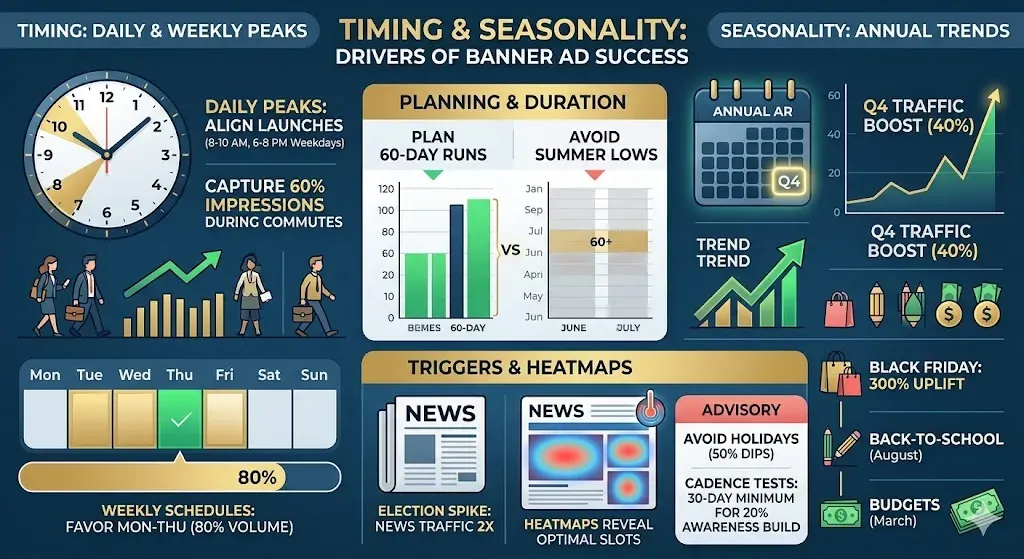
Event triggers like elections spike news traffic 2x. Heatmaps from tools reveal optimal slots. Avoid holidays with 50% dips. Cadence tests confirm 30-day minimum for 20% awareness build.
What compliance and technical factors must banner campaigns address?
Compliance factors enforce GDPR consent (85% opt-in rates), no misleading claims, and file sizes under 150KB; technical specs demand responsive design for 55% mobile traffic.
GDPR requires transparent banners explaining data use. UK ASA bans false scarcity. Tech: AMP for mobile acceleration, HTTPS for security. Ad blockers necessitate contextual fallbacks.
Responsive banners scale from 320×50 mobile to 970×250 desktop. Latency tests cap at 1.5 seconds. Audit creatives pre-upload for 100% compliance.
How do competitive and performance benchmarks guide planning?
Competitive benchmarks target CTR above 0.3% (industry 0.15%), viewability over 70%, CPA under £15; audit rivals via tools for 10-20% edge.
Benchmarks derive from IAB UK reports: display averages 0.12% CTR. Set KPIs 2x averages for outperformance. Competitor analysis scans ad creatives on 50 sites.
Performance ladders escalate budgets at milestones: 0.4% CTR unlocks 50% scale. Quarterly reviews adjust against 5% market shifts.
What use cases highlight top factors in banner campaign launches?
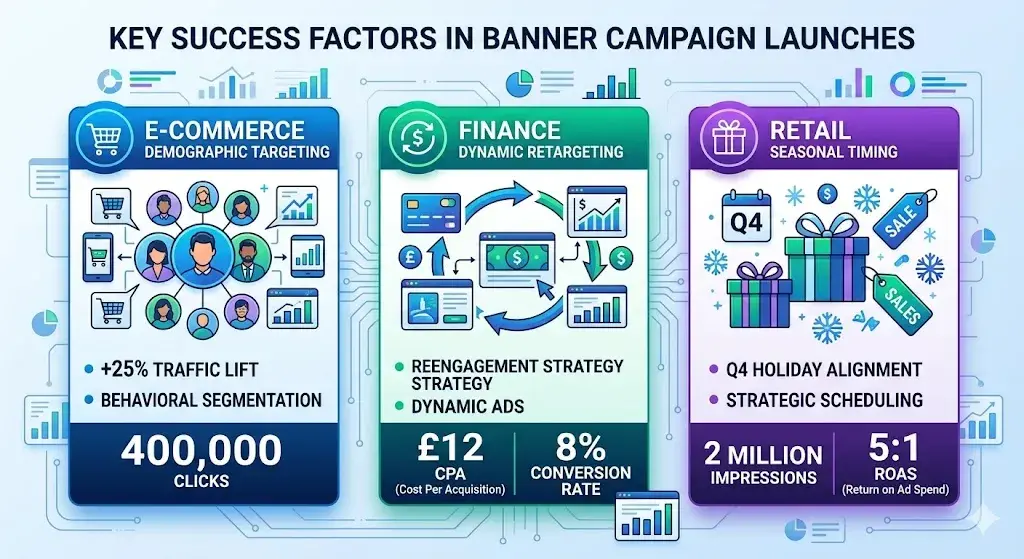
Use cases show e-commerce targeting demographics for 25% traffic lift, finance using retargeting for £12 CPA, retail timing Q4 for 5:1 ROAS.
E-commerce cases segment by behavior, achieving 400,000 clicks. Finance retargets with dynamic ads, converting 8%. Retail aligns seasonality, hitting 2 million impressions. For launch steps, How to Launch High Converting Banner Advertising Campaigns Across Multiple News Websites?.