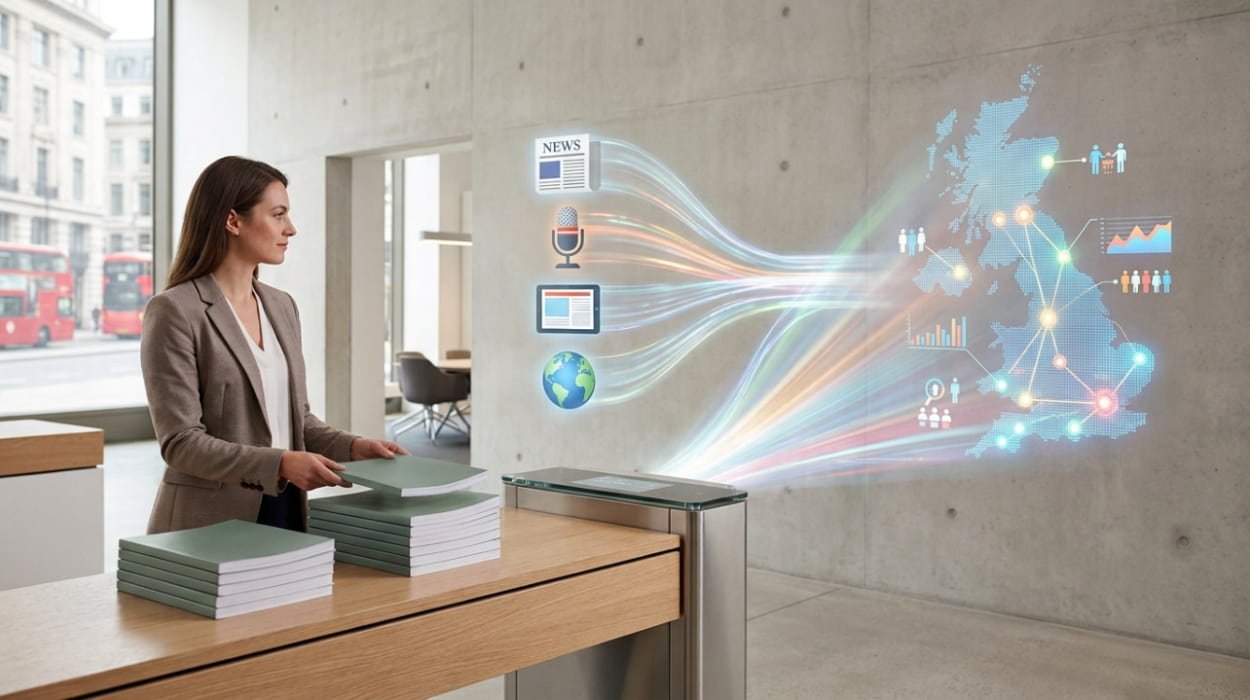
Businesses sell banner advertising space by integrating supply-side platforms (SSPs) and direct deals. They set inventory prices, target premium advertisers, and optimize fill rates. Revenue grows 30-50% with programmatic sales. Direct sales yield higher CPMs at £10-£20. Programmatic fills 80% of unsold inventory automatically.
Selling banner advertising space means publishers offer ad inventory on their sites to advertisers for revenue. Inventory includes fixed banner positions like 300×250 pixels. Sales occur via direct contracts or programmatic auctions.
Publishers control ad placements on headers, sidebars, and footers. They define sizes and refresh rates. High-traffic UK sites attract e-commerce and finance advertisers.
Revenue models charge per impression (CPM), click (CPC), or sale (CPA). Average CPM reaches £5-£15 for niche audiences. Publishers track unsold space as remnant inventory. Contracts specify run dates, creatives, and performance guarantees. Legal terms cover ad specs and payment schedules.
How Do Businesses Start Selling Banner Ad Space?
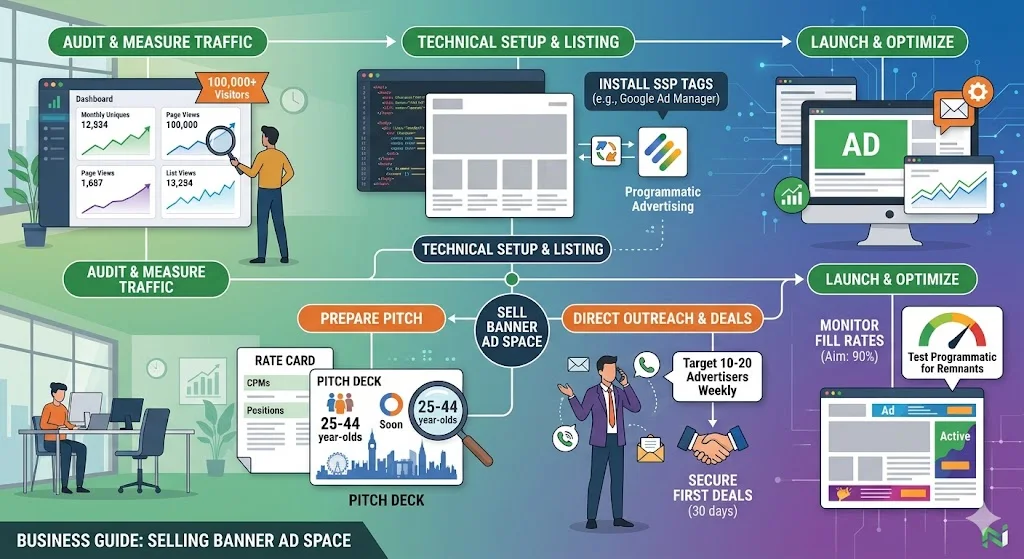
Businesses start by auditing traffic, installing SSP tags, and listing inventory on ad exchanges. They set floor prices at £2 CPM minimum. Direct outreach targets 10-20 relevant advertisers weekly.
Audit tools measure monthly uniques and page views. Sites with 100,000+ visitors qualify for premium networks. Install JavaScript tags from SSPs like Google Ad Manager.
Create rate cards listing positions and CPMs. Pitch decks highlight audience demographics like 25-44-year-olds in London. Secure first deals within 30 days. Test programmatic for remnants. Monitor fill rates aiming for 90%.
What Platforms Help Sell Banner Ad Inventory?
Platforms include SSPs like Google Ad Manager, Magnite, and PubMatic. SSPs connect to DSPs for RTB auctions. Direct platforms like OpenX handle custom deals. SSPs aggregate demand from multiple exchanges. They optimize bids to maximize revenue. UK publishers report 25% uplift from header bidding.
Google Ad Manager offers free tiers for small sites. It supports unified auctions with 50+ partners. Magnite specializes in video but handles display banners. PubMatic provides deal ID for preferred buyers. Setup takes 1-2 weeks with account managers.
Which SSP Features Boost Revenue?
SSP features include header bidding, private marketplaces (PMPs), and yield optimization. Header bidding runs parallel auctions for 20% higher bids. PMPs reserve inventory for top payers at £15 CPM.
Header bidding code loads pre-page auction. It prevents first-bid wins. Yield tools adjust floors dynamically based on demand. Private marketplaces invite select DSPs. They guarantee volume at fixed CPMs.
What Pricing Strategies Work for Banner Space?
Pricing strategies set CPM floors, tiered rates, and dynamic bidding. Floor CPM starts at £3 for general traffic. Premium positions charge £12-£25. Static CPM bills £5 per 1000 impressions. Tiered drops to £4 after 500,000 impressions. Dynamic floors rise 10% during peak hours.
Direct deals negotiate £10-£30 CPM for exclusives. Sponsors pay £500 weekly for homepage takeovers. Package bundles like leaderboard plus sidebar at 20% discount. Annual contracts lock £8 average.
How Does Programmatic Selling Work for Websites?
Programmatic selling automates auctions via RTB on ad exchanges. SSPs send bid requests per impression. Highest bid wins in 150 milliseconds, filling 85% inventory.
Exchanges like OpenX and AppNexus match supply and demand. DSPs bid using real-time data. Publishers set rules like block categories (e.g., gambling). OpenRTB protocol standardizes requests with user IDs and ad sizes. Post-auction, VAST tags serve creatives. Waterfall fallback sells remnants sequentially. Hybrid models blend RTB with direct.
What Are Direct Sales Tactics for Banner Space?
Direct sales tactics involve email pitches, rate cards, and IO contracts. Target 50 advertisers matching niche. Close 10% with follow-ups within 48 hours.
Build media kits with traffic stats and audience insights. Email templates highlight ROI like 0.5% CTR benchmarks. Insertion orders (IOs) detail CPM, impressions, and creatives. Traffickers upload ads to servers. Reports share weekly performance.
Relationship managers nurture repeats. Upsell premium slots post-campaign. For foundational knowledge, What Is Online Banner Advertising and How Does It Actually Work Today?.
How Do Businesses Optimize Banner Inventory for Sales?
Businesses optimize by refreshing ads every 60 seconds, capping frequency at 3 per user, and A/B testing positions. Refresh boosts revenue 15%. Capping prevents fatigue. Ad refresh rotates creatives dynamically. Viewability tools ensure 70% on-screen time. Heatmaps identify high-engagement zones like above-fold.
A/B tests compare sidebar vs. interstitial. Machine learning predicts optimal fills.Clean inventory rejects low-quality ads via blocklists.
What Benefits Come from Selling Banner Space?
Benefits include 20-40% revenue diversification, passive income from programmatic, and audience monetization without content changes. Sites add £2,000 monthly from 500,000 views.
Diversification reduces reliance on subscriptions. Programmatic runs 24/7 across devices. Premium direct deals fund growth.
Data from sales refines content strategies. Compliance with UK GDPR builds trust.Scale to £10,000+ monthly with 1M traffic. To compare top opportunities, Which Websites Offer the Most Effective Banner Advertising Opportunities for Brands Today?.
What Use Cases Show Effective Banner Sales?
Use cases include news sites selling to brands, e-commerce blogs to affiliates, and forums to local services. News sites earn £15 CPM from finance ads.
News publishers package political banners during elections. E-commerce blogs sell product feeds to retailers. Forums target niche ads like tech gadgets to gamers. SaaS sites monetize sidebars with tool CTAs. Local UK directories sell geo-targeted banners to shops. Outcomes show 35% revenue growth year one.
How Do UK Regulations Affect Banner Sales?
UK regulations require GDPR consent for targeting and ASA ad rules for transparency. Publishers use CMPs for cookie banners. Fines reach £20M for violations.
GDPR mandates explicit opt-in for personalized ads. ASA bans misleading claims in creatives. PECR governs email pitches to businesses. Publishers audit partners quarterly. Compliant setups retain 95% advertisers.
What Tools Track and Report Banner Revenue?
Tools like Google Analytics, Ad Manager reports, and Parse.ly track impressions, revenue, and CTR. Dashboards update real-time with £ breakdowns. Google Analytics tags ad clicks to conversions. Ad Manager exports CSV fills and eCPM.
Parse.ly segments by device and geography. Alerts notify low fill rates below 80%. Integrate APIs for custom dashboards. Monthly reconciliations match invoices.
How Can Businesses Scale Banner Sales?
Businesses scale by expanding inventory, joining networks, and hiring sales teams. Add 10 new positions yearly. Networks boost reach 300%. Expand to mobile apps and newsletters. Sales teams close £50K quarterly.
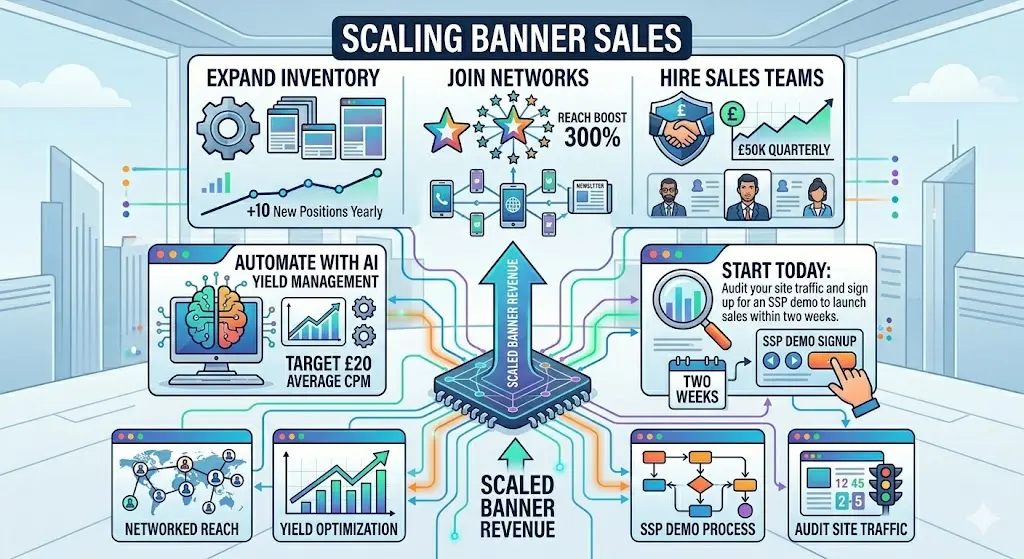
Automate with AI yield management. Target £20 average CPM. Start today: Audit your site traffic and sign up for an SSP demo to launch sales within two weeks.