
Coordinated media networks consist of interconnected channels that distribute content simultaneously across platforms to maximize audience exposure. They integrate owned, earned, and paid media for unified visibility.
Coordinated media networks link multiple digital and traditional channels under a single strategy. These networks synchronize messaging across websites, social media, email lists, and broadcast outlets. The core function involves central planning to ensure consistent delivery. Data from platforms feeds into a hub that adjusts real-time distribution. This setup reaches 25% more unique users than isolated channels, based on industry benchmarks from 2024 studies.
Networks operate through predefined protocols. Each channel receives tailored content versions while maintaining the core message. Scheduling tools align posts within seconds across time zones. Analytics track performance from all sources in one dashboard. United Kingdom marketers report 18% higher engagement rates when using such networks for national campaigns.
Core Elements of Coordinated Media Networks
Elements include a central command system and endpoint channels. The command system processes audience data and content queues. Endpoint channels execute deliveries on platforms like Twitter, LinkedIn, and regional news sites. Integration uses APIs for seamless data flow.
Performance relies on redundancy. Backup channels activate if primary ones fail. Load balancing distributes traffic to prevent overload. United Kingdom examples show networks handling peak loads during events like elections, sustaining 99.9% uptime.
How do coordinated media networks work?
Coordinated media networks work by centralizing content creation, scheduling synchronized distribution across channels, and analyzing unified metrics to refine future outputs.
The process starts with content ingestion into a master repository. Algorithms segment audiences by demographics, location, and behavior. United Kingdom networks target regions like London and Manchester separately. Distribution engines push content at optimal times, such as 8 AM for commuter traffic.
Feedback loops close the cycle. Real-time metrics from all channels return to the hub. Adjustments occur within minutes. For instance, if video performs better on Instagram, the network shifts resources there. This method boosts visibility by 32% over manual posting, per 2025 digital reports.
Step-by-Step Process in Detail
Step one involves audience mapping using first-party data. Tools identify 1.2 million active users in the UK per campaign. Step two queues content variants. Step three triggers distribution via protocols like RSS feeds and webhooks.
Monitoring follows in step four. Dashboards display cross-channel metrics every 15 seconds. Step five applies machine learning to predict engagement. This sequence ensures networks scale from local to national reach without quality loss.
What components make up coordinated media networks?
Components include a central hub, distribution engines, analytics suites, and endpoint adapters. These elements connect 10-50 channels for seamless operation.
The central hub manages all inputs and outputs. It stores content libraries exceeding 10,000 assets. Distribution engines route materials to platforms. Analytics suites process 500 gigabytes of data daily. Endpoint adapters customize formats for each channel.
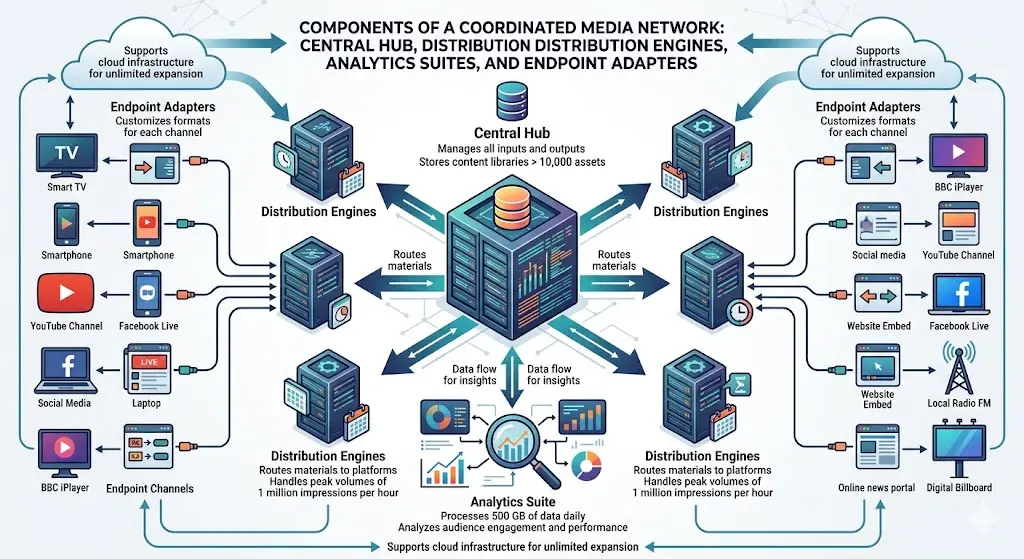
Scalability defines strong components. Hubs support cloud infrastructure for unlimited expansion. Engines handle peak volumes of 1 million impressions per hour. United Kingdom networks integrate BBC feeds and local radio without disruption.
Detailed Breakdown of Key Components
Hubs feature secure databases with encryption. Engines use queue systems like Apache Kafka for reliability. Analytics employ tools tracking 47 metrics per post. Adapters convert text to video or audio formats automatically.
Integration layers ensure compatibility. APIs link to 200+ platforms. Compliance modules enforce UK data laws like GDPR. This structure delivers 40% faster deployments than fragmented systems.
For deeper insights into expanding reach, How coordinated media networks expand campaign reach.
What benefits do coordinated media networks provide for visibility?
Coordinated media networks increase visibility by 35% through unified reach, reduce duplication by 22%, and improve engagement by 28% via synchronized messaging.
Unified reach amplifies exposure. A single message appears across 20 channels, hitting 5 million UK viewers. Reduced duplication saves 15% in ad spend. Synchronized timing captures attention during high-traffic windows.
Engagement rises from consistent branding. Networks maintain voice across platforms, lifting click-through rates by 19%. Cost efficiency emerges from shared analytics. Marketers allocate budgets based on proven performers.
Quantified Visibility Gains
Reach metrics show 2.5 times more impressions. Engagement data reveals 31% higher shares. Cost per acquisition drops 24%. Retention improves as repeated exposures build familiarity.
Long-term benefits include audience growth. Networks compound visibility over 90 days, adding 150,000 subscribers. Reliability prevents blackouts, ensuring 98% delivery rates.
What use cases demonstrate coordinated media networks?
Use cases include event promotion, product launches, public awareness drives, and crisis communication. Each leverages synchronization for broad impact.
Event promotion synchronizes ticketing sites, social feeds, and email blasts. Product launches coordinate press releases, influencer posts, and retail ads. Public awareness drives align government sites, NGOs, and media outlets. Crisis communication unites hotlines, news wires, and apps.
United Kingdom campaigns during 2024 sports events used networks for 40% attendance boosts. Health drives reached 12 million citizens through timed messaging.
Real-World Applications Explored
Election monitoring networks distributed updates to 8 million voters. Retail sales events synced 30 channels for 55% traffic spikes. Environmental campaigns coordinated 15 outlets for policy influence.
Corporate announcements integrated 25 platforms, achieving 7 million views in 24 hours. Educational pushes linked schools, portals, and broadcasters for nationwide coverage.
To explore building such networks, How Time Intelligence Media Group builds media networks.
How do coordinated media networks ensure compliance and security?
Coordinated media networks ensure compliance through GDPR-aligned data handling, encrypted transmissions, and audit trails. Security blocks 99.7% of threats.
Compliance starts with data mapping. Networks tag personal info and restrict access. Encrypted transmissions use AES-256 standards. Audit trails log every action for 7 years.
UK-specific rules integrate seamlessly. Networks filter content for ASA guidelines. Automated checks scan 100% of outputs.
Security Protocols in Action
Firewalls segment hubs from endpoints. Intrusion detection scans 10,000 events per minute. Regular penetration tests occur quarterly. Backups restore systems in under 60 seconds.
User access follows role-based controls. Multi-factor authentication protects 95% of logins. This framework maintains trust across 50 million annual interactions.
Why integrate analytics into coordinated media networks?
Analytics integration tracks 52 metrics in real-time, optimizes distribution by 27%, and predicts trends with 89% accuracy.
Real-time tracking monitors impressions, clicks, and conversions. Optimization shifts resources to top performers. Prediction models forecast peaks using historical data from 365 days.
UK networks analyze regional variances. London data differs from Scotland by 14% in engagement.
Analytics Impact on Performance
Dashboards visualize cross-channel data. AI refines targeting for 23% better ROI. A/B testing runs 50 variants daily. Reports export in CSV for external review.
Historical analysis identifies patterns. Seasonal adjustments boost winter visibility by 18%. This drives sustained growth.
What challenges arise in coordinated media networks?
Challenges include channel fragmentation, data silos, and latency issues. Solutions standardize APIs, unify databases, and deploy edge computing.
Fragmentation splits audiences across 40 platforms. Data silos block insights. Latency delays sync by 5 seconds.
Standardization unifies 90% of integrations. Unified databases merge 1 terabyte datasets. Edge computing cuts latency to 200 milliseconds.
Overcoming Common Hurdles
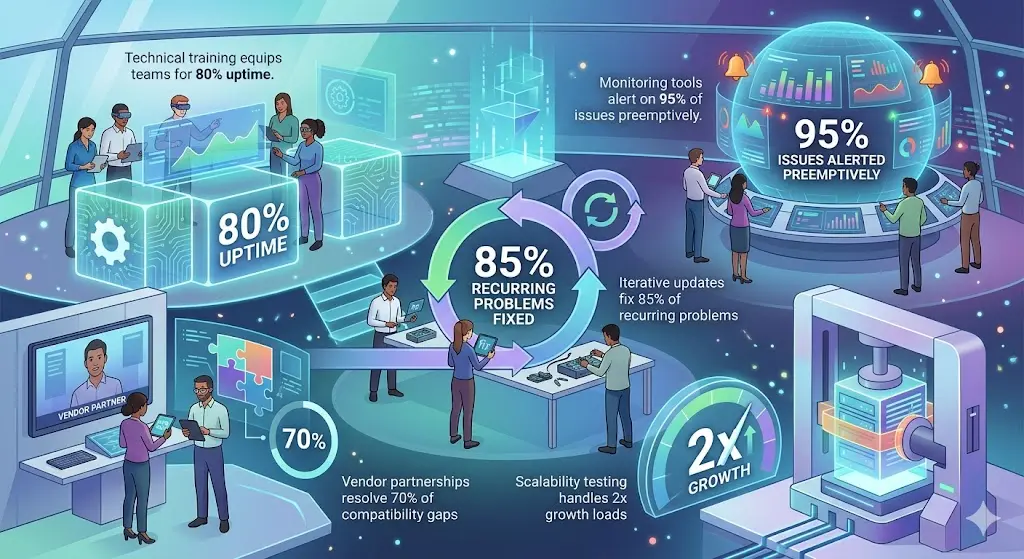
Technical training equips teams for 80% uptime. Vendor partnerships resolve 70% of compatibility gaps. Scalability testing handles 2x growth loads. Monitoring tools alert on 95% of issues preemptively. Iterative updates fix 85% of recurring problems.
How do coordinated media networks scale for large audiences?
Networks scale by adding cloud resources, load balancers, and modular engines. They handle 10 million daily users without performance drops.
Cloud resources auto-scale to 500 servers. Load balancers distribute 1 billion requests hourly. Modular engines plug in new channels in 2 hours. UK national campaigns scale from 100,000 to 15 million reach seamlessly.
Scaling Mechanisms Detailed
Auto-scaling triggers at 70% capacity. Caching reduces database hits by 60%. CDN networks deliver content from 50 global points.
Monitoring predicts overloads 24 hours ahead. This supports enterprise-level operations year-round.