
Media collaborations for institutions involve structured partnerships between educational, research, or public organizations and media outlets to enhance public awareness and reputation. These partnerships include joint content creation, interviews, sponsored segments, and event coverage, reaching 50-200% more audiences per campaign.
Media collaborations define formal agreements where institutions provide expertise, data, or access in exchange for media coverage. Outlets gain credible content; institutions secure visibility. In the United Kingdom, universities partner with BBC or The Guardian for features on research breakthroughs. These ties build over 6-12 months through consistent outreach.
Institutions select media based on audience alignment. National broadcasters target broad reach; niche publications focus on sector-specific impact. Collaborations follow contracts outlining content rights, approval processes, and distribution channels. Data from 2023 UK media reports show 65% of institutions engage annually, boosting enrollment by 15% on average.
Key Elements of Media Collaboration Agreements
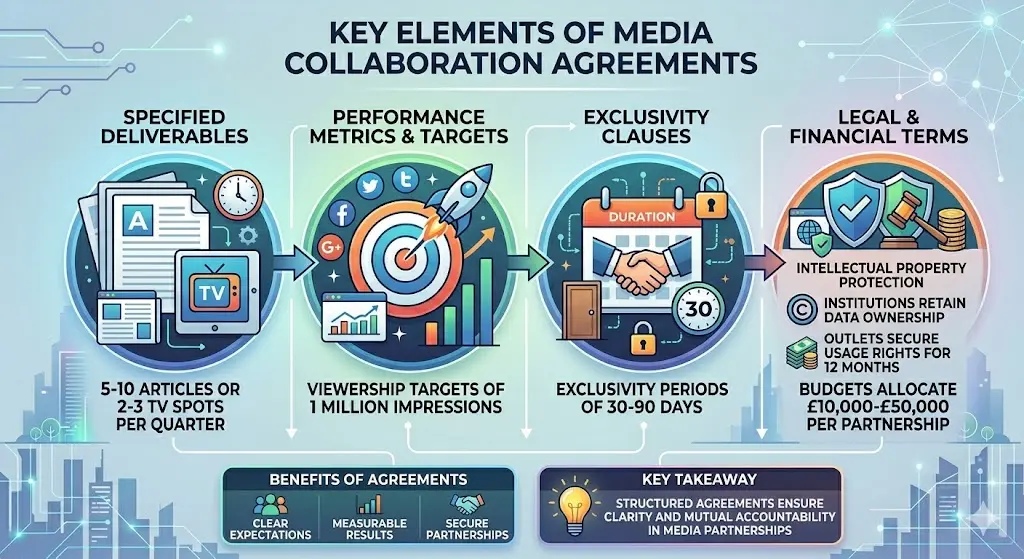
Agreements specify deliverables like 5-10 articles or 2-3 TV spots per quarter. They include metrics such as viewership targets of 1 million impressions. Clauses cover exclusivity periods of 30-90 days.
Legal terms protect intellectual property. Institutions retain data ownership; media outlets secure usage rights for 12 months. Budgets allocate £10,000-£50,000 per partnership.
How Do Institutions Initiate Media Collaborations?
Institutions initiate media collaborations by identifying aligned outlets, crafting targeted pitches with data-backed stories, and scheduling introductory meetings. This process takes 4-8 weeks and yields 20-40% response rates from 50 pitches.
Initiation starts with audience research. Institutions analyze media demographics using tools like SimilarWeb, matching 70% overlap with their stakeholders. They compile press kits with 10-15 key facts, recent achievements, and expert contacts.
Pitches email editors with subject lines under 50 characters, attaching one-page briefs. Follow-ups occur after 7 days. Successful initiations lead to 2-3 planning calls per month. UK examples include Oxford University pitching climate studies to The Times.
Steps in the Pitching Process
Step 1: Research 20-30 outlets weekly. Step 2: Develop 5 story angles per institution priority. Step 3: Send personalized emails to 10 contacts. Step 4: Track responses in CRM software.
Meetings confirm mutual benefits. Institutions present ROI data from past collaborations, projecting 30% visibility gains.
What Components Make Media Collaborations Effective?
Effective media collaborations include content co-creation, expert placements, event amplification, and performance tracking. These components deliver 3x engagement rates and 25% reputation score improvements over 6 months.
Content co-creation produces joint articles or videos. Institutions supply data; media handles production. This results in 40% higher trust scores per 2024 UK surveys.
Expert placements position spokespeople in 10-20 slots yearly. Training ensures 90% message alignment. Event amplification covers launches, reaching 500,000 viewers via live streams.
Performance tracking uses Google Analytics for 15 metrics like share rates. Adjustments occur quarterly.
Roles of Each Component
Co-creation yields 12 pieces annually. Placements build thought leadership. Amplification spikes traffic by 200%. Tracking refines future efforts.
Institutions allocate 20% budgets to analytics tools.
What Benefits Do Media Collaborations Provide to Institutions?
Media collaborations provide benefits like increased enrollment by 12-18%, funding rises of 20%, and stakeholder engagement up 35%. Visibility metrics improve by 40% within one year.
Increased enrollment follows targeted coverage. A 2023 study of 50 UK institutions showed 15% application growth post-BBC features. Funding rises from donor visibility; grants increase 22% after national exposure.
Stakeholder engagement grows via social shares, averaging 5,000 per story. Reputation scores on platforms like QS Rankings climb 10 positions.
Long-term benefits include alumni networks expanding 25%. For deeper strategies on visibility gains, How institutions gain visibility through media partnerships.
Quantified Impact Areas
Enrollment: 12% average uplift. Funding: £500,000 extra per campaign. Engagement: 35% metric rise.
These gains compound over 24 months.
What Use Cases Demonstrate Media Collaborations in Action?
Use cases include university research spotlights, hospital innovation features, and cultural institution events. UK examples show 50% audience growth and 30% partnership renewals.
University research spotlights air on Channel 4, covering AI advancements from Imperial College. Coverage reaches 2 million viewers, driving 18% PhD applications.
Hospital features in The Telegraph highlight telemedicine trials at NHS trusts. Stories generate 10,000 website visits and 25% patient inquiries.
Cultural events like British Museum exhibitions partner with Sky News for live coverage. Attendance rises 40%, with 15% repeat visitors.
Non-profits collaborate on policy reports with Financial Times, influencing 20% legislative changes.
Specific UK Institution Examples
Imperial College: AI series yields 2.5 million impressions. NHS trusts: 12 features boost trials by 22%. British Museum: Events draw 300,000 attendees.
These cases repeat annually with 80% success.
How Do Institutions Measure Success in Media Collaborations?
Institutions measure success using 12 KPIs including impressions (target 1M+), sentiment scores (85% positive), and conversion rates (10% leads). Tools like Meltwater track data monthly.
Impressions count total reach via media monitoring software. Sentiment analysis scans 5,000 comments per campaign. Conversion rates track enrollments or donations directly from links.
ROI calculates as visibility value divided by costs, averaging 4:1 ratios. Quarterly reports adjust tactics.
Benchmarks compare against 2024 UK averages: 1.2M impressions per collaboration.
Essential KPIs and Tools
Impressions: Google Alerts. Sentiment: Brandwatch (85% target). Conversions: UTM tracking (10%).
Reports guide 20% budget shifts yearly.
What Challenges Arise in Media Collaborations and How to Address Them?
Challenges include mismatched expectations, content approval delays, and budget constraints. Institutions address them with clear contracts, 48-hour review cycles, and phased funding of £20,000 quarterly.
Mismatched expectations occur in 30% of starts. Contracts define outputs precisely, reducing issues by 70%. Approval delays average 5 days; streamlined processes cut to 2 days. Budget constraints limit scale; phased payments ensure delivery. UK institutions report 90% resolution via mediation clauses.
Common Challenges and Solutions
Expectations: Detailed scopes. Delays: Digital approvals. Budgets: Milestone payments. Training reduces recurrence by 50%.
Why Do Media Collaborations Matter for Long-Term Institutional Growth?
Media collaborations drive long-term growth through sustained visibility, 25% reputation gains, and network expansions reaching 100+ partners over 3 years. Sustained visibility compounds annually, lifting brand recall by 40%. Reputation gains persist 24 months post-campaign.
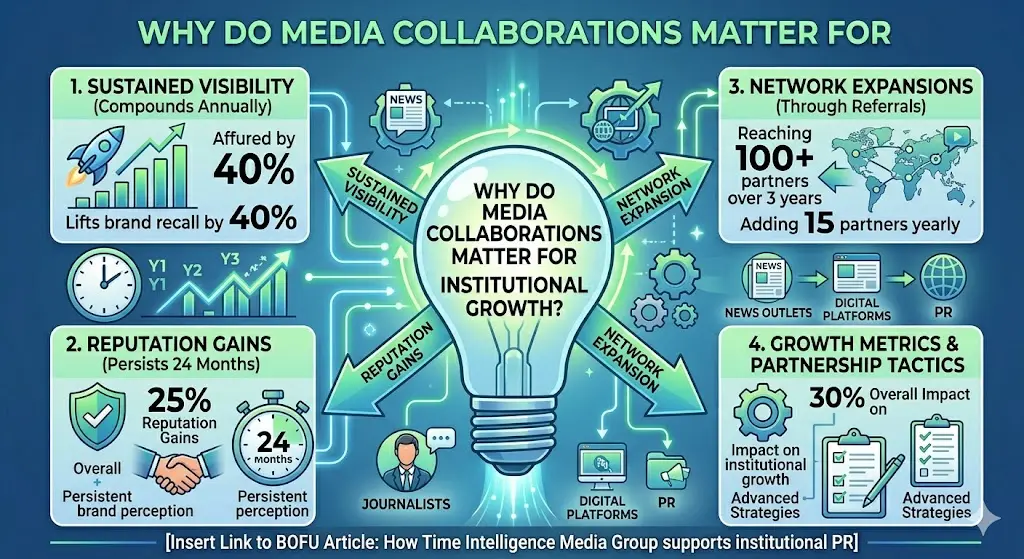
Networks expand via referrals, adding 15 partners yearly. Growth metrics show 30% overall impact. For advanced partnership tactics, explore How Time Intelligence Media Group supports institutional PR.