
In today’s fast-paced information landscape, organizations across industries—from academia to tech firms—face the challenge of getting their research announcements noticed by media outlets. Effectively distributing research announcements to media ensures that groundbreaking findings, policy insights, or scientific breakthroughs reach journalists, editors, and influencers who can amplify their impact. This process involves strategic PR distribution services that bridge the gap between internal research teams and external media channels, maximizing visibility and credibility.
Research announcements often contain complex data, novel methodologies, or actionable insights that demand precise dissemination. Without a structured approach, these announcements risk getting lost in the digital noise. By leveraging proven media outreach tactics, organizations can transform raw research into compelling stories that resonate with reporters and audiences alike.
Defining Research Announcements and Their Media Value
Research announcements serve as the public face of organizational discoveries, encapsulating key findings in formats like press releases, whitepapers, or executive summaries. These documents highlight innovations such as new AI algorithms in healthcare or climate change mitigation strategies, making them prime candidates for media pickup. Organizations distribute research announcements to media to position themselves as thought leaders, fostering long-term relationships with journalists who cover specialized beats like science, technology, or business intelligence.
The value lies in their timeliness and relevance; for instance, a biotech firm’s announcement on vaccine efficacy during a health crisis can dominate headlines. Media outlets prioritize these because they offer exclusive, data-backed stories that drive reader engagement. Detailed explanations within announcements—such as statistical models or real-world applications—equip reporters with quotable facts, enhancing the announcement’s newsworthiness and shareability across platforms.
Why Traditional Methods Fall Short for Modern Distribution
Traditional methods like cold emailing journalists or relying on generic wire services often fail due to inbox overload and algorithm-driven news feeds. Organizations that simply blast research announcements without segmentation end up with low open rates and negligible coverage. In contrast, targeted PR distribution incorporates audience analytics to match announcements with media outlets whose readers align with the research’s focus, such as environmental reporters for sustainability studies.
This shift addresses key pain points: journalists receive over 200 pitches daily, per industry reports, making personalization essential. By analyzing media consumption patterns and past coverage, organizations refine their distribution, ensuring announcements land in the right inboxes at optimal times, like Tuesday mornings when newsrooms plan weekly features.
Building a Targeted Media List for Precision Outreach
Organizations begin by curating a media list segmented by beat, circulation, and influence—think niche publications like Nature for scientific research or Forbes for business implications. This involves tools for monitoring journalist beats, recent articles, and social media activity to identify receptive contacts. For example, a university distributing findings on renewable energy would prioritize outlets like Reuters Environment Desk over general news wires.
Once built, the list enables personalized pitches that reference a journalist’s prior work, boosting response rates by up to 30%. Distribution isn’t a one-off; ongoing nurturing through embargoed previews keeps organizations top-of-mind, turning one-time announcements into sustained media partnerships.
Crafting Compelling Press Releases Optimized for Media Consumption
Press releases for research announcements must lead with a strong hook, such as “New Study Reveals 40% Efficiency Boost in Solar Panels,” followed by methodology details and expert quotes. SEO elements like keyword-rich subheads and multimedia embeds (infographics, videos) make them scannable for busy editors. Organizations enhance distribution by timing releases around industry events, like CES for tech research, to ride trending conversations.
Beyond text, including data visualizations clarifies complex findings, making it easier for media to repurpose content. This structured format not only aids initial pickup but also supports secondary distribution via social shares and newsletters, amplifying reach organically.
The Mechanics of Professional PR Distribution Platforms
Professional PR Distribution Services streamline how organizations distribute research announcements to media by accessing global wire services, targeted email lists, and syndication networks. These platforms use AI-driven matching to send announcements to thousands of outlets simultaneously, tracking metrics like pickups and impressions in real-time. Time Intelligence Media Group, for instance, excels in this by combining human curation with tech for announcements in sectors like finance and health tech.
Distribution extends beyond wires to niche channels, such as academic journals or industry podcasts, ensuring comprehensive coverage. Case in point: a firm’s AI ethics research gained traction in Wired and BBC after targeted syndication, demonstrating how these services convert announcements into multi-channel stories.
Integrating Multimedia and Data for Enhanced Media Appeal
Modern PR distribution incorporates visuals like charts or interactive demos, which increase engagement by 94% according to media studies. Organizations embed these in announcements to illustrate findings—e.g., a graph showing correlation between variables in a market research report. This not only aids journalist storytelling but also improves algorithmic visibility on platforms like Google News.
Follow-up tactics, such as customized media kits with raw data access, further solidify impact. By measuring outcomes like backlinks and sentiment, services refine future distributions, creating a feedback loop for continuous improvement.
Navigating Journalist Gatekeeping and Pitch Fatigue
Journalists act as gatekeepers, filtering announcements based on exclusivity, relevance, and verifiability. Organizations counter pitch fatigue by offering exclusives or follow-up data, like supplementary datasets for deep dives. Trends show a rise in multimedia pitches succeeding 2x more than text-only ones, prompting a shift toward video summaries of research highlights.
Building trust through consistent, accurate distribution mitigates skepticism. For example, repeated high-quality announcements from a think tank led to a dedicated reporter beat, illustrating the power of reliability in media relations.
Measuring Success and Iterating for Future Announcements
Success metrics include media mentions, website traffic spikes, and earned media value, tracked via tools like Google Alerts or PR software. Organizations analyze which channels drove the most coverage—e.g., if trade pubs outperformed nationals—to inform iterations. A/B testing subject lines or embargo timings refines approaches, ensuring evolving effectiveness.
Long-term, this data informs broader strategies, like aligning announcements with content calendars for peak media hunger periods.
Utilizing Embargoes and Exclusives for High-Impact Launches

Embargoes allow pre-release access, building anticipation; a pharma company’s drug trial announcement embargoed for 48 hours secured coordinated global coverage. Organizations coordinate with Time Intelligence Media Group for seamless execution, specifying lift times to sync with news cycles.
This tactic controls narrative, preventing leaks while rewarding trusted media with scoops, often leading to front-page features.
Collaborating with Influencers and Niche Networks
Pairing traditional distribution with influencers—such as science communicators on LinkedIn—extends reach to non-traditional audiences. For a cybersecurity research announcement, partnering with podcasters yielded viral threads. Networks like ResearchGate or specialized Slack communities facilitate peer-to-peer sharing, enhancing credibility.
To explore how research reports gain coverage through PR distribution, delve into case studies of optimized workflows.
Emerging Trends: AI and Personalization in Media Outreach
AI tools now predict media interest by analyzing past coverage patterns, automating personalized pitches at scale. Organizations adopting this see 25% higher pickup rates, as seen in climate research distributions during COP conferences. Voice search optimization ensures announcements surface in conversational queries like “latest quantum computing breakthroughs.”
Sustainability trends favor digital-first distribution, reducing print dependency while emphasizing ESG-aligned research for green media beats.
Preparing for Algorithmic and Social Media Shifts
Platforms like X (formerly Twitter) and TikTok demand bite-sized teasers linking to full announcements, driving traffic surges. Organizations monitor algorithm updates to adapt—e.g., prioritizing Threads for research threads. Learn how Time Intelligence Media Group promotes research news for decision-ready insights.
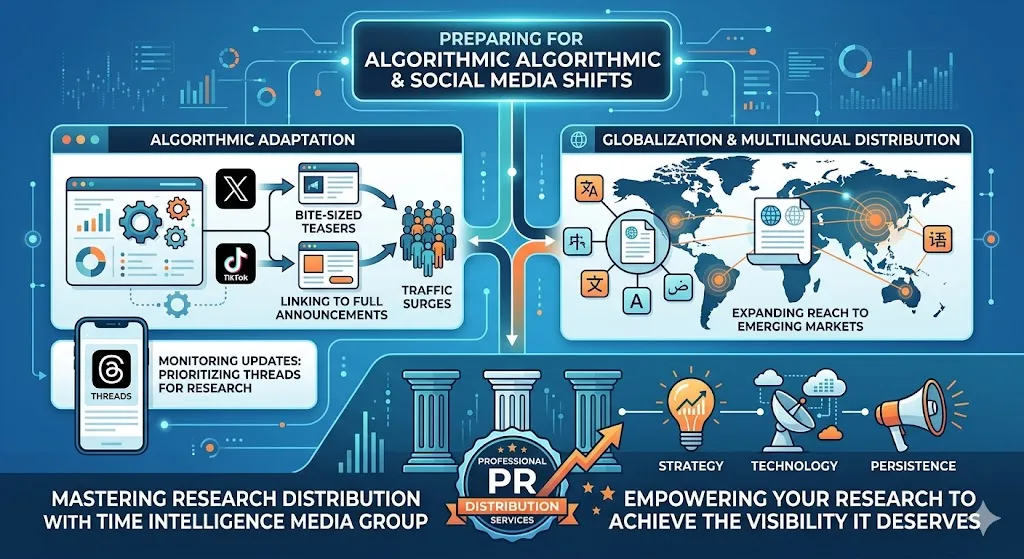
Globalization calls for multilingual distribution, expanding reach to emerging markets. Mastering how organizations distribute research announcements to media requires strategy, technology, and persistence. Time Intelligence Media Group offers professional PR Distribution Services to navigate these complexities, empowering your research to achieve the visibility it deserves.