

What Is Energy Market Data in the Context of UK Media Relations?
Energy market data is structured quantitative information from power, gas, and renewable sectors, including wholesale prices, carbon intensity metrics, grid capacities, and commercial consumption trends across the UK energy system.
Energy market data transforms complex market activity into objective, measurable insights. National Grid ESO, Ofgem, and the Department for Energy Security and Net Zero generate foundational datasets daily. Commercial organisations collect operational metrics such as half-hourly consumption patterns, renewable integration rates, and industrial power costs.
Business and trade media require verified figures to substantiate claims about the energy transition, inflation, and industrial productivity. Raw datasets do not attract news coverage on their own. Journalists require context, comparative baselines, and clear economic implications to convert raw figures into news stories.
Structured energy reporting connects raw data points to macroeconomic trends. High-value report topics focus on volatile pricing, grid constraints, and net-zero targets. For additional context on why utility companies invest in content generation, see original research on market change.
How Do You Convert Raw Energy Datasets Into a Media-Ready Report Structure?
Converting raw energy datasets into a media-ready report requires cleaning data, identifying statistically significant trends, structuring findings into executive summaries, and adding expert commentary that explains commercial, regulatory, and environmental impacts.
Cleaning and Standardising Data Inputs
Raw data contains anomalies, missing timestamps, and inconsistent units. Standardise all power metrics into gigawatt-hours or megawatt-hours, and convert currency metrics into British Pounds Sterling (£). Filter out temporary outages unless the anomaly itself represents the core news story.
Extracting Core Statistical Findings
Isolate changes across specific timeframes, such as year-on-year shifts, quarterly comparisons, or post-regulatory changes. Focus on percentage changes, peak volume records, and baseline deviations. A shift from 15 per cent to 32 per cent renewable penetration represents a clear narrative anchor.
Structuring the Report Narrative
Organise the report into five core sections:
- Executive Summary: Key findings and primary statistical highlights.
- Methodology: Data sources, sample sizes, and collection dates.
- Market Analysis: Detailed breakdowns of supply, demand, and price variations.
- Regional and Sectoral Impacts: Specific implications for UK manufacturing, commercial real estate, or regional grids.
- Strategic Outlook: Data-backed projections for the upcoming 6 to 12 months.
What Key Components Make an Energy Data Report Newsworthy to UK Journalists?
A newsworthy energy data report features exclusive data, clear geographical relevance, precise methodological transparency, concise executive summaries, and direct connections to active UK economic or regulatory news agendas.
Exclusivity and Data Novelty
UK national and trade outlets prioritise proprietary datasets. Newsrooms reject aggregated data from public sources unless the analysis applies a unique analytical framework or combines disparate datasets to reveal an unrecorded trend.
Direct Link to UK Policy and Economic Milestones
Align research findings with current legislative developments and economic metrics. Relevant frameworks include:
- The UK Net Zero Strategy and carbon budget targets.
- Ofgem price cap announcements and regulatory decisions.
- UK inflation reports and commercial energy support schemes.
- Grid connection queues and infrastructure expansion plans.
Geographical and Sectoral Specificity
National reporters request UK-wide implications. Regional and trade publications require localised or sector-specific breakdowns. Segment data by region, such as Scotland, the Midlands, or Greater London, and by industry, such as manufacturing, retail, or data centres.
Absolute Methodological Transparency
Trade journalists verify data sources before publishing. Reports must state the exact date ranges, data generation methods, sample sizes, and calculation formulas. Clear methodologies build trust with technical editors at publications like Utility Week, ICIS, and Current±.
Explore More Expert Insights:
How to Analyse the Impact of a New UK Regulation on Your Sector and Publish the Findings as a Research Report
How to Plan Sponsored Content That Strengthens Your Branded Search Results Alongside Your Website and Profiles
What Is the Step-by-Step Process for Drafting and Publishing Energy Market Research?
The drafting and publishing process follows four phases: defining data hypotheses, conducting statistical analysis, writing structured narrative sections, and releasing the finalised report to target media outlets.
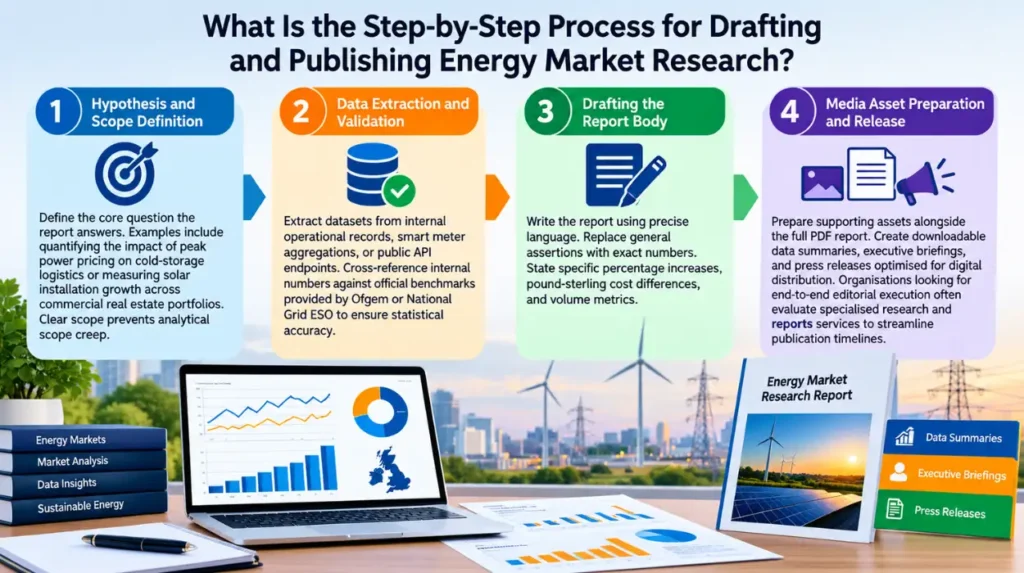
Phase 1: Hypothesis and Scope Definition
Define the core question the report answers. Examples include quantifying the impact of peak power pricing on cold-storage logistics or measuring solar installation growth across commercial real estate portfolios. Clear scope prevents analytical scope creep.
Phase 2: Data Extraction and Validation
Extract datasets from internal operational records, smart meter aggregations, or public API endpoints. Cross-reference internal numbers against official benchmarks provided by Ofgem or National Grid ESO to ensure statistical accuracy.
Phase 3: Drafting the Report Body
Write the report using precise language. Replace general assertions with exact numbers. State specific percentage increases, pound-sterling cost differences, and volume metrics.
Phase 4: Media Asset Preparation and Release
Prepare supporting assets alongside the full PDF report. Create downloadable data summaries, executive briefings, and press releases optimised for digital distribution. Organisations looking for end-to-end editorial execution often evaluate specialised research and reports services to streamline publication timelines.
Which UK Business and Trade Outlets Cover Energy Market Data Reports?
UK business national newspapers, vertical energy trade publications, regional business journals, and sector-specific commercial titles publish stories based on verified energy market research.
National Business Media
National publications focus on macroeconomic impact, consumer costs, inflation, and major industrial shifts.
- The Financial Times: Focuses on global market integration, corporate energy costs, and policy impacts.
- The Times (Business): Focuses on corporate strategy, infrastructure investment, and national energy security.
- The Daily Telegraph (Business): Focuses on regulatory burdens, market competition, and commercial enterprise impacts.
Specialised Energy and Utilities Trade Outlets
Trade outlets require granular technical details, policy analysis, and operational insights.
- Utility Week: Covers utility operations, regulation, water, gas, and electricity networks.
- Current±: Focuses on renewable energy integration, electric vehicle infrastructure, energy storage, and smart grids.
- Energy Voice: Covers traditional oil and gas sectors, offshore wind, hydrogen, and the broader UK energy transition.
- ICIS Heren: Focuses on wholesale gas, power, and carbon pricing analysis.
Vertical Industry Outlets
Vertical titles cover energy data through the lens of specific operational costs and sustainability requirements.
- The Grocer: Covers energy costs across food manufacturing, cold chains, and supermarket retail operations.
- Building: Focuses on embodied carbon, commercial property energy ratings, and building regulations.
- Manufacturing Weekly: Focuses on industrial power tariffs, energy efficiency investment, and factory production costs.
How Do You Measure the ROI and Impact of a Published Energy Research Report?
Measure energy research report impact by tracking tier-one media coverage, trade publication pickups, inbound backlink counts, report download volumes, direct commercial leads, and organic search engine visibility.
Earned Media Footprint
Track total media coverage across print, digital, and broadcast channels. Classify coverage by outlet authority, audience reach, and message inclusion. Count direct brand mentions and key dataset citations.
Digital Search and Link Metrics
Analyse digital performance using standard web analytics and SEO tools:
- Inbound Backlinks: Count high-authority editorial links pointing to the report domain.
- Keyword Rankings: Monitor organic search positions for target market data terms.
- Referral Traffic: Measure direct website visitors arriving via media coverage links.
Lead Generation and Audience Engagement
Track reader conversions from report download pages. Measure PDF downloads, executive summary views, and demo or consultation requests originating from research readers.
What Common Pitfalls Cause Business Media to Reject Energy Data Reports?
Journalists reject energy reports due to outdated data, weak methodology, overt promotional bias, generic conclusions, overly complex formatting, and lack of clear economic context.
Overly Promotional Language
Reports designed as sales collateral fail media review. Remove product references, sales pitches, and biased language from the body of the report. Keep the document objective, factual, and analytical.
Outdated Information
Energy markets move rapidly. Publishing data older than three months reduces media interest unless the report explicitly focuses on multi-year historical comparisons. Use real-time or recent quarterly data.
Unsubstantiated Claims
Assertions without backing statistics diminish report credibility. State exact sample sizes, date ranges, and validation methods. Avoid broad statements about industry trends without accompanying figures.
Poor Formatting and Restricted Access
Requiring journalists to fill out long registration forms to view research reduces coverage. Provide ungated access, explicit press summaries, and downloadable key facts directly on the newsroom landing page.
Energy Market Data Reporting Strategy
Turning energy market data into media coverage requires structured quantitative analysis, strict methodological clarity, and precise alignment with UK news agendas. National and trade journalists publish reports that provide verified statistics, clear regional or industry segmentation, and objective economic insights. By avoiding promotional language, standardising data units, and providing accessible summary materials, energy organisations turn complex operational figures into high-value media coverage and authoritative market research.
FAQs
Q1: How do you turn energy market data into a research report?
Ans: Start by defining a clear energy market question, then collect reliable data from authoritative industry, government, and regulatory sources. Analyse the findings, identify significant market trends, and present the evidence in a structured research report with clear conclusions.
Q2: What makes an energy market research report newsworthy?
Ans: A newsworthy energy market report presents original findings, significant market changes, credible statistics, and clear implications for businesses or consumers. Strong evidence and a timely angle increase the likelihood of coverage by UK business and trade media.
Q3: What data should be included in an energy market research report?
Ans: Useful energy market research can include pricing trends, supply and demand data, investment activity, regulatory changes, production levels, consumption patterns, and market forecasts. Data should be recent, verifiable, and directly relevant to the report’s research question.
Q4: How can energy research reports attract UK business media coverage?
Ans: Energy research reports should translate complex market data into clear findings that matter to UK businesses, industries, policymakers, or consumers. Original statistics, strong evidence, timely insights, and concise news angles make research more suitable for business and trade media coverage.
Q5: Why is original energy market research important for trade media?
Ans: Original energy market research provides journalists with new evidence, statistics, and sector insights that can support reporting on market change. It can also strengthen the credibility of industry analysis when findings are transparent, well-sourced, and independently verifiable.



