

What are sponsored content services for branded search results?
Sponsored content services create paid editorial placements that provide accurate, relevant brand information across third-party publications, supporting a broader search presence alongside a company website, profiles, and other owned assets.
Branded search results are the pages that appear when users search for a company, organisation, executive, product, service, or distinctive brand term. These results can include the official website, social profiles, business listings, news coverage, articles, interviews, and other third-party pages.
Sponsored content provides an additional publishing channel. It places approved brand information within relevant media environments while keeping the commercial nature of the placement identifiable.
For organisations managing branded search visibility, the publishing objective is not limited to obtaining one article. The process requires consistent entity information, relevant subjects, accurate claims, and publication across appropriate media properties.
What does sponsored content cover?
Sponsored content can cover:
- Corporate developments
- Business services
- Industry expertise
- Executive expertise
- Research findings
- Market developments
- Product information
- Organisational announcements
- Sector-specific subjects
For example, a UK technology company can publish sponsored articles covering its cybersecurity services, research activity, executive expertise, and developments in the technology sector.
How does Times Intelligence Media Group approach sponsored content for branded search?
Times Intelligence Media Group structures sponsored content around brand identity, service relevance, subject expertise, publication context, and consistent information so each placement contributes useful third-party content to the wider branded search environment.
The process begins with the organisation and its search context. Brand terminology must remain consistent across published material. Corporate names, service names, executive names, locations, sectors, and factual descriptions require controlled usage.
The next stage connects the brand with useful subjects. A sponsored article needs a defined editorial topic rather than repeated promotional language.
For example, a financial services organisation can publish content about financial reporting developments, regulatory preparation, industry research, or business finance processes while accurately describing its relevant expertise.
This approach creates a clearer relationship between the organisation, its expertise, and the subjects covered in its published content.
How is the publishing sequence structured?
A structured sequence can include:
- Brand foundation
- Service context
- Expertise coverage
- Leadership visibility
- Sector relevance
- Corporate developments
- Publication and indexing
- Ongoing content review
Each stage serves a defined content purpose. The sequence also prevents multiple sponsored articles from repeating identical information.
What components are included in sponsored content services?
Sponsored content services include content planning, editorial development, factual review, publication placement, brand terminology control, subject selection, media distribution, and monitoring of published pages within the broader branded search environment.
A complete service connects content production with publication requirements. Each component addresses a different part of the publishing process.
Brand information control
Brand information establishes the factual foundation of each article. It includes the organisation name, business description, services, locations, sectors, and relevant professional information.
Consistent terminology helps different published pages describe the same organisation accurately.
Subject and service alignment
Sponsored content requires a clear connection between the subject and the organisation.
A professional services company can publish an article about its specialist sector, followed by content explaining a relevant service, then another article covering an executive area of expertise.
This creates broader contextual coverage without repeating the same article structure.
Editorial content development
Editorial development turns business information into useful subject-led content.
The article remains focused on a defined topic. Brand references appear where they provide factual context. This structure supports readability while maintaining the commercial purpose of sponsored publication.
Media publication
Publication places the approved content on relevant third-party media properties.
The publication environment forms part of the content context. Sector relevance, audience relevance, publication quality, and content accuracy all contribute to the usefulness of the placement.
Compliance and factual review
Content review checks claims before publication. This process is particularly relevant for regulated sectors.
Financial services, healthcare, legal services, technology, energy, and professional services often require controlled wording for claims, credentials, statistics, and service descriptions.
How does sponsored content work alongside a company website and profiles?
Sponsored content works alongside owned digital assets by adding third-party published information to the wider brand entity, while the company website and official profiles remain primary sources for corporate information and direct brand communication.
A branded search environment contains multiple information sources. The official website provides first-party information. Official profiles provide additional organisational and professional context. Third-party publications provide independent publishing environments containing brand-related information.
The purpose of sponsored content is not to replace the company website.
Instead, it extends the information environment around the brand.
The relationship can be structured as:
Website → official information
Profiles → professional and social context
Sponsored publications → third-party editorial context
Corporate announcements → developments and updates
Industry content → subject and expertise context
This structure gives search users access to multiple relevant sources when researching an organisation.
For a deeper understanding of planning this relationship, it can be used through the keyword sponsored content planning.
What types of organisations can use sponsored content services?
Sponsored content services apply to organisations that need structured third-party publishing around their corporate identity, services, expertise, executives, developments, or sector presence across relevant media and business audiences.
The service applies across multiple sectors. The content structure changes according to the organisation’s subject area and communication requirements.
Professional services
Accountancy firms, consultancies, legal firms, recruitment companies, and business advisory organisations can use sponsored content to cover specialist subjects and service areas.
Technology companies
Software companies, cybersecurity providers, IT businesses, and technology consultancies can publish content around technical subjects, product categories, research, and industry developments.
Financial services
Financial organisations can publish approved content covering financial markets, business finance, investment subjects, reporting, compliance, and sector developments.
Industrial and engineering organisations
Manufacturing, engineering, energy, construction, and industrial businesses can use specialist content to explain technical capabilities, projects, research, and market developments.
Healthcare organisations
Healthcare businesses can use carefully reviewed content covering services, professional expertise, research, awareness subjects, and organisational developments.
Each sector requires terminology that matches its professional context. Claims also require appropriate factual review.
How can sponsored content support branded search visibility?
Sponsored content expands the number of relevant third-party pages associated with a brand, giving search engines and users additional published sources that describe the organisation, its expertise, services, sectors, and corporate developments.
Branded visibility depends on the information available about an entity.
A company with only one official page has a narrower published information environment than a company with an official website, professional profiles, industry coverage, corporate announcements, and relevant third-party articles.
Sponsored content adds another category of published information.
The effect depends on content quality, relevance, publication context, indexing, and consistency. Publication alone does not guarantee a particular search position.
What information can sponsored content reinforce?
Sponsored content can reinforce factual associations such as:
- Brand and corporate name
- Brand and service
- Brand and industry
- Brand and location
- Brand and executive
- Brand and specialist subject
- Brand and corporate development
For example, a UK engineering company can publish separate articles about engineering consultancy, industrial technology, sustainability projects, and technical leadership. Each article establishes a different contextual association.
Explore More Expert Insights:
Time Intelligence Media Group Sponsored Content Services With Compliance Review for Regulated Sectors
Times Intelligence Media Group Sponsored Content Services With Named Authors and Credentials
What makes a sponsored content publishing sequence effective?
An effective publishing sequence uses distinct subjects, consistent entity information, relevant publications, controlled claims, and progressive coverage across services, expertise, leadership, sectors, and corporate developments without creating repetitive content.
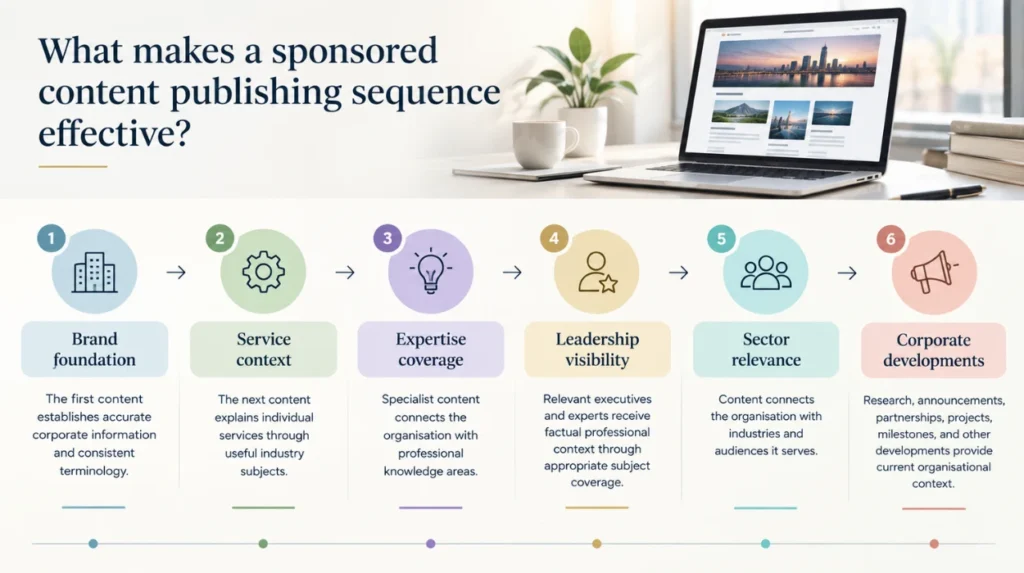
A sequence requires planning before publication.
The first stage establishes the corporate entity. Later stages expand relevant contextual relationships.
Brand foundation
The first content establishes accurate corporate information and consistent terminology.
Service context
The next content explains individual services through useful industry subjects.
Expertise coverage
Specialist content connects the organisation with professional knowledge areas.
Leadership visibility
Relevant executives and experts receive factual professional context through appropriate subject coverage.
Sector relevance
Content connects the organisation with industries and audiences it serves.
Corporate developments
Research, announcements, partnerships, projects, milestones, and other developments provide current organisational context.
This sequence creates different content purposes while maintaining consistent brand information.
When does a business need a sponsored content service?
A business needs a structured sponsored content service when it requires planned third-party publication, consistent brand information, specialist editorial development, media placement, compliance review, or broader coverage around its branded search presence.
Internal teams often manage websites, social profiles, press releases, and corporate communications separately. Sponsored content introduces additional publishing requirements.
A specialist service provides a defined workflow for content planning, development, review, publication, and monitoring.
This becomes particularly relevant when an organisation needs multiple articles covering different services, sectors, executives, or corporate developments.
For example, a growing UK consultancy entering three new sectors can require separate subject-led content for each sector rather than repeating one corporate profile.
What should businesses check before choosing sponsored content services?
Businesses should check publication relevance, editorial quality, brand accuracy, compliance processes, content ownership, disclosure practices, publication reporting, indexing status, and the provider’s ability to structure content around defined search and business entities.
The decision process requires measurable service details.
Publication relevance
Check whether publications match the intended sector, geography, audience, or subject.
Editorial standards
Review how content is researched, written, edited, and approved.
Brand accuracy
Confirm that names, services, executives, locations, statistics, and corporate descriptions remain accurate.
Compliance controls
Check whether claims receive appropriate review before publication.
Reporting
Confirm what publication details are provided after content goes live.
Content strategy
Assess whether the service creates distinct content subjects rather than publishing repetitive brand descriptions.
Why choose Times Intelligence Media Group for sponsored content services?
Times Intelligence Media Group provides sponsored content services focused on structured editorial publishing, brand information, sector relevance, specialist subjects, and third-party media placement for organisations developing stronger and more comprehensive branded search environments.
The service is designed around planned publication rather than isolated article production.
Content can be structured around corporate information, services, expertise, leadership, sectors, research, and developments. Each subject provides a defined reason for publication.
The process also supports consistency across multiple sponsored articles. Brand terminology remains controlled while individual articles address different search and audience contexts.
For organisations operating in regulated or specialist sectors, factual review provides an additional control point before publication.
The service can support businesses that need a managed workflow from content planning through publication.
How can a business start a sponsored content campaign with Times Intelligence Media Group?
A business can start by defining its brand information, target subjects, services, sectors, audience, publication requirements, and content objectives, then use Times Intelligence Media Group to structure, review, and publish the planned sponsored content.
The starting point is a defined content requirement.
Businesses can identify the services that require greater contextual coverage, the industries they serve, relevant executives, corporate developments, and specialist subjects.
The next step is mapping these subjects into a publishing sequence.
Times Intelligence Media Group can then support the content development and sponsored publication process according to the agreed requirements.
The result is a structured collection of third-party content that works alongside the organisation’s website and official profiles.
Businesses researching the broader relationship between sponsored articles and branded search can also review the keyword sponsored articles and branded search.
FAQs
Q1: How can sponsored content strengthen branded search results?
Ans: Sponsored content can create additional relevant, authoritative pages that appear when users search for a brand name. A consistent publishing strategy can expand branded search visibility beyond the company website and social profiles.
Q2: What should sponsored content include to support branded search visibility?
Ans: Sponsored content should include accurate brand information, relevant services, industry expertise, and consistent terminology. These elements help search engines and users connect published content with the organisation and its areas of expertise.
Q3: Can sponsored articles improve a company’s online brand presence?
Ans: Sponsored articles can expand a company’s digital presence by placing brand information across relevant publishing platforms. When content is accurate and contextually relevant, it can provide additional search results for branded queries.
Q4: How does Times Intelligence Media Group approach sponsored content for brand visibility?
Ans: Times Intelligence Media Group sponsored content can be structured around corporate information, services, expertise, sectors, leadership, and business developments. This creates a broader set of relevant content assets associated with the brand.
Q5: Why is consistency important in sponsored content publishing?
Ans: Consistent brand terminology and factual information help maintain a clear digital identity across sponsored articles and other online profiles. A structured publishing sequence also supports stronger topical relevance around branded search queries.



