

What are Times Intelligence Media Group sponsored content services with named authors and credentials?
Times Intelligence Media Group sponsored content services provide branded articles with identifiable authors, relevant credentials, verifiable sources, clear sponsorship context, and structured presentation, helping businesses publish attributable content that gives readers information about who created it and how evidence supports it.
Sponsored content is paid content published to communicate a company, service, product, campaign, research finding, or business message to a defined audience. A professional sponsored article separates commercial purpose from factual presentation.
Named authorship establishes who created the article. Credentials explain why that person has relevant knowledge or professional experience. Verifiable sources provide evidence behind factual statements.
Google states that clear authorship information helps visitors understand who created content. It also recommends accurate bylines and background information about authors where appropriate.
For businesses commissioning sponsored content, these elements form part of a transparent publishing process rather than functioning as a standalone ranking technique.
Named authors and expert credentials provide the educational context for understanding these requirements.
How does Times Intelligence Media Group prepare sponsored articles with named authors?
Times Intelligence Media Group structures sponsored articles around a defined subject, appropriate author, verified credentials, reliable sources, commercial disclosure, editorial requirements, and final quality checks before publication across the selected media environment.
1. Define the sponsored content subject
The process starts with the exact subject.
A clear subject determines the expertise required from the author and the evidence required for the article.
For example, a cybersecurity article requires knowledge of cybersecurity concepts, threat environments, controls, or relevant business practices. A financial services article requires appropriate financial knowledge and reliable financial sources.
2. Select an identifiable author
The article receives a specific author identity rather than an anonymous or generic attribution.
The author profile identifies the person’s name and relevant professional background. Google specifically recommends making it clear who created content and providing background information through bylines or author pages where appropriate.
3. Verify relevant credentials
Credentials connect the author to the subject.
Relevant evidence includes:
- Professional role
- Industry experience
- Academic qualifications
- Professional certifications
- Specialist publications
- Relevant professional activity
Credentials need to accurately represent the author’s background. Google warns against deceptive authorship information, fabricated creator profiles, and false credentials.
4. Build the evidence base
The article uses sources that directly support its factual claims.
Sources can include government publications, regulatory documents, recognised industry organisations, research institutions, company reports, statistical datasets, and other authoritative references relevant to the subject.
Named authors, credentials and verifiable sources explain how these elements are attached to sponsored content in practical publishing terms.
What components are included in named-author sponsored content?
A complete named-author sponsored article combines a visible byline, relevant author credentials, source-supported claims, transparent commercial context, focused editorial structure, accurate factual information, and appropriate publishing details for the intended United Kingdom audience.
Author byline
The byline identifies the person responsible for creating the article.
A useful byline contains the author’s actual name and does not rely on generic descriptions such as editorial team unless that attribution accurately represents the content creation process.
Author credentials
Credentials provide context about the author’s expertise.
For example, an article about employment law can identify an author with relevant legal experience. An article about cloud infrastructure can identify an author with relevant technology experience.
The credential needs to relate directly to the article’s subject.
Verifiable sources
Sources support factual statements with identifiable evidence.
A claim about UK employment legislation requires an appropriate legal or government source. A claim about market statistics requires a recognised dataset or research source.
This improves factual traceability and allows readers to inspect the evidence.
Sponsorship identification
Sponsored content needs clear commercial context.
The article remains useful to readers while making its commercial nature understandable. This distinction is important because Google emphasises content created primarily to help people rather than content created primarily to manipulate search rankings.
Editorial structure
The article uses a clear hierarchy.
A typical structure contains:
- Descriptive headline
- Author byline
- Author credentials
- Introduction
- Evidence-supported sections
- Relevant company or service information
- Supporting sources
- Commercial disclosure where applicable
- Relevant call to action
How are author credentials and sources checked before publication?
The checking process compares the author’s stated background with the subject, reviews factual claims against identifiable sources, checks names and professional details, confirms attribution accuracy, and removes unsupported statements before the sponsored article reaches publication.
Subject-to-author check
The first check compares the article topic with the author’s stated expertise.
An author covering enterprise cybersecurity needs credentials connected to cybersecurity, information technology, risk, compliance, or another directly relevant discipline.
Credential verification
Professional information is checked for consistency.
The publishing process avoids unsupported titles, invented qualifications, and credentials that do not relate to the subject.
Source verification
Each important factual claim requires an identifiable source.
For example, a statement about a UK regulation needs evidence from the relevant regulatory or government source. A statement about an industry trend requires evidence from credible research or data.
Content accuracy review
The final review checks:
- Names
- Dates
- Statistics
- Organisations
- Regulations
- Technical terminology
- Source attribution
- Author details
- Sponsorship information
Google’s guidance specifically asks whether content contains easily verifiable factual errors and whether the expertise involved is demonstrable.
What are the business benefits of sponsored content with transparent authorship?
Named authorship and relevant credentials give sponsored content clearer attribution, while verified sources improve factual traceability, and structured presentation helps businesses communicate expertise, services, research, and commercial information without presenting anonymous promotional material as independent editorial reporting.
Stronger content transparency
Readers can identify who created the article and understand the author’s relevant background.
This creates a clearer relationship between the content, author, subject, and evidence.
Better information traceability
Verifiable sources allow readers to investigate important claims.
This is particularly relevant for technical, regulatory, financial, healthcare, legal, and research-driven subjects where unsupported claims create information-quality problems.
Clearer expert positioning
A relevant author profile gives businesses a structured way to communicate subject expertise.
For example, a technology company publishing an article about artificial intelligence can use an author with relevant technology experience rather than assigning an unrelated generic author identity.
Better publishing consistency
A defined process creates consistent standards across multiple sponsored articles.
Each article can follow the same sequence: subject definition, author selection, credential confirmation, research, writing, factual review, sponsorship identification, and publication.
Explore More Expert Insights:
Times Intelligence Media Group Sponsored Content Services for Explainer and How-To Articles
Times Intelligence Media Group Research and Reports Services Sized to Your Brief
When do businesses use Times Intelligence Media Group sponsored content services?
Businesses use sponsored content services when they need attributable media content for brand communication, thought leadership, product information, industry education, campaign support, research communication, or service awareness with identifiable authors and evidence-based presentation.
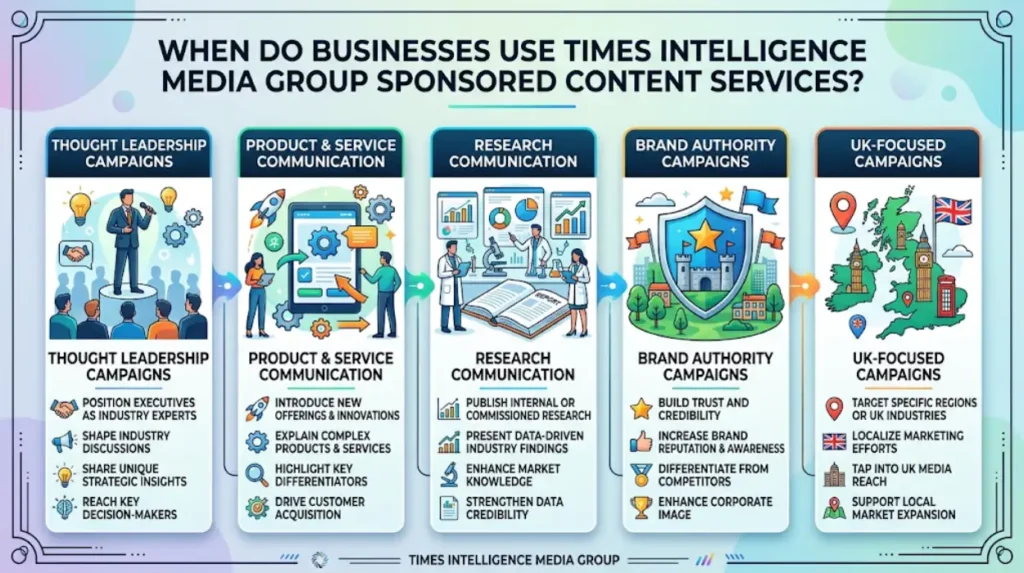
Thought leadership campaigns
Businesses publishing specialist insights can attach relevant authorship to articles covering their areas of expertise.
For example, a technology company can publish content about cloud computing, artificial intelligence, cybersecurity, or enterprise software through an appropriately qualified author.
Product and service communication
Sponsored articles can explain a product or service within a broader subject.
The content focuses on useful information while clearly identifying the commercial relationship.
Research communication
Organisations with proprietary research can use sponsored content to communicate findings, methodology, market observations, and business implications.
Important statistics require clear sourcing and accurate presentation.
Brand authority campaigns
Brands operating in specialist sectors can use named authorship to connect subject expertise with company communication.
Examples include financial services, technology, professional services, manufacturing, healthcare, energy, and business consulting.
UK-focused campaigns
UK businesses can structure sponsored content around subjects relevant to British audiences.
Examples include UK regulations, domestic market developments, business trends, professional practices, regional markets, and industry-specific developments.
How does Times Intelligence Media Group support the final sponsored content publication?
Times Intelligence Media Group supports the publishing workflow by organising the article around attributable authorship, relevant credentials, evidence-based content, transparent commercial presentation, structured formatting, and publication requirements established for the selected sponsored content campaign.
The final article needs consistency between its visible information and its underlying content.
The author name needs to match the stated author identity. Credentials need to describe the actual professional background. Sources need to support the factual claims they accompany.
Google also provides structured-data guidance for helping Search understand page content. Article-related structured data can include author information, while Google’s documentation provides examples using an author as a Person with a name and profile URL.
Structured data does not replace visible, accurate authorship. The information presented to users needs to remain consistent with the structured information.
Why choose Times Intelligence Media Group for named-author sponsored content?
Times Intelligence Media Group provides a structured sponsored content approach that connects author identification, professional credentials, source verification, editorial organisation, and commercial communication into one publishing workflow for businesses targeting defined audiences and specialist subjects.
The service is designed for campaigns where attribution and evidence form important parts of the content specification.
Businesses can define:
- Target audience
- Subject area
- Campaign objective
- Author requirements
- Credential requirements
- Source requirements
- Geographic audience
- Commercial message
- Publication requirements
This creates a documented content specification before publication.
The approach also aligns with Google’s broader people-first guidance, which emphasises original value, clear authorship, demonstrable expertise, reliable information, and content created primarily to help users rather than manipulate search rankings.
How can a business start a sponsored content campaign with named authors?
A business can begin by defining its subject, audience, campaign objective, preferred author expertise, evidence requirements, commercial message, and publishing requirements, then use Times Intelligence Media Group to organise these elements into a structured sponsored content workflow.
Start with the subject and intended audience.
Define the expertise required for the author.
Identify the claims that require supporting evidence.
Prepare company information that needs to appear in the article.
Confirm the desired UK audience and publication requirements.
Then establish the final article specification before writing and publication.
For businesses seeking sponsored content with identifiable authors, relevant credentials, verifiable sources, and structured commercial communication, Times Intelligence Media Group Sponsored Content Services With Named Authors and Credentials provides a defined route from content requirements to publication.
FAQs
Q1: What should sponsored content include about the author and their credentials?
Ans: Sponsored content should identify the named author and provide relevant credentials that demonstrate subject expertise. Author bios, professional experience, qualifications, and verifiable sources can strengthen content transparency and credibility.
Q2: Why are named authors important in sponsored content?
Ans: Named authors make it clear who researched and wrote the sponsored article. Author attribution supports transparency and helps readers assess the writer’s relevant experience and subject knowledge.
Q3: How can credentials improve the credibility of sponsored articles?
Ans: Relevant credentials show that the author has appropriate knowledge or experience in the subject covered. Credentials should be accurate, specific, and supported by verifiable professional information where possible.
Q4: Should sponsored content include verifiable sources?
Ans: Yes, sponsored articles should use reliable and relevant sources when making factual or data-based claims. Clear source attribution helps readers verify information and improves the transparency of the content.
Q5: How does Times Intelligence Media Group handle named authors and credentials in sponsored content?
Ans: Times Intelligence Media Group Sponsored Content Services can structure sponsored articles with clear author attribution, relevant credentials, and verifiable sources. These elements help distinguish the content creator and provide readers with context for evaluating the information presented.



