

Sponsored content is paid editorial material created to communicate information about a company, product, service, organisation, or issue. Its presentation does not remove the need for clear authorship, reliable sourcing, and useful information.
Google’s E-E-A-T framework refers to Experience, Expertise, Authoritativeness, and Trustworthiness. These concepts help assess whether content provides reliable value for users. E-E-A-T is not a single ranking factor or a certification. It is a framework used in Google’s search quality guidance to describe important characteristics of high-quality content.
Named authors and expert credentials provide identifiable information about who created content and why that person has relevant knowledge. Verifiable sources provide evidence for factual statements. Together, these elements establish context around the content.
What does E-E-A-T mean for sponsored content?
E-E-A-T describes experience, expertise, authoritativeness, and trustworthiness, which help users and quality evaluators understand content quality. Sponsored articles need clear authorship, relevant expertise, accurate information, and transparent sourcing when those elements affect credibility.
Experience
Experience concerns the extent to which content reflects first-hand involvement with a subject. A person who has directly worked with a process, product, profession, or situation can provide experience-based information.
For example, an accountant discussing practical financial reporting procedures has professional experience relevant to accounting content. A journalist covering an industry event has direct reporting experience when the article accurately reflects observed information and documented statements.
Expertise
Expertise concerns demonstrated knowledge of a subject. Credentials can establish relevant expertise when they accurately represent the author’s background.
Examples include:
- A solicitor writing about UK employment law.
- A chartered accountant explaining financial reporting.
- A cybersecurity professional discussing security controls.
- A medical professional explaining a clinical topic.
Credentials need to relate directly to the subject. A general professional title does not automatically establish expertise in every topic.
Authoritativeness
Authoritativeness concerns the credibility of the content creator, the website, and the information provided. A recognised professional background, established publication record, accurate references, and reliable external sources contribute to contextual understanding.
Trustworthiness
Trustworthiness concerns whether users can understand who created the content, whether claims are supported, and whether important information is presented accurately and transparently.
For sponsored content, transparency also includes identifying the commercial nature of the material when required by applicable advertising and publishing standards.
Why does a named author matter in sponsored content?
A named author gives sponsored content an identifiable creator and establishes accountability for the information presented. It helps users understand authorship, evaluate relevant expertise, distinguish editorial responsibility, and investigate the author’s professional background.
An author byline answers a basic information question: who created this material?
A generic label such as Editorial Team provides less information about individual responsibility. A specific byline gives readers an identifiable person associated with the article.
Author identification also creates a connection between the article and the author’s professional background. An author profile can contain relevant qualifications, professional experience, areas of specialisation, and published work.
This information becomes particularly important for specialised subjects. Technical, financial, legal, medical, scientific, and regulatory topics require subject-specific knowledge.
What information belongs in an author profile?
A useful author profile contains factual information directly relevant to the published subject.
Common elements include:
- Full author name.
- Professional role.
- Relevant qualifications.
- Professional experience.
- Areas of expertise.
- Relevant professional affiliations.
- Links to appropriate author pages or published work.
The information must accurately represent the individual. Credentials do not function as decorative elements. They establish context for evaluating the author’s knowledge.
How do expert credentials support content credibility?
Expert credentials connect an author’s documented knowledge to the subject covered in an article. Relevant qualifications, professional roles, industry experience, and specialist knowledge provide users with factual context when assessing the reliability of specialised information.
Credentials are most useful when they have a direct relationship with the subject.
For example, an article explaining UK tax compliance benefits from an author with relevant accounting or tax experience. An article explaining network security benefits from an author with cybersecurity expertise.
A credential becomes less meaningful when it has no connection to the subject. A marketing qualification does not establish specialist authority on clinical diagnosis. A general management position does not establish legal expertise.
What makes credentials verifiable?
Verifiable credentials can be connected to reliable professional information.
Verification can involve:
- An official professional profile.
- A recognised professional register.
- An employer or institutional biography.
- A university or professional body profile.
- A documented publication record.
- Relevant professional certifications.
The purpose is factual verification. The article does not need an extensive biography. It needs enough information to establish why the author is relevant to the topic.
Why are verifiable sources important for sponsored articles?
Verifiable sources allow readers to check factual claims against identifiable evidence. They strengthen transparency by connecting statistics, research findings, regulations, and other substantive statements to recognised primary or authoritative information.
Sponsored content frequently includes factual claims about markets, products, regulations, research, statistics, consumer behaviour, or industry developments.
These claims require evidence when they present information as fact.
A source should identify where the information originated. Examples include government departments, regulators, universities, peer-reviewed research, recognised professional organisations, official datasets, and original company documents.
For example, UK employment information can reference official government or regulatory material. A scientific claim can reference the underlying research publication. A market statistic can reference the organisation responsible for collecting or publishing the data.
What makes a source useful?
A useful source has identifiable authorship or institutional responsibility, relevant evidence, and a direct relationship with the claim.
Source quality also depends on the type of information being supported. A government regulation requires an authoritative regulatory source. A research finding requires access to the underlying study. A company product specification requires the relevant official documentation.
Search snippets do not replace source verification. A secondary article does not automatically establish the original evidence behind a claim.
Explore More Expert Insights:
What Is a Sponsored Explainer Article and When Does It Work Better Than a Brand Announcement?
How Long Should a UK Industry Research Report Be to Hold Reader and Journalist Attention?
How should authors, credentials, and sources be added to sponsored content?
Authors, credentials, and sources belong in clearly identifiable parts of the article. The byline identifies the creator, the author profile establishes relevant expertise, and citations connect factual claims to verifiable evidence.
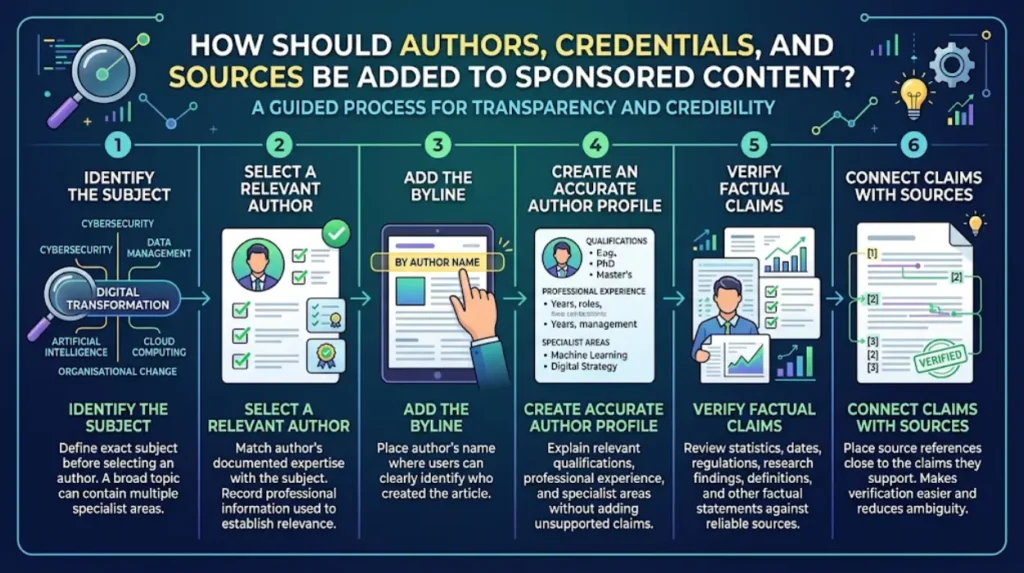
A consistent publishing process improves transparency.
Step 1: Identify the subject
Define the exact subject before selecting an author. A broad topic can contain multiple specialist areas.
For example, digital transformation can involve cybersecurity, data management, artificial intelligence, cloud computing, or organisational change. Each area requires different subject knowledge.
Step 2: Select a relevant author
Match the author’s documented expertise with the subject. Record the professional information used to establish relevance.
Step 3: Add the byline
Place the author’s name where users can clearly identify who created the article.
Step 4: Create an accurate author profile
Explain relevant qualifications, professional experience, and specialist areas without adding unsupported claims.
Step 5: Verify factual claims
Review statistics, dates, regulations, research findings, definitions, and other factual statements against reliable sources.
Step 6: Connect claims with sources
Place source references close to the claims they support. This makes verification easier and reduces ambiguity about which evidence supports each statement.
What components establish credibility in a sponsored article?
Credibility in sponsored content comes from several connected components: identifiable authorship, relevant expertise, accurate credentials, reliable evidence, transparent commercial disclosure, factual accuracy, and clear separation between supported information and promotional claims.
These components serve different purposes.
| Component | Primary function |
|---|---|
| Named author | Identifies content responsibility |
| Author credentials | Establishes relevant expertise |
| Author profile | Provides professional context |
| Primary sources | Supports factual claims |
| Research sources | Supports evidence-based statements |
| Government sources | Supports official information |
| Regulatory sources | Supports compliance information |
| Commercial disclosure | Clarifies the sponsored nature |
| Accurate references | Enables verification |
No single component establishes every aspect of content quality. The elements work together to provide users with context.
How does clear authorship improve transparency?
Clear authorship improves transparency by showing who created the material and allowing readers to investigate that person’s relevant background. It establishes identifiable responsibility instead of presenting specialised information without an identifiable creator.
Transparency becomes particularly important when sponsored content resembles conventional editorial material.
A byline distinguishes individual authorship from anonymous publication. An author page provides additional context. A professional biography explains relevant experience.
Transparency also requires accurate representation. An author must not be presented as a specialist without evidence supporting that description.
How do named experts and sources affect different types of sponsored content?
The importance of authorship and sourcing increases with subject complexity and potential user impact. Legal, financial, medical, scientific, technical, and regulatory content requires particularly clear expertise, accurate evidence, and reliable supporting sources.
Different subjects require different evidence structures.
Financial content
Financial articles can involve taxation, investment, accounting, banking, or corporate reporting. Relevant professional expertise and authoritative financial sources provide essential context.
Legal content
Legal articles require accurate references to legislation, regulations, courts, or recognised legal authorities. A relevant legal professional can provide subject-specific expertise.
Health content
Health-related content requires careful sourcing and appropriate subject expertise because factual errors can affect personal decisions. Relevant medical or scientific credentials provide important context.
Technical content
Technical articles often involve specialist systems, standards, specifications, or procedures. Authors with relevant technical experience can explain complex subjects accurately.
Business content
Business articles can involve management, procurement, operations, human resources, strategy, or market analysis. Author expertise needs to correspond with the specific business subject rather than business topics generally.
How can publishers check whether sponsored content meets E-E-A-T principles?
Publishers can review sponsored content by checking author identity, credential relevance, source quality, factual accuracy, transparency, and claim-to-source connections before publication. Each element requires factual verification against appropriate evidence.
A practical review can follow a six-part checklist:
- Author: Is the author clearly identified?
- Expertise: Does the author have relevant knowledge?
- Credentials: Are qualifications and professional claims accurate?
- Evidence: Are substantive factual claims supported?
- Sources: Are sources identifiable and appropriate?
- Transparency: Is the sponsored nature of the content clearly communicated?
This process creates a documented quality check before publication.
The review also separates two different questions: whether the content contains useful information and whether the commercial relationship is transparent. Both affect how readers understand sponsored material.
What should readers look for when evaluating sponsored content?
Readers can evaluate sponsored content by checking the author’s identity, relevant credentials, supporting sources, publication transparency, factual claims, and evidence. These details provide practical information for assessing how the article was produced.
Readers can start with the byline. They can then review the author profile and check whether the stated expertise matches the subject.
The next step is source verification. Important statistics and factual claims need identifiable evidence.
Readers can also distinguish factual information from promotional statements. A sponsored article can contain useful information while also serving a commercial purpose. Recognising that context helps readers interpret the material accurately.
For publishers and content creators, these principles establish a clear framework for producing sponsored articles with identifiable authorship, relevant expertise, verifiable evidence, and transparent presentation.
For readers, they provide practical signals for understanding who produced an article, what knowledge supports it, and where its factual claims originate.
A deeper examination of the publishing process is covered in named author, credentials and verifiable sources, which focuses on attaching these elements to a sponsored article.
FAQs
Q1: Why do named authors matter for sponsored content under Google’s E-E-A-T guidelines?
Ans: Named authors provide clear authorship and help readers understand who created the sponsored content. Author information can also provide context about the writer’s experience and expertise on the subject.
Q2: How do expert credentials support E-E-A-T in sponsored content?
Ans: Expert credentials show relevant knowledge, professional experience, or qualifications connected to the topic. For sponsored content, clear credentials can help establish who is qualified to provide the information presented.
Q3: Should sponsored content include an author bio and credentials?
Ans: Yes, an author bio can identify the writer and explain relevant experience, qualifications, or subject expertise. This information helps readers assess the source and supports transparency around content authorship.
Q4: Does Google require expert credentials for sponsored content?
Ans: Google does not require every sponsored article to display specific professional credentials. However, demonstrating appropriate experience, expertise, and trustworthy authorship can help readers understand the reliability and context of the content.
Q5: How can Times Intelligence Media Group improve author transparency in sponsored content?
Ans: Sponsored content can include a named author, a relevant author bio, professional background, and clear sponsorship disclosure. These elements make authorship and the commercial nature of the content easier for readers and search systems to understand.



