

What is a reader-question topical map?
A reader-question topical map organises recurring audience questions into connected content topics, search intents, entities, and subtopics, showing where existing coverage is strong and where competitors leave identifiable information gaps.
A topical map defines the subject coverage required for a website to demonstrate depth around a specific theme. A reader-question topical map starts with questions instead of isolated keywords. It connects those questions to search intent, entities, content formats, and related subjects.
Reader questions provide direct evidence of information demand. Repeated questions identify subjects that audiences actively seek. Similar questions reveal relationships between topics. Unanswered questions identify potential content gaps.
For example, a media company researching public relations can identify questions about press distribution, media targeting, journalist outreach, brand visibility, news indexing, and campaign measurement. These questions form related topic groups rather than separate keyword targets.
The process also extends the work described in the Reveal Search Demand educational stage. The focus moves from identifying search demand to organising that demand into a structured content system.
Why do question patterns matter?
Question patterns reveal how audiences divide a subject into smaller information needs. A single topic such as press distribution contains multiple search intents.
Examples include:
- What is press distribution?
- How does press distribution work?
- Which publications receive a press release?
- How does Google News indexing affect press coverage?
- How can organisations measure press distribution results?
- What information belongs in a press release?
Each question represents a distinct information requirement. Grouping these requirements creates a clearer topical structure.
How do you identify recurring question patterns across audience research?
Recurring question patterns emerge when similar information needs appear across search queries, audience research, content interactions, media coverage, and competitor pages, allowing related questions to be grouped by subject, intent, entity, and stage.
The first step is collecting questions without immediately assigning them to articles. The raw question set provides the evidence required for classification.
Search queries provide one source. Existing articles provide another. Frequently asked questions, editorial requests, customer conversations, industry discussions, and audience research add further question signals.
The collected questions then require normalisation. Different wording can represent the same underlying information need.
For example:
- How does press distribution work?
- How are press releases distributed?
- What happens after a press release is distributed?
These questions share a distribution-process theme but represent different stages of the same information journey.
Which patterns deserve separate content?
Separate content is appropriate when questions have different search intents, entities, processes, or required evidence.
For example, how to distribute a press release and how to measure press distribution results require different information. Combining both subjects into one short page reduces depth.
Questions with the same intent and entity can form one content cluster. Questions with different intent but a strong relationship can become supporting pages within the same topical group.
How should similar questions be classified?
Classification works through four core dimensions:
- Topic — the primary subject.
- Entity — the person, organisation, process, platform, service, or concept involved.
- Intent — the information need behind the question.
- Content role — the position of the question within the wider topical map.
This structure converts unorganised questions into usable content intelligence.
How do you convert reader questions into a topical map?
Convert reader questions into a topical map by grouping related questions into topic clusters, assigning search intent and entities, identifying parent and supporting topics, and connecting each cluster to defined content coverage requirements.
Start with the broad subject. Then identify the major entities associated with it. After that, group questions according to their relationships.
For example, a topical map for media research and reporting can include:
- Research reports
- Audience insights
- Data analysis
- Media trends
- Industry research
- Regional audience behaviour
- Rapid-response reporting
- Evidence-based editorial content
Each topic contains smaller question groups.
What does a question-led topic cluster contain?
A useful cluster contains a parent topic and supporting questions.
For example, audience insights can contain questions about:
- Audience demographics
- Audience interests
- Search behaviour
- Content preferences
- Regional differences
- Question patterns
- Information gaps
- Competitor coverage
The parent topic establishes the subject. Supporting questions establish the required depth.
The map also records relationships between topics. Audience insights connect with search demand analysis. Search demand connects with content planning. Content planning connects with topical authority.
How do entities improve topical map accuracy?
Entities provide precise meaning. An entity represents a defined subject such as a media publication, audience segment, search platform, research method, industry, service, or geographic market.
For example, UK regional news audiences represent an audience entity. Google Search represents a search platform entity. Press distribution represents a media activity entity.
Entity relationships prevent a topical map from becoming a collection of disconnected keywords. They establish how subjects interact within the wider information system.
How do you find content gaps that competitors have missed?
Competitor content gaps appear when audience questions have clear relevance but competing pages provide incomplete, outdated, disconnected, or absent coverage, leaving identifiable information needs outside their existing topical structures.
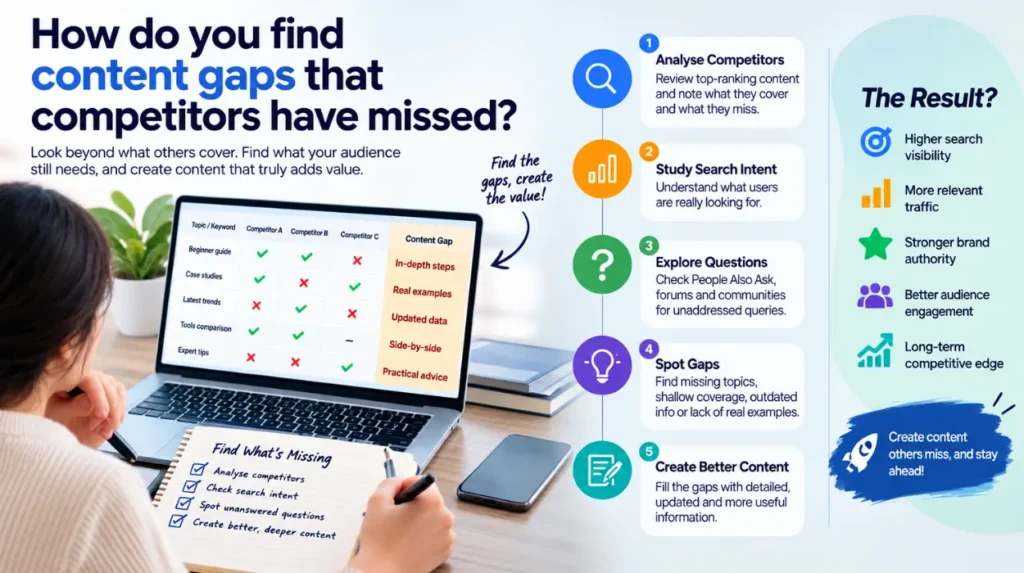
Competitor analysis starts with coverage comparison. It does not stop at counting pages or matching keywords.
A competitor can rank for a broad subject while missing important supporting questions. Another competitor can publish many articles but fail to connect related entities into a coherent topical structure.
The comparison requires question-level analysis.
What types of competitor gaps can question patterns reveal?
Several gap types are measurable.
Coverage gaps occur when competitors do not address a relevant question.
Depth gaps occur when competitors mention a subject without explaining its important components.
Entity gaps occur when related entities are absent from existing coverage.
Intent gaps occur when competitors address one search intent while ignoring another.
Freshness gaps occur when published information does not reflect current data, regulations, industry developments, or audience behaviour.
For example, a competitor page about UK media distribution can explain distribution channels while omitting audience segmentation, regional publication differences, indexing, measurement, and question-led planning.
Those omissions create specific opportunities for broader topical coverage.
How should gaps be prioritised?
Prioritisation uses relevance, audience demand, topical relationship, competitor coverage, and business context.
A question directly connected to the primary subject receives greater structural importance than an unrelated question with similar wording.
The map also identifies foundational questions. A definition page can support several detailed pages. A measurement topic can connect to reporting methodology. A regional topic can connect to audience behaviour.
This creates an interconnected information architecture.
How should question clusters connect to existing content?
Question clusters connect to existing content through contextual internal links, parent-child topic relationships, consistent entities, and clear search intent, creating a structured path between foundational information and detailed supporting content.
Existing content provides the starting architecture. New questions do not automatically require new pages.
A content audit identifies pages that already answer part of the question set. Those pages can then be expanded, consolidated, or connected.
For example, an existing article about audience research can link to supporting content about question patterns, search demand, regional audiences, and competitor coverage gaps.
The internal structure becomes stronger when each page has a defined topical role.
What makes an internal link contextually relevant?
A contextual internal link connects two pages because they address related information needs.
The anchor text identifies the relevant concept. The surrounding sentence explains the relationship.
For example, an article explaining search demand can link naturally to content about audience insights services when the discussion moves from audience questions to structured research.
The BOFU stage can then provide information about question-led topical authority planning for readers who need a defined service approach.
Internal linking works best when links follow the subject relationship rather than being inserted only for navigation.
How can a topical map reveal opportunities competitors have not covered?
A topical map reveals overlooked opportunities by comparing the complete question set with competitor coverage, exposing unanswered questions, weak supporting topics, missing entities, incomplete processes, and disconnected information across the same subject.
The map provides a coverage matrix. Each question receives a status such as covered, partially covered, or absent.
The comparison then identifies clusters where competitors have limited depth.
For example, competitors covering media research often focus on reports and statistics. Question analysis can identify additional information needs around audience segmentation, regional demand, source verification, rapid-response data, editorial interpretation, and content application.
The resulting opportunities are specific. They are not based on assumptions about competitor weaknesses.
Why are overlooked supporting topics important?
Supporting topics strengthen subject completeness. Search engines and readers encounter related questions around a primary subject.
A page about audience research becomes more comprehensive when connected to audience segmentation, question analysis, search demand, content planning, data interpretation, and competitor coverage.
These supporting topics also create additional entry points into the website.
A strong topical map therefore measures coverage across the entire subject rather than focusing on one high-volume keyword.
How can reader-question topical mapping support content planning?
Reader-question topical mapping turns audience demand into a structured publishing framework, helping teams define priority topics, supporting pages, internal links, content formats, evidence requirements, and coverage gaps before production begins.
The map becomes a practical editorial planning document.
Each topic can receive a defined content role. Foundational pages explain core concepts. Supporting pages answer specific questions. Comparative pages address distinctions between related subjects. Research-led pages present evidence and data.
This approach also reduces duplicate content.
When two questions address the same intent, they can be consolidated. When one question requires distinct evidence, it receives separate coverage.
What content formats can support different questions?
Different questions require different formats.
- Definitions work well in explanatory articles.
- Process questions require step-by-step guides.
- Data questions require research reports.
- Comparison questions require structured comparisons.
- Regional questions require location-specific analysis.
- Current-event questions require rapid-response reporting.
- Service questions require detailed solution pages.
The format follows the information requirement.
Explore More Expert Insights:
How to Use Audience Insights to Choose Between Contextual and Behavioural Targeting for a UK Campaign
How to Build a Consent-Led Audience Data Collection Process That Still Delivers Usable Insights
Where can question-led topical mapping be used?
Question-led topical mapping applies to media research, business content, public relations, audience analysis, industry reporting, service marketing, editorial planning, and search-focused publishing where audience questions define the required depth of subject coverage.
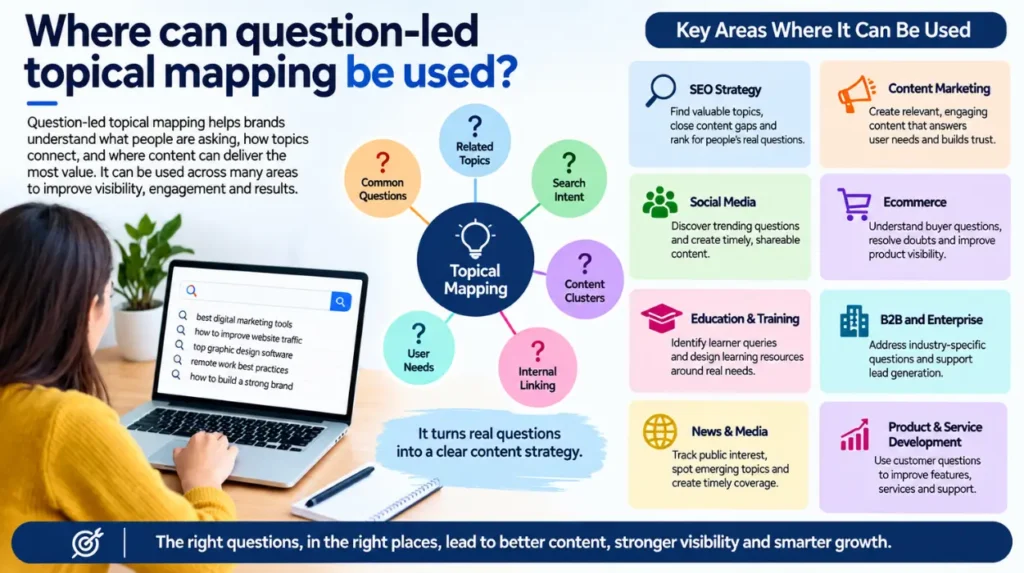
Media organisations can use question patterns to identify information demand around industries, audiences, regions, and current events.
Business publishers can map questions around services, market changes, regulations, and operational challenges.
Public relations teams can identify recurring questions around media visibility, distribution, reputation, and audience engagement.
Research teams can use the same structure to organise evidence around defined audience information needs.
How does this approach support UK-focused content planning?
UK content planning requires attention to UK audiences, regional media structures, local search behaviour, and sector-specific information needs.
For example, a topical map covering UK media audiences can distinguish national publications from regional titles. It can also separate audience questions by industry, location, and information requirement.
This creates more precise content coverage than a single national keyword strategy.
How does a question-led topical map improve topical authority planning?
A question-led topical map improves topical authority planning by connecting audience demand, entities, search intent, content relationships, and competitor gaps into one structured coverage model that supports comprehensive and evidence-led publishing.
Topical authority depends on meaningful subject coverage. Question patterns provide a practical method for defining that coverage.
The process begins with audience questions. It continues through classification, clustering, entity mapping, competitor comparison, gap identification, content planning, and internal linking.
The result is a structured information system rather than a list of isolated article ideas.
For teams developing this approach at a deeper strategic level, audience insights services provide a route from question research to structured audience and topical authority planning.
The key output is a map showing what audiences ask, what competitors cover, what information remains incomplete, and how related content connects.
This makes content planning more measurable. Each new page has a defined topical purpose. Each internal link has a defined relationship. Each identified gap has a documented question behind it.
Reader questions therefore become more than search queries. They become a framework for defining complete subject coverage and identifying areas where existing competitor content does not answer the information needs of the target audience.
FAQs
Q1: How can reader questions help identify content gaps?
Ans: Reader questions reveal the specific topics, concerns, and search intents that existing content may not fully address. Grouping recurring questions helps identify content gaps and opportunities for more complete topic coverage.
Q2: How do you turn reader questions into a topical map?
Ans: Organise reader questions into related topic clusters based on search intent, subject relevance, and the depth of information required. The resulting topical map can connect primary topics, supporting subtopics, and unanswered questions into a structured content plan.
Q3: How can a topical map reveal gaps competitors have missed?
Ans: Compare your question-based topic clusters with the subjects and subtopics covered by competing content. Questions that show clear reader interest but receive limited or incomplete competitor coverage can indicate potential content gaps.
Q4: What types of reader questions should be included in a topical map?
Ans: Include questions covering definitions, processes, problems, comparisons, use cases, benefits, costs, and practical decision-making. These question patterns help create broader topic coverage while matching different stages of search intent.
Q5: How can businesses use reader question patterns for SEO content planning?
Ans: Businesses can analyse recurring reader questions to prioritise topics based on relevance, search intent, and existing content coverage. Times Intelligence Media Group can use these patterns to structure topic clusters that address unanswered questions and strengthen topical relevance.



