

What is contextual targeting and behavioural targeting on UK news sites?
Contextual targeting places advertisements based on the specific editorial content of a webpage at the moment of consumption. Behavioural targeting delivers advertisements based on an individual user’s historic online browsing activity, demonstrated interests, and tracked digital actions over time.
Contextual targeting analyses the environment where an advertisement appears. On UK news sites, contextual engines process published text, category taxonomy, and article sentiment. The system evaluates the page content instantly when a user loads an article. An advertisement for motor insurance appears on an article discussing vehicle safety standards. The advertisement matches the reader’s immediate focus rather than the reader’s historical activity.
Behavioural targeting analyses the individual viewing the advertisement. This method tracks user actions across digital platforms over extended periods, such as 30 to 90 days. Tracking scripts store browser interactions, search queries, page visits, and click records. A reader viewing a weather report on a UK news platform receives a travel advertisement because their historical record shows previous visits to flight booking websites. The advertisement matches the user profile regardless of the current article topic.
The fundamental distinction resides in the source of relevance. Contextual targeting relies on real-time content environment data. Behavioural targeting relies on personal user tracking data. Both methods operate within the legal frameworks of the United Kingdom, including the UK General Data Protection Regulation (UK GDPR), the Data Protection Act 2018, and the Privacy and Electronic Communications Regulations (PECR). The Information Commissioner’s Office (ICO) enforces these regulations across all digital publishing channels.
How do contextual and behavioural targeting mechanisms work on news websites?
Contextual mechanisms scan page text, metadata, and image tags using natural language processing to categorise content instantly. Behavioural mechanisms collect user identifiers, track cross-site navigation history over 30 to 90 days, build audience segments, and serve matching ads upon page load.
The Technical Workflow of Contextual Ad Placement
The contextual targeting process initiates when a news publisher publishes an article or when a user requests a URL. An automated web crawler or real-time page scraper inspects the published document. Natural language processing algorithms parse text elements, including headlines, subheadings, body text, and embedded image captions. The algorithm classifies the article into standardised categories established by the Interactive Advertising Bureau (IAB), such as Business, Technology, or Sports.
The system calculates semantic sentiment and safety parameters within 100 milliseconds. Sentiment analysis identifies whether an article discusses positive, neutral, or negative events, such as corporate earnings or industrial accidents. Brand safety filters evaluate keywords to prevent ad placements alongside controversial or sensitive news events, such as civil unrest or natural disasters. The ad server matches advertiser criteria with the derived page taxonomy and serves the advertisement to the matching slot.
The Technical Workflow of Behavioural Ad Placement
The behavioural targeting process relies on continuous data collection across multiple web domains. When a user visits a digital platform, consent management platforms prompt the visitor to accept or decline tracking cookies under PECR requirements. Upon consent, tracking scripts deposit unique alphanumeric identifiers within the user’s web browser or mobile storage.
Data management platforms aggregate these identifiers to compile browsing profiles. The system records specific actions, such as visiting 5 real estate pages within 14 days or clicking 3 retail product links. These actions place the user into predefined audience segments, such as prospective homebuyers or fashion consumers. When the user visits a news site, the ad exchange requests the user ID, matches the profile to active campaign parameters, and bids on the available ad impression.
Explore More Expert Insights:
What Do UK GDPR and PECR Mean for the Way Audience Data Is Collected From News Readers?
Why relying purely on email newsletters limits the public mobilisation potential of new foundations
What key components distinguish contextual targeting from behavioural targeting?
Contextual targeting relies on page URL structure, Interactive Advertising Bureau categories, keyword sentiment, and real-time editorial context. Behavioural targeting relies on unique browser identifiers, third-party and first-party cookie data, IP addresses, historical interaction logs, and audience segment profiles.
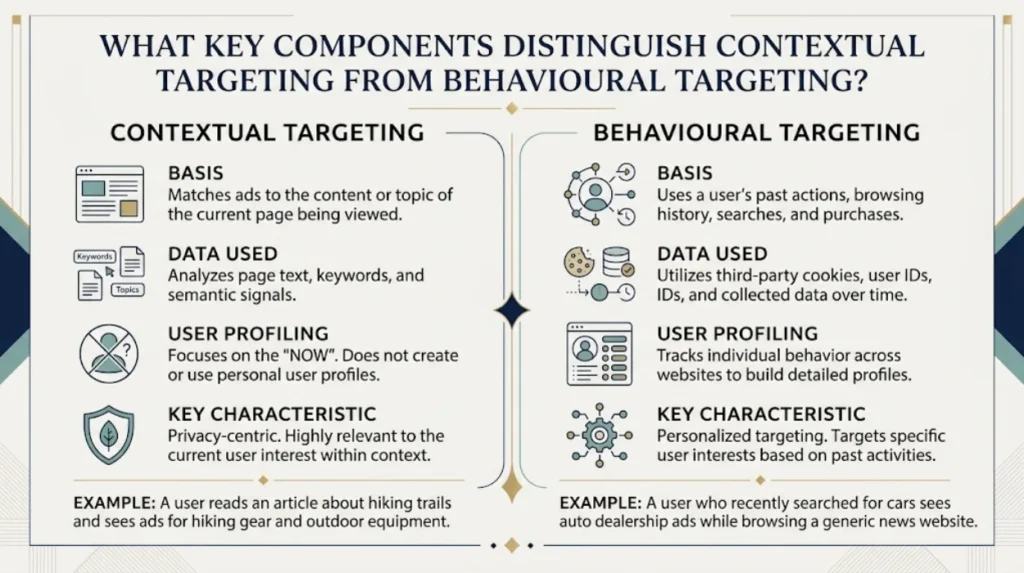
Core Data Inputs for Contextual Systems
Contextual frameworks utilise non-personal data points derived directly from the host document. Key components include page metadata, open-graph tags, URL strings, and language structures. Publishers configure structural taxonomies that divide news websites into distinct verticals, such as politics, personal finance, culture, and lifestyle.
Real-time context engines analyse keyword density and contextual proximity. For instance, the presence of the word “bank” near “central rates” indicates a financial topic, whereas “bank” near “river” indicates a geographical topic. The system evaluates these linguistic associations without storing individual user identities, IP addresses, or device signatures.
Core Data Inputs for Behavioural Systems
Behavioural frameworks depend on personal data attributes linked to individual devices or authenticated user accounts. Key components include third-party tracking cookies, first-party publisher cookies, device fingerprints, and local storage tokens. These identifiers persist across multiple web sessions to record user navigation pathways.
Data technology platforms construct behavioural profiles using 3 primary layers of data:
- First-party interaction logs: Direct records of user activity on a specific news domain, such as saved articles, subscription status, and section visits.
- Third-party tracking data: Cross-site navigation records collected across unaffiliated commercial websites, e-commerce stores, and search portals.
- Deterministic identity graphs: Linked identity records established when users log into publisher platforms using verified email addresses or universal ID networks.
Regulatory Dependencies and Technical Constraints
Contextual components operate independently of user consent mechanisms because they process non-personal environment data. Behavioural components require explicit user consent under Article 6 of the UK GDPR and PECR regulations. The ongoing deprecation of third-party cookies in major web browsers limits the longevity and scale of cross-site behavioural tracking components on digital news platforms.
What are the primary benefits of contextual and behavioural targeting for UK news campaigns?
Contextual targeting ensures strict privacy compliance, eliminates user tracking consent requirements, protects brand safety through real-time sentiment analysis, and reaches readers during active intent. Behavioural targeting provides precise audience relevance, cross-site user retargeting capabilities, and historical interest matching across news sections.
Advantages of Editorial Context Alignment
Contextual targeting provides total immunity to privacy regulation changes and browser cookie restrictions. Campaigns using contextual mechanisms do not process personal data, eliminating compliance liabilities under the Data Protection Act 2018. Advertisers achieve immediate scale across 100% of UK news site traffic because ad delivery does not depend on user consent opt-in rates.
Contextual alignment places messages directly within relevant mindsets. A reader consuming an article on home renovation displays active interest in building supplies and architectural design. Advertisements delivered in this context generate high engagement due to immediate topical relevance. Additionally, real-time sentiment analysis ensures brands avoid appearing next to negative news stories, such as natural disasters or financial crises.
Advantages of Audience Profile Matching
Behavioural targeting enables advertisers to reach specific consumer demographics regardless of the article content being consumed. A brand seeking frequent business travellers delivers ads to identified users while those users read sports news, entertainment reviews, or local political reporting. This capability expands inventory options beyond over-subscribed endemic news sections.
Behavioural mechanisms support sequential messaging and frequency capping across campaigns. Marketers track how many times a unique user views an advertisement across 30 days. Systems deliver progressive campaign messages based on prior user actions, such as showing a product offer only after a user views an initial introductory video ad.
When should advertisers deploy contextual targeting versus behavioural targeting on news platforms?
Contextual targeting delivers optimal results for top-of-funnel brand awareness, high-intent product launches, and privacy-restricted sectors like financial services or healthcare. Behavioural targeting yields optimal results for direct-response retargeting, highly niche demographic reach, and repeat consumer engagement strategies across general news inventory.
High-Intent Content Scenarios
Contextual targeting excels in campaign scenarios where consumer mindset directly aligns with specific editorial environments. B2B software providers capture qualified leads by placing ads within technology and corporate finance sections of news platforms. Automotive manufacturers launch new electric vehicle models by targeting environmental coverage, green energy reports, and motoring columns.
Regulated industries, such as pharmaceutical products, legal services, and financial advisory firms, leverage contextual targeting to mitigate legal risks. These sectors avoid processing sensitive personal data while still reaching audiences seeking relevant advice or product information. Strategic planners analyse audience insights to select the appropriate delivery mechanism for specific commercial goals.
Audience Retargeting and Demographic Scenarios
Behavioural targeting serves specific strategic requirements focused on user attributes rather than page topics. E-commerce retailers deploy behavioural retargeting to re-engage consumers who abandoned digital shopping carts within the previous 7 days. The news platform displays personalised product ads to these specific individuals as they read breaking news updates.
Niche consumer targeting also relies on behavioural frameworks. Luxury watch brands target high-net-worth individuals by building segments based on past visits to luxury travel portals, premium real estate listings, and wealth management content. The ad delivers across general news sections, optimising media spend by filtering out non-qualifying readers.
How do UK privacy regulations and cookie deprecation shape the future of news site targeting?
Regulatory enforcement by the Information Commissioner’s Office and the deprecation of third-party tracking cookies reduce behavioural targeting scalability on UK news sites. Consequently, publishers and advertisers increasingly adopt privacy-first contextual targeting alongside publisher-owned first-party data strategies to maintain advertising effectiveness.
The Shift Toward Privacy-Preserving Targeting Models
The regulatory framework in the United Kingdom creates operational friction for traditional behavioural tracking models. The ICO requires explicit, freely given consent before tracking technologies store or retrieve information from user devices. Consent opt-in rates on UK news websites vary between 40% and 70%, leaving a substantial portion of site traffic unaddressable through third-party behavioural profiling.
Web browser modifications permanently alter tracking infrastructure. Major web engines block third-party cookies by default, rendering cross-site tracking tags non-functional. As a result, advertisers lose the ability to follow individual user trajectories across independent news publishing properties.
The Expansion of Advanced Contextual and First-Party Frameworks
UK news publishers respond to these changes by expanding first-party data architectures and advanced machine-learning contextual tools. Publishers encourage user registration and paid subscriptions to establish consent-compliant first-party data ecosystems. These environments combine declared user preferences with logged-in reading habits, offering privacy-compliant audience segments within a single publisher network.
Simultaneously, machine learning enhances contextual targeting sophistication. Modern natural language models analyse full-page semantics, tone, entity relationships, and sentiment in real time. These advanced systems classify articles beyond basic keywords, enabling advertisers to target nuanced themes, such as sustainable manufacturing or digital transformation, with total precision. Contextual targeting provides a sustainable, scalable mechanism for digital advertising across UK news media, securing brand visibility while respecting consumer data privacy.
FAQs
Q1: What is the difference between contextual targeting and behavioural targeting on UK news sites?
Ans: Contextual targeting places adverts based on the content of the page, while behavioural targeting uses information about a user’s previous browsing activity. On UK news sites, contextual targeting focuses on article relevance, whereas behavioural targeting focuses on inferred audience interests.
Q2: How does contextual targeting work on UK news websites?
Ans: Contextual targeting analyses the subject, keywords, categories, and themes of a news article to determine suitable advertising placements. It allows advertisers to reach audiences through relevant editorial environments without relying on individual browsing histories.
Q3: What is behavioural targeting in digital advertising?
Ans: Behavioural targeting uses data about a user’s online activity to identify interests and likely preferences for advertising. On UK news sites, this can include signals from browsing behaviour, previous interactions, and audience segments, subject to applicable privacy and consent requirements.
Q4: Is contextual targeting more privacy-friendly than behavioural targeting?
Ans: Contextual targeting can be more privacy-friendly because it targets the content environment rather than relying on individual browsing behaviour. Behavioural targeting generally involves greater use of user or audience data and therefore requires careful consideration of consent, data protection, and transparency.
Q5: Which targeting method is better for advertising on UK news sites?
Ans: The appropriate method depends on the campaign objective, audience strategy, available data, and privacy requirements. Contextual targeting suits campaigns focused on relevant editorial environments, while behavioural targeting is designed to reach defined audience segments based on user activity.



