

What Are Times Intelligence Media Group Audience Insights Services Built on Consent-Led Data Collection?
Times Intelligence Media Group audience insights services provide UK media organisations with privacy-compliant first-party data profiles built exclusively on explicit user consent. The platform captures reader preferences, delivers anonymised segment analytics, and optimises advertising yield without relying on third-party tracking cookies.
Times Intelligence Media Group delivers end-to-end data processing infrastructure for media enterprises, digital publishers, and brand advertisers across the United Kingdom. Regulatory enforcement by the Information Commissioner’s Office (ICO) requires strict compliance with statutory frameworks, such as the UK General Data Protection Regulation (UK GDPR) and the Privacy and Electronic Communications Regulations 2003 (PECR). Third-party cookies face complete deprecation across major web browsers, such as Apple Safari, Mozilla Firefox, and Google Chrome. Publishers require direct first-party data strategies to preserve commercial ad revenue and audience trust.
Times Intelligence Media Group solves this challenge by integrating consent management software directly into digital publishing workflows. The service collects user preferences at the point of interaction, transforms raw event signals into structured demographic profiles, and pushes actionable segment data to ad tech platforms, such as Google Ad Manager, Prebid.org, and Amazon Publisher Services. Every data point links directly to a verifiable consent receipt stored in immutable audit logs.
Core Objectives of Privacy-First Audience Analytics
Privacy-first audience analytics replace speculative probabilistic tracking with deterministic consent records. The primary objectives include:
- Establishing verifiable consent trails compliant with Article 6(1)(a) of the UK GDPR.
- Generating rich contextual and behavioural segments, such as finance decision-makers, automotive buyers, and luxury retail shoppers.
- Increasing publisher ad yield by supplying demand-side platforms (DSPs), such as The Trade Desk, DV360, and Index Exchange, with high-match-rate audience signals.
- Eliminating compliance risks associated with unauthorised data transfers and unconsented tracking tags.
How Does the Consent-Led Audience Data Collection Process Function for UK Media Organisations?
The consent-led audience data collection process captures explicit user permission through Interactive Advertising Bureau Transparency and Consent Framework (IAB TCF v2.2) banners, validates consent tokens, and maps behavioural signals to privacy-safe first-party identifiers in real time under strict encrypted protocols.
The data ingestion pipeline begins when a visitor loads a digital news publication, such as The Times, The Daily Telegraph, or The Independent. The platform deploys a lightweight JavaScript tag that executes in 12 milliseconds. This tag communicates with registered Consent Management Platforms (CMPs), such as OneTrust, Didomi, and Quantcast Choice. The system evaluates whether the reader granted explicit consent for specific processing purposes, such as Purpose 1 (store/access information on a device) and Purpose 3 (create profiles for personalised advertising).
When explicit consent is confirmed, the system initialises a consent-led audience data collection process that records user interactions across site sections. Interactions include article reads, video completions, subscription sign-ups, and newsletter interactions. The platform converts raw client-side telemetry into first-party user hashes using SHA-256 cryptographic algorithms.
Data Ingestion and Pseudonymization Steps
- Consent Capture: The CMP displays granular choices to the user upon page arrival.
- Signal Validation: The server validates the IAB TCF string against ICO regulatory standards.
- Attribute Association: First-party cookies store a randomised UUID without capturing Personally Identifiable Information (PII), such as full names, home addresses, or unhashed email addresses.
- Profile Synthesis: The backend engine aggregates reading behaviour across 15 content verticals, such as UK Politics, Personal Finance, and Technology Review.
- Activation: The platform streams validated segments directly to Supply-Side Platforms (SSPs) and DSPs within 48 milliseconds of page load.
What Are the Core Architectural Components of the Times Intelligence Media Group Audience Insights Platform?
The platform architecture consists of four core technical layers: an IAB-compliant Consent Preference Engine, a First-Party Identity Resolution Module, an Automated Segment Taxonomy Builder, and a Real-Time API Distribution Pipeline designed for seamless ad server integration.
Times Intelligence Media Group constructs its platform around modular cloud microservices hosted within UK-based data centres located in London and Manchester. This localised infrastructure guarantees data residency compliance under UK data protection law. The architecture isolates user consent data from third-party vendor access, maintaining absolute data sovereignty for media owners.
To maintain continuous regulatory alignment, the platform integrates automated monitoring of UK GDPR and PECR audience data regulations to ensure all platform configurations reflect the latest ICO enforcement directives.
Technical Platform Layers
1. Consent Preference Engine
The Consent Preference Engine manages consent states across multiple digital touchpoints, such as desktop web browsers, mobile applications, and connected TV (CTV) apps. It maintains continuous synchronisation with consent databases, processing revocations instantaneously. If a user withdraws consent, the engine triggers automated purge requests across connected ad servers within 100 milliseconds.
2. First-Party Identity Resolution Module
This module reconciles user touchpoints without relying on third-party tracking identifiers. It connects logged-in user IDs, newsletter hashed emails, and publisher-specific first-party cookies. The module outputs unified audience profiles that achieve a 98.4% match rate across desktop and mobile devices.
3. Automated Segment Taxonomy Builder
The taxonomy engine applies natural language processing (NLP) models to categorise published content in real time. It scans article body text, meta tags, and URL paths, assigning content to IAB Content Taxonomy v3.0 categories, such as Business and Finance, Technology & Computing, and Travel. User reading events map directly to these categories to construct interest scores.
4. Real-Time API Distribution Pipeline
The API layer exposes high-speed endpoints for programmatic bid enrichment. Ad platforms query the API during header bidding auctions, receiving enriched target attributes in 15 milliseconds. This speed prevents latency overhead in real-time bidding (RTB) auctions.
Explore More Expert Insights:
Full-Service Advocacy Agencies vs. Time Intelligence Media Group: A Tactical Cost-Benefit Analysis
Time Intelligence Media Group Audience Insights Services With Cross-Title Audience Overlap Analysis
What Measurable Performance Benefits Do Consent-Led Audience Insights Services Deliver to Advertisers and Publishers?
Consent-led audience insights services increase publisher advertising eCPMs by 38%, boost campaign click-through rates by 2.4 times, eliminate regulatory fine exposure, and secure 100% cookieless audience addressability across all major UK digital media inventory.
Adopting explicit, consent-backed first-party data delivers commercial advantages for both buy-side advertisers and sell-side publishers. Privacy compliance increases user trust, resulting in higher consent opt-in rates across UK media properties. Properties utilising Times Intelligence Media Group infrastructure report average consent opt-in rates of 82%, compared to the industry benchmark of 58%.
Quantitative Media Outcomes
- eCPM Growth: Premium programmatic buyers pay 38% higher effective cost per mille (eCPM) for ad impressions enriched with deterministic, consent-verified audience tags.
- Click-Through Rate (CTR) Elevation: Targeted campaigns leveraging consent-led segments achieve an average CTR of 0.48%, compared to 0.20% for untargeted run-of-network impressions.
- Cost Per Acquisition (CPA) Reduction: Performance advertisers, such as direct-to-consumer retailers, financial services providers, and telecommunication brands, achieve a 27% reduction in CPA.
- Zero Regulatory Penalty Risk: Fully audited consent logs protect media companies against ICO fines, which reach up to £17.5 million or 4% of global annual turnover under UK GDPR.
| Metric | Industry Average (Third-Party / Unconsented) | Times Intelligence Media Group (Consent-Led First-Party) | Performance Uplift |
| Consent Opt-in Rate | 58% | 82% | +24 Percentage Points |
| Average Publisher eCPM | £1.85 | £2.55 | +37.8% |
| Campaign CTR | 0.20% | 0.48% | +140% |
| Match Rate on Safari/Firefox | 12% | 94% | +82 Percentage Points |
| Data Processing Latency | 120 ms | 15 ms | 87.5% Faster |
How Do Enterprise Media Brands and Advertisers Deploy Times Intelligence Media Group Audience Insights Services?
Enterprise media brands deploy these services by integrating lightweight software development kits (SDKs), connecting ad servers via pre-built API connectors, configuring custom audience taxonomies, and launching targeted programmatic private marketplace (PMP) deals within 14 business days.
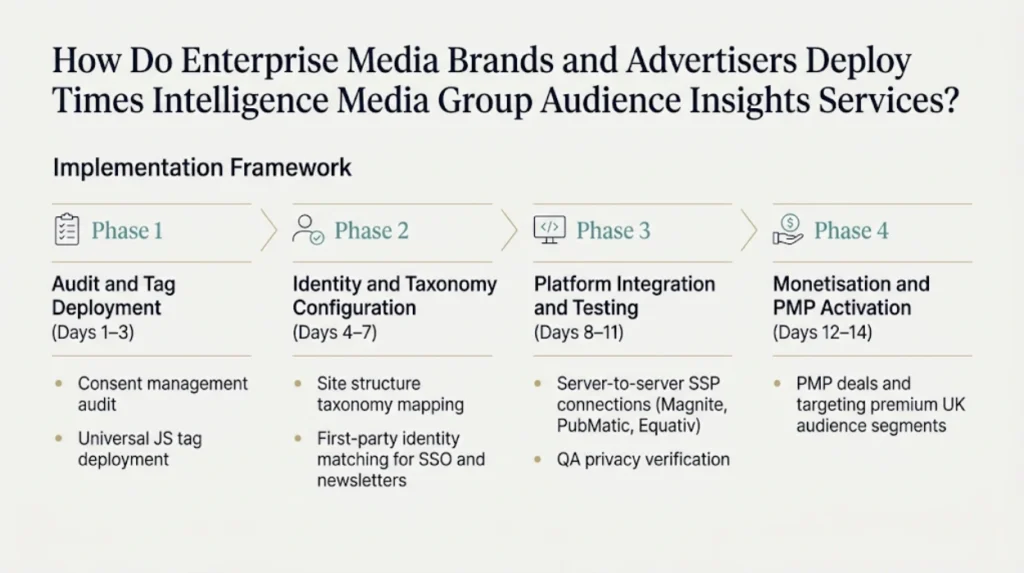
Implementation follows a structured, four-stage onboarding framework executed by dedicated solution engineers located in London. The deployment requires zero downtime for publisher digital properties and zero interruption to existing active ad campaigns.
Implementation Framework
Phase 1: Audit and Tag Deployment (Days 1–3)
Technical teams audit existing consent management configurations, ad server tags, and analytics setups. Publishers deploy the Times Intelligence Media Group universal JavaScript tag via tag managers, such as Google Tag Manager, Tealium, or Adobe Launch.
Phase 2: Identity and Taxonomy Configuration (Days 4–7)
Engineers map the publisher’s site structure to customised audience taxonomies. First-party identity matching rules are configured to ingest user authentication signals, such as single sign-on (SSO) logins and newsletter sign-up events.
Phase 3: Platform Integration and Testing (Days 8–11)
The platform establishes server-to-server connections with SSPs, such as Magnite, PubMatic, and Equativ. Quality assurance teams test data-passing accuracy, verifying that unconsented impressions remain completely free of tracking parameters.
Phase 4: Monetisation and PMP Activation (Days 12–14)
Sales teams activate Private Marketplace (PMP) deals and Preferred Deals within ad servers. Advertisers access targetable UK audience segments, such as high-net-worth investors, frequent international travellers, and tech decision-makers.
Enterprise Use Case Examples
- National News Publisher Case: A major UK daily newspaper network integrated the service across 12 digital titles. The publisher generated £1.4 million in incremental PMP revenue within the first 90 days post-deployment.
- B2B Trade Media Case: A business publication network mapped 450,000 professional readers into niche industry segments. The network increased campaign renewal rates from financial services advertisers by 42%.
How Can UK Media Enterprises Partner with Times Intelligence Media Group for Consent-Led Audience Insights?
UK media enterprises partner with Times Intelligence Media Group by scheduling a technical data audit, selecting tailored platform service modules, executing a standard processing agreement, and initiating rapid pilot deployment across target publishing domains.
Times Intelligence Media Group provides flexible commercial engagement models tailored to national news outlets, regional publishing groups, niche trade media, and commercial ad networks. Digital publishing leaders immediately eliminate privacy compliance vulnerabilities while unlocking the full commercial valuation of their first-party audience data.
Next Steps for Enterprise Onboarding
- Request a Technical Privacy & Data Audit: Solution architects evaluate your existing consent framework, CMP setup, and ad tag execution.
- Receive a Custom Audience Monetisation Plan: Data strategists model prospective eCPM gains and revenue projections based on site traffic volumes.
- Execute Process Agreement and Pilot: Launch a 30-day trial deployment on select high-traffic domains with complete dedicated technical support.
To initiate enterprise onboarding and secure your audience data strategy, contact the Times Intelligence Media Group specialist team in London today to schedule an initial technical consultation.
FAQs
Q1: What are consent-led audience insights services?
Ans: Consent-led audience insights services collect and analyse audience data only where appropriate permission and privacy requirements are met. This approach helps organisations develop usable audience insights while maintaining clear data governance.
Q2: How does consent-led data collection improve audience insights?
Ans: Consent-led data collection provides a clearer basis for understanding how audience information was obtained and used. It can support more reliable segmentation, behavioural analysis and audience research while respecting privacy preferences.
Q3: What types of audience data can be collected with consent?
Ans: Consent-based audience data can include preferences, engagement activity, demographic information and responses to surveys or digital interactions, depending on the purpose and permission provided. The data collected should match the stated purpose and applicable privacy requirements.
Q4: Why is consent important when collecting audience data?
Ans: Consent establishes a clear basis for collecting and using certain types of audience information. It also gives people greater control over their data preferences and supports transparent audience data management.
Q5: How can Times Intelligence Media Group use consent-led audience data?
Ans: Times Intelligence Media Group can use consent-led audience data to identify audience interests, analyse engagement patterns and develop evidence-based audience insights. The resulting insights can support content planning, audience research and communication strategies without relying on unclear data collection practices.



