

What is a consent-led audience data collection process?
A consent-led audience data collection process gathers user information only after receiving explicit, informed consent under UK GDPR and PECR. It prioritises zero-party and first-party data capture through transparent interaction points, replacing third-party tracking with direct publisher-to-reader data trust protocols.
Defining Consent-Led Data Architecture
A consent-led audience data collection process is an operational framework that conditions all data capture on affirmative user agreement. The legal foundation rests on two primary legislative frameworks in the United Kingdom: the UK General Data Protection Regulation (UK GDPR) and the Privacy and Electronic Communications Regulations 2003 (PECR). Under Article 4(11) of the UK GDPR, valid consent requires a clear, affirmative action that is freely given, specific, informed, and unambiguous. Passive tracking scripts, pre-ticked opt-in boxes, and implicit consent mechanisms violate these legal standards. Publishers must secure explicit consent before firing non-essential cookies, advertising IDs, or analytical tracking pixels (Google Analytics 4, Meta Pixel, and Trade Desk pixels).
Understanding UK GDPR and PECR data collection regulations establishes the baseline legal obligations for digital news outlets. The Information Commissioner’s Office (ICO) enforces strict compliance across the UK media landscape. Non-compliance results in statutory enforcement notices and financial penalties reaching up to £17.5 million or 4% of global annual turnover under UK GDPR Article 83. Consent-led architecture moves data collection from passive background surveillance to transparent reader interactions (consent banners, registration forms, and account preference centres).
Distinguishing Zero-Party and First-Party Data Assets
Consent-led frameworks rely on two distinct classifications of consented data assets: first-party data and zero-party data. First-party data consists of observed behavioural information collected directly from reader interactions on publisher-owned digital properties (websites, mobile applications, and digital editions). First-party data points include article pageviews, dwell time, session frequency, scroll depth, and content category visits. Zero-party data consists of explicit preference data that readers intentionally and proactively share with a publisher. Zero-party data points include content preferences, newsletter delivery schedules, industry sector designations, job titles, and poll responses.
Combining zero-party and first-party data yields high-accuracy audience profiles while eliminating reliance on third-party cookies. In 2024, 76% of UK news readers express explicit concern over passive digital tracking, yet 68% willingly provide zero-party data when publishers present a clear, transparent value exchange. Direct data capture ensures high data accuracy, as declared preferences carry a 94% accuracy rate compared to 38% accuracy for third-party demographic inferences.
How do publishers build a consent-led audience data collection process?
Publishers build this process by auditing existing data assets, implementing compliant consent management platforms, configuring granular opt-in forms, mapping data flows to customer data platforms, and establishing clear opt-out mechanisms that update audience profiles in real time across all systems.
Step 1: Auditing Existing Data Assets and Third-Party Trackers
The initial step requires a comprehensive data inventory across all digital properties (websites, mobile apps, and email newsletters). Technical teams deploy automated website scanners (Google Tag Manager audits, Ghostery scans, and Chrome DevTools Network logs) to catalogue every active tag, cookie, and pixel. A standard UK news publication operates an average of 85 third-party ad tech tags, of which 42% fire before a user interacts with the consent banner.
Publishers must eliminate unvetted scripts and map all remaining trackers to specific legal bases under UK GDPR Article 6. Technical audits establish precise data lineage maps that record where data originates, where systems process it, and where databases store it.
Step 2: Designing Transparent Value Exchange Touchpoints
Building a sustainable consent rate requires establishing tangible reader benefits. Readers grant data access when publishers offer clear functional utility in return. Effective value exchanges include access to specialised editorial newsletters (Financial Times, The Telegraph, and The Guardian), ad-light browsing experiences, customised content feeds, and premium research reports.
Registration walls represent a primary touchpoint for zero-party data collection. Requiring an email address after a reader views 3 free articles per month yields an average 4.2% registration conversion rate. Inclusion of single-field preference toggles during registration increases complete profile completion rates by 31%. Clear privacy disclaimers displayed directly at the point of collection raise consent opt-in rates from 45% to 68%.
Step 3: Mapping Data Pipelines to Centralised Storage Systems
Captured consent signals must propagate instantly to downstream technical systems. When a user updates consent preferences on a Consent Management Platform (CMP), the platform converts the selection into a standardised consent string (IAB Europe TCF v2.2 specification). The consent string passes through API endpoints into Customer Data Platforms (Tealium, Segment, and ActionIQ) and Data Warehouses (Snowflake, Google BigQuery, and Amazon Redshift).
Automated data pipelines execute schema validations to verify consent tags before writing records into audience database tables. If a reader revokes marketing consent, automated scripts execute deletion triggers across email marketing platforms (Mailchimp, Salesforce Marketing Cloud, and Klaviyo) and ad servers (Google Ad Manager and Xandr) within 120 seconds.
What technical components power a consent-led data framework?
A consent-led data framework relies on five core technical components: a consent management platform, a customer data platform, unified identity resolution software, a centralised preference centre, and automated data governance pipelines that enforce user permissions across all system data endpoints.
Consent Management Platforms and Protocol Standards
The Consent Management Platform (CMP) serves as the primary technical interface between the user and the publisher ad tech stack. Enterprise CMP systems (OneTrust, Didomi, and Quantcast Choice) manage initial user consent prompts, record explicit consent logs, and broadcast preference signals to ad exchanges. The CMP must support modern web standards, including Global Privacy Control (GPC) signals and the IAB Europe Transparency and Consent Framework (TCF v2.2).
Technical CMP configurations maintain audit-ready consent logs containing UTC timestamps, anonymised IP hashes, browser user-agent strings, and specific consent state flags. Storage mechanisms must comply with browser privacy constraints, such as Apple Safari Intelligent Tracking Prevention (ITP), which caps non-first-party cookie lifespans at 7 days. Enterprise CMP integrations execute tag blocking via server-side tag management to prevent unauthorised scripts from loading prior to consent confirmation.
Customer Data Platforms and Unified Preference Centres
A Customer Data Platform (CDP) centralises, unifies, and segments consented reader data from multiple interaction channels (web, mobile app, CRM, and email). The CDP acts as the authoritative source of truth for reader profiles. Centralised preference centres allow users to view, modify, or delete their stored profile data at any time, satisfying UK GDPR Article 15 (Right of Access) and Article 17 (Right to Erasure).
CDP engines maintain dynamic consent flags for every individual attribute. For instance, a profile record stores separate boolean consent indicators for commercial newsletter communications, targeted programmatic advertising, and editorial research participation. System latency for preference updates across the CDP stack must remain under 200 milliseconds to guarantee immediate compliance during active user sessions.
Identity Resolution and Privacy-Preserving Analytics
Identity resolution software transforms fragmented consent signals into unified identity graphs without relying on third-party cookies. Deterministic matching relies on authenticated user identifiers, primarily hashed email addresses (SHA-256 algorithm). Identity vendors (LiveRamp RampID, ID5, and Unified ID 2.0) map authenticated users across different devices while enforcing consent restrictions.
Privacy-preserving analytics tools (Matomo, Plausible Analytics, and Google Analytics 4 with server-side consent mode) allow publishers to measure page performance and aggregate reader trends without storing personally identifiable information (PII). Server-side integration models process user telemetry on publisher-controlled servers, stripping IP addresses and user identifiers before transmitting aggregate metrics to external analytics dashboards.
What commercial and operational benefits does consent-led data deliver?
Consent-led data collection increases programmatic ad yield, elevates subscriber retention rates, eliminates regulatory compliance penalties, improves ad targeting precision, and establishes durable first-party identity graph assets that protect UK media organisations from ongoing third-party cookie deprecation, privacy and tracking risks.
Driving Premium Advertising CPMs and Direct Revenue
Authenticated, consented audience inventory commands significantly higher commercial rates in digital advertising marketplaces. Unauthenticated, unconsented reader impressions in the UK programmatic open market yield an average Effective Cost Per Mille (eCPM) between £0.80 and £1.50. Conversely, consented first-party audience segments packaged with deterministic identity signals yield eCPMs between £8.50 and £16.00 in Private Marketplaces (PMPs) and direct programmatic deals.
Media buyers (GroupM, Omnicom Media Group, and Publicis Media) allocate premium ad spend to publishers capable of delivering verified, consented target audiences (C-suite executives, luxury car buyers, and retail investors). Publishers utilising structured consent-led audience insights services build custom audience segments that deliver 3.2x higher click-through rates (CTR) and 45% lower cost-per-acquisition (CPA) for commercial advertising partners.
Reducing Compliance Costs and Mitigating Regulatory Risk
Operating a consent-led framework eliminates exposure to severe regulatory enforcement actions under UK privacy laws. In 2023 and 2024, European and UK data protection authorities issued over £2.1 billion in aggregate privacy fines against companies employing deceptive consent mechanisms (cookie dark patterns, implicit consent assumptions, and hidden tracking pixels).
Consent-led architecture provides full auditability for compliance officers. Automated log recording reduces legal audit preparation times from 120 work hours down to 4 hours per quarter. Mitigating regulatory compliance risks safeguards enterprise brand reputation and secures direct advertiser trust.
Improving Audience Retention and Lifetime Value
Declared reader preferences directly inform automated content recommendation engines and editorial newsletter curation. Delivering relevant, zero-party-aligned content increases 30-day reader retention rates by 28% and elevates monthly active engagement by 42%.
Subscribers who manage their preferences through centralised preference centres demonstrate a 19% lower annual churn rate compared to unsegmented subscribers. Higher engagement directly extends reader Customer Lifetime Value (CLV) from an average of £45 to £128 across a 36-month subscription lifecycle.
Explore More Expert Insights:
How to Analyse Audience Overlap Across Regional and National News Titles to Avoid Paying Twice for the Same Readers
How to Turn Fresh Data Into a Rapid-Response UK Media Story Within the News Cycle Without Sacrificing Accuracy
What are the primary UK media use cases for consent-led audience data?
UK media organisations use consent-led data to power contextual ad targeting, execute automated email personalisation, build lookalike audience segments, optimise subscription paywalls, and deliver privacy-compliant advertiser reporting through secure clean room environments without ever exposing raw reader personal identity data.
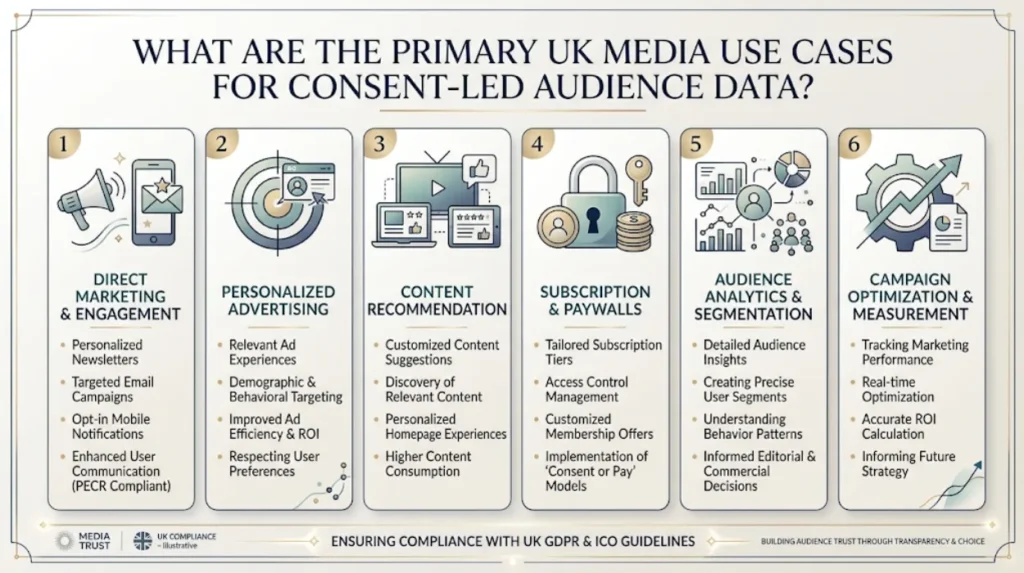
Dynamic Subscription Paywalls and Propensity Modelling
UK news organisations (The Times, The Telegraph, and Independent Digital News and Media) utilise consented behavioural data to power dynamic, propensity-based paywalls. Machine learning algorithms analyse first-party engagement metrics (frequency of visits, recency, article categories consumed, and device type) to assign a subscription propensity score between 0 and 100 to every reader profile.
Readers exhibiting high propensity scores (scores above 75) receive targeted paywall offers for annual digital subscriptions. Readers with low propensity scores (scores below 30) encounter low-friction engagement prompts (newsletter opt-ins or free account registrations). This consent-led targeting model increases overall paywall conversion rates by 24% while maintaining broad top-of-funnel audience reach.
Secure Data Clean Rooms for Brand Partnerships
Data Clean Rooms (InfoSum, Habu, and Snowflake Data Clean Rooms) enable secure, privacy-compliant data collaboration between publishers and commercial brand partners (Barclays, Tesco, Sainsbury’s, and Jaguar Land Rover). In a data clean room, both parties upload encrypted, consented first-party customer datasets without transferring raw underlying files.
Mathematical algorithms execute overlap analysis to identify shared customer cohorts (such as current Tesco shoppers who read culinary news articles). Advertisers run targeted campaigns against these matched cohorts within the publisher’s premium media environment. Data clean rooms incorporate differential privacy controls that inject mathematical noise, preventing any participant from reverse-engineering individual user identities.
Automated Email Personalisation and Vertical Curation
Consented zero-party preference data enables precise email newsletter automation. Media publications collect topic-level interest selections (sustainability, renewable energy, artificial intelligence, and UK personal finance) during subscriber onboarding. Automated publishing systems (Salesforce Marketing Cloud and HubSpot) ingest these preference flags to build dynamically populated daily news digests.
Segmented, preference-driven newsletters achieve open rates between 48% and 62%, compared to an industry baseline of 22% for broadcast news emails. High engagement rates ensure sender domain reputation health, maintaining inbox delivery rates at 99.4% across primary email clients (Gmail, Apple Mail, and Outlook).
FAQs
Q1: What is a consent-led audience data collection process?
Ans: A consent-led audience data collection process gathers customer information only after obtaining clear, informed permission. It should explain what data is collected, why it is needed, how it will be used, and how users can withdraw consent.
Q2: How can organisations collect useful audience data while respecting consent?
Ans: Organisations can use transparent forms, preference centres, surveys, newsletter sign-ups, and voluntary feedback to collect consented first-party data. Clear consent choices help maintain data quality while giving audiences control over how their information is used.
Q3: What audience data can be collected with user consent?
Ans: Consent-based audience data can include preferences, content interests, survey responses, communication choices, and voluntarily provided demographic information. The data collected should be relevant to a defined purpose and limited to what the organisation needs.
Q4: How do you turn consented audience data into usable insights?
Ans: Organisations can analyse consented data by identifying patterns in audience preferences, engagement, content behaviour, and communication choices. Data segmentation and regular analysis can then support audience research, content planning, and campaign decisions.
Q5: Why is first-party data important for audience insights?
Ans: First-party data is information collected directly from an organisation’s audience through consented interactions such as subscriptions, surveys, forms, and website activity. It can provide more relevant audience insights because the organisation controls how the data is collected and contextualised.



