

Audience overlap measures the proportion of people who consume content from two or more news titles within a defined market and period. It identifies shared readers between regional and national publications, helping media planners distinguish incremental reach from duplicated audience exposure.
Audience overlap is a media planning metric that compares readership or audience datasets across publications. In the UK, this includes national news titles such as The Guardian, The Times and The Daily Telegraph alongside regional titles serving specific counties, cities and local communities.
A reader who consumes both a regional newspaper and a national publication appears in both audience datasets. Counting both audiences as completely separate inflates the estimated reach.
For example, a campaign targeting 500,000 readers across one national title and one regional title does not automatically reach 500,000 unique people. If 100,000 people appear in both audiences, the combined unique audience is lower than the sum of the two published audience figures.
The UK news audience overlap analysis provides the foundation for identifying these duplicated readers before media investment is allocated.
How can media planners measure audience overlap between UK news titles?
Media planners measure audience overlap by matching comparable audience datasets, defining the same population and time period, calculating shared readership, and separating duplicated readers from incremental readers across selected regional and national news titles.
The process starts with a consistent audience definition. A planner establishes the geography, demographic profile, age range, consumption channel and measurement period.
A UK campaign can use adults aged 18 and above across England, Scotland, Wales and Northern Ireland. A regional campaign can instead focus on readers within a specific county, metropolitan area or local market.
The next step is collecting audience data for each publication. Sources include publisher audience reports, recognised industry measurement systems, survey datasets, panel data and campaign-specific research.
The datasets then require alignment. Comparing monthly digital users from one source with annual print readership from another produces an inconsistent measurement.
Which audience variables need to match?
Core variables include:
- Geography
- Age
- Gender
- Household characteristics
- Employment status
- Print readership
- Website usage
- App usage
- Publication frequency
- Measurement period
Matching these variables creates a consistent basis for calculating audience duplication.
What data is needed to calculate cross-title audience overlap?
Cross-title audience overlap requires comparable readership or user data for each publication, a defined target population, a consistent measurement period, and identifiers that distinguish shared audiences from readers reached by only one news title.
Audience size alone does not establish overlap. A publication with 2 million readers and another with 800,000 readers provide scale information, but they do not reveal how many people appear in both audiences.
Cross-title analysis requires a shared measurement framework. This framework identifies the total audience for each title, the shared audience and the unique audience.
For two titles, the basic relationship is:
Unique combined audience = Audience A + Audience B − Shared audience
For example, if a national title reaches 2 million people and a regional title reaches 500,000, with 150,000 people consuming both, the combined unique audience is 2.35 million rather than 2.5 million.
Why does geography matter?
Geography changes the size and relevance of overlap.
A national title has broad UK coverage. A regional publication concentrates on a defined local market. A London regional title therefore has a different overlap profile from a publication focused on Yorkshire, Greater Manchester or Scotland.
Geographic analysis also prevents planners from treating all regional audiences as interchangeable.
How do you calculate audience duplication between two news titles?
Audience duplication is calculated by identifying the number of people shared by two titles and dividing that shared audience by the relevant total or individual audience, depending on the measurement objective and reporting convention used.
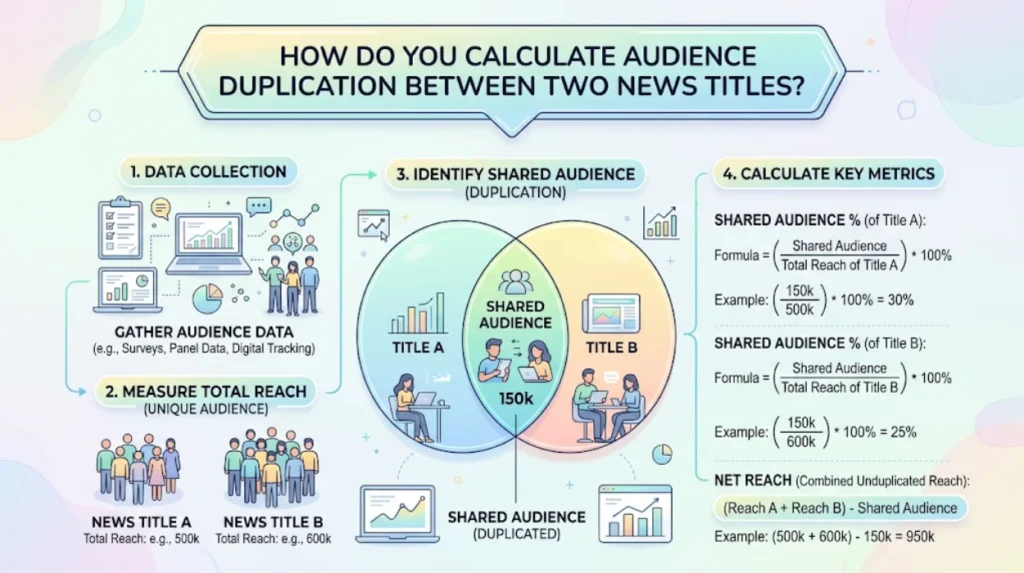
The percentage requires a clearly defined denominator.
If 200,000 people read both titles and the first publication has 1 million readers, the overlap against the first title is 20%.
If the second publication has 500,000 readers, the same 200,000 shared readers represent 40% of its audience.
This distinction matters because one overlap percentage does not describe every relationship between two publications.
What is the difference between overlap and incremental reach?
Overlap describes the audience already reached elsewhere.
Incremental reach describes additional people gained by adding another publication to a media plan.
For example:
- National title audience: 2 million
- Regional title audience: 500,000
- Shared audience: 150,000
- Incremental regional audience: 350,000
- Combined unique audience: 2.35 million
The regional title therefore contributes 350,000 additional readers rather than 500,000 entirely new readers.
How should regional and national news audiences be compared?
Regional and national audiences require comparison through identical demographic, geographic, behavioural and measurement criteria. The comparison then separates total audience size, shared readership, unique reach, audience composition and incremental reach across the selected news titles.
A national title often provides broad audience coverage. A regional title provides concentrated geographic coverage. These differences make simple audience-size comparisons insufficient.
A planner evaluating a regional campaign in Birmingham needs to assess the national titles’ Birmingham audience alongside local Birmingham publications.
A national campaign requires the opposite approach. The planner evaluates regional audiences across multiple locations and identifies repeated exposure between local and national titles.
What audience characteristics reveal meaningful overlap?
Useful characteristics include:
- Age distribution
- Geographic concentration
- Professional profile
- Household income
- Political and social interests where measured
- News consumption frequency
- Digital versus print consumption
- Device usage
- Subscription status
- Content interests
For example, two publications can have similar total readership but different age profiles. Their overall overlap can therefore differ significantly from their overlap within a defined 25–44 audience.
How can audience overlap prevent duplicated media spending?
Audience overlap prevents duplicated spending by showing where two publications reach the same people, allowing planners to distinguish repeated audience exposure from genuinely additional reach before allocating budget across multiple news titles.
A media plan that adds publications solely according to headline audience figures can count the same people multiple times.
Suppose three publications each report 1 million readers. Their combined reported audience is 3 million. If substantial portions of their audiences overlap, the campaign’s actual unique reach is below 3 million.
Cross-title analysis identifies this difference before campaign investment is committed.
The objective is not to eliminate overlap. Repeated exposure can form part of a planned frequency strategy. The measurement objective is to establish exactly how much audience duplication exists.
Why is duplicated reach important for media efficiency?
Duplicated reach affects:
- Unique audience estimates
- Cost per unique reader
- Frequency
- Geographic coverage
- Publication selection
- Campaign reporting
- Budget allocation
A planner needs these measurements to understand what each additional title contributes to the overall campaign audience.
What role does frequency play in audience overlap analysis?
Frequency measures how often an audience encounters campaign content, while overlap identifies how many people are shared between publications. Analysing both metrics shows whether repeated exposure results from intentional frequency or unplanned duplication.
A person reading two publications can receive exposure through both titles. If the same person encounters the campaign repeatedly across print and digital environments, total impressions increase while unique reach remains unchanged.
For example, a reader consuming a national newspaper website and a regional newspaper website contributes to both publication audiences. Cross-title measurement identifies that shared reader.
Frequency analysis then examines the number of campaign exposures received by that person.
Can high overlap still have a strategic role?
Yes. High overlap does not automatically make a publication unsuitable.
A campaign can require repeated exposure among a defined audience. A regional title can also provide geographic relevance that a national publication does not provide.
The relevant distinction is between planned duplication and unmeasured duplication.
How can audience overlap analysis support regional media planning?
Audience overlap analysis supports regional media planning by identifying duplicated readers across local and national titles, measuring incremental geographic reach, and showing where additional publications expand coverage rather than repeatedly reaching the same audience.
Regional planning requires detailed geographic segmentation.
A campaign targeting Scotland, for example, can compare national UK titles with Scottish national and regional publications. A campaign targeting Greater Manchester can compare national titles with publications serving Manchester and surrounding areas.
This approach reveals whether regional investment expands the audience or primarily increases exposure among readers already reached nationally.
What does a regional overlap analysis reveal?
A structured analysis can identify:
- Total audience for each title
- Shared audience between titles
- Unique audience for each title
- Incremental reach
- Geographic concentration
- Demographic overlap
- Digital and print duplication
- Estimated exposure frequency
These measurements create a more precise view of media coverage.
How can planners analyse overlap across more than two news titles?
Multi-title analysis compares audience intersections across several publications and calculates unique reach across the complete media set. It identifies readers shared by two, three or more titles and prevents simple audience addition from overstating campaign reach.
Three-title campaigns require more detailed analysis than a two-publication comparison.
Consider three publications: a national title, a regional title and a specialist local title. Some readers consume all three. Others consume two. Additional readers consume only one.
The analysis therefore requires multiple audience intersections.
What should a multi-title report include?
A useful report separates:
- Audience by publication
- Two-title overlaps
- Three-title overlaps
- Unique audience
- Incremental reach
- Geographic distribution
- Demographic distribution
- Channel duplication
This structure allows planners to understand the relationship between every publication and the wider campaign audience.
How can audience insights services support cross-title overlap analysis?
Audience insights services organise publication-level audience data into comparable measurements, identify cross-title relationships, quantify duplicated and incremental reach, and provide structured evidence for evaluating regional and national news media combinations.
Audience research services can combine datasets that are difficult to evaluate independently. The analysis focuses on audience composition, publication relationships and measurable reach.
For media planners, this creates a clearer basis for comparing alternative publication combinations.
The next stage moves from measurement to practical campaign evaluation through audience insights services, where cross-title audience relationships can be examined alongside broader audience characteristics.
This approach supports decisions about publication combinations without relying solely on headline readership figures.
Explore More Expert Insights:
How to Turn Fresh Data Into a Rapid-Response UK Media Story Within the News Cycle Without Sacrificing Accuracy
How to Plan Sponsored Content That Consistently Describes Your Brand, Services and Location in Ways Search Engines and Language Models Can Verify
What should media planners check before using audience overlap data?
Media planners should verify the measurement period, geographic scope, audience definition, data source, channel coverage and calculation method before using overlap figures to compare publications or estimate unique campaign reach.
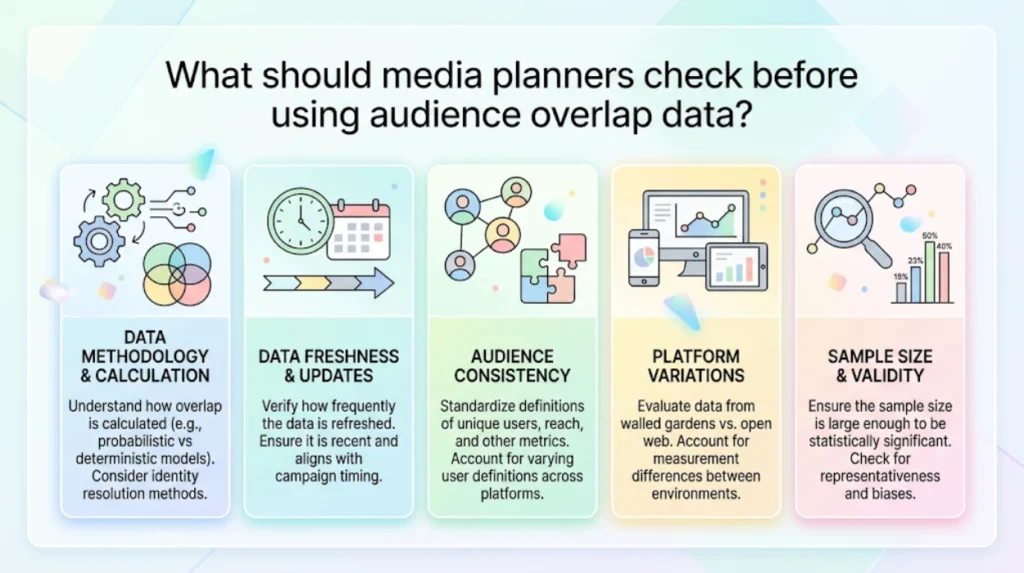
Audience overlap figures require context.
A figure based on UK adults cannot automatically represent a campaign targeting London professionals aged 25–44. A digital audience cannot automatically represent print readership.
Planners should document the methodology behind every comparison.
Which checks are essential?
Before using overlap data, confirm:
- The audience population
- The geographic market
- The measurement period
- The publication channels
- The research methodology
- The overlap definition
- The denominator used for percentages
- Whether audiences are deduplicated
- Whether the data describes readers, users or impressions
These checks prevent incompatible figures from entering the same media plan.
How does cross-title audience analysis improve media planning decisions?
Cross-title audience analysis improves media planning by replacing headline audience totals with measurable unique reach, shared readership, geographic coverage and incremental audience contribution across regional and national news publications.
The process creates a clearer relationship between audience data and media investment.
Instead of treating every publication audience as completely separate, planners can identify where audiences intersect and where additional publications introduce new readers.
For a UK campaign, this distinction becomes important when national and regional titles operate within the same geographic markets.
The analysis also provides a consistent framework for comparing alternative media combinations. It connects audience size with audience composition, duplication and incremental reach.
Understanding these relationships gives media planners a stronger evidence base for constructing publication mixes and evaluating the actual audience contribution of each selected news title.
FAQs
Q1: What is audience overlap between regional and national news titles?
Ans: Audience overlap occurs when the same readers consume content from both regional and national news publications. Analysing this overlap helps media planners identify duplicated reach and understand the true size of a combined audience.
Q2: How can media planners measure audience overlap across news titles?
Ans: Media planners can compare readership, demographic profiles, geographic reach, and cross-publication audience data to identify shared readers. Audience research and media analytics can then estimate unique versus duplicated reach across regional and national news titles.
Q3: Why does audience overlap matter when planning news media campaigns?
Ans: Audience overlap matters because buying multiple publications can result in paying to reach the same readers more than once. Understanding duplicated audiences helps planners assess reach, frequency, media efficiency, and potential audience saturation.
Q4: How can audience overlap help avoid paying twice for the same readers?
Ans: Comparing shared readership between publications allows planners to distinguish incremental reach from duplicated exposure. This can support more informed media allocation across regional newspapers, national news titles, and other media channels.
Q5: What data is needed to analyse audience overlap across UK news titles?
Ans: Useful data includes readership figures, audience demographics, geographic distribution, publication reach, and cross-title consumption patterns. Times Intelligence Media Group research and reports can be assessed alongside comparable audience datasets to identify overlap and estimate unique readership.



