

Time Intelligence Media Group Audience Insights Services analyse audience behaviour, reach, engagement, demographics, and cross-title relationships to identify where UK news audiences overlap, helping media planners allocate budgets across regional and national titles with greater data precision.
Audience insights provide a structured view of how people interact with news brands. Relevant measures include audience size, engagement, referral behaviour, geographic distribution, content interaction, and repeat readership.
Time Intelligence Media Group provides Audience Insights Services as part of its wider media intelligence offering. The organisation operates multiple UK news brands, including East London Times, North London News, South London News, West London News, Edinburgh Daily News, and Birmingham Express.
For media planning, the critical question is not simply how many people each title reaches. The critical question is how many distinct people the combined portfolio reaches.
A campaign using one national title and several regional titles can count some of the same readers more than once. Cross-title analysis identifies this duplication before media budgets are allocated.
How does cross-title audience overlap analysis work?
Cross-title audience overlap analysis compares audience characteristics and behavioural signals across multiple news titles to identify shared readership, unique audiences, geographic concentration, and duplicated reach within a proposed media plan.
The process starts by defining the titles and audience segments under review. A planner can compare national newspapers with regional publications or compare several regional titles serving neighbouring markets.
The analysis then establishes comparable audience measures. These include:
- Unique audience
- Estimated reach
- Geographic location
- Audience demographics
- Engagement levels
- Content interests
- Referral behaviour
- Frequency of exposure
- Cross-title readership
The resulting dataset separates total portfolio reach from duplicated audience exposure.
For example, a campaign targeting London professionals can examine a national title alongside East London Times, North London News, South London News, and West London News. The analysis identifies whether those regional audiences provide additional reach or substantially repeat the same audience.
This distinction changes how media planners interpret headline audience figures.
How is duplicated reach identified?
Duplicated reach refers to people represented in more than one publication audience. If the same audience segment appears across three titles, adding the published audience figures together overstates the number of distinct people reached.
Cross-title analysis identifies these intersections.
The result is a more structured view of audience composition. Media teams can separate:
- Total reported audience
- Unique audience
- Shared audience
- Incremental audience
- Audience concentration by location
This supports more accurate portfolio planning.
What data does Time Intelligence Media Group use for audience analysis?
Audience analysis combines measurable audience, engagement, geographic, demographic, and behavioural indicators to establish how different news titles perform individually and collectively within a defined UK media planning requirement.
Audience insights depend on consistent measurement. Each title needs comparable indicators before overlap can be interpreted accurately.
Time Intelligence Media Group’s published audience insights material describes analysis using behavioural signals such as page views, bounce rates, social shares, dwell time, scroll depth, repeat visits, and other engagement measures.
Its wider measurement framework also identifies metrics such as unique impressions, estimated audience size, referral sessions, average session duration, social shares, and engagement rate.
Geographic audience data
Geographic analysis identifies where audiences are concentrated.
For UK campaigns, this can include national, regional, city, or local market distinctions. A campaign focused on Birmingham requires different audience analysis from a campaign focused on London.
Geographic segmentation also helps identify whether several regional titles contribute genuinely different local audiences.
Behavioural audience data
Behavioural data explains how audiences interact with content.
Measures such as dwell time, repeat visits, scroll depth, and content engagement provide evidence about audience quality beyond headline reach. Time Intelligence Media Group describes these measures as part of its approach to understanding reader behaviour.
Demographic and audience segmentation
Audience segmentation separates groups according to relevant characteristics and campaign objectives.
A B2B campaign can focus on business professionals. A consumer campaign can focus on geographic communities or specific demographic groups. The analysis then compares these segments across selected news titles.
How can media planners compare regional and national news audiences?
Media planners compare regional and national audiences by measuring shared readership, unique reach, geographic relevance, engagement, and audience concentration rather than adding each publication’s reported audience figures without adjustment.
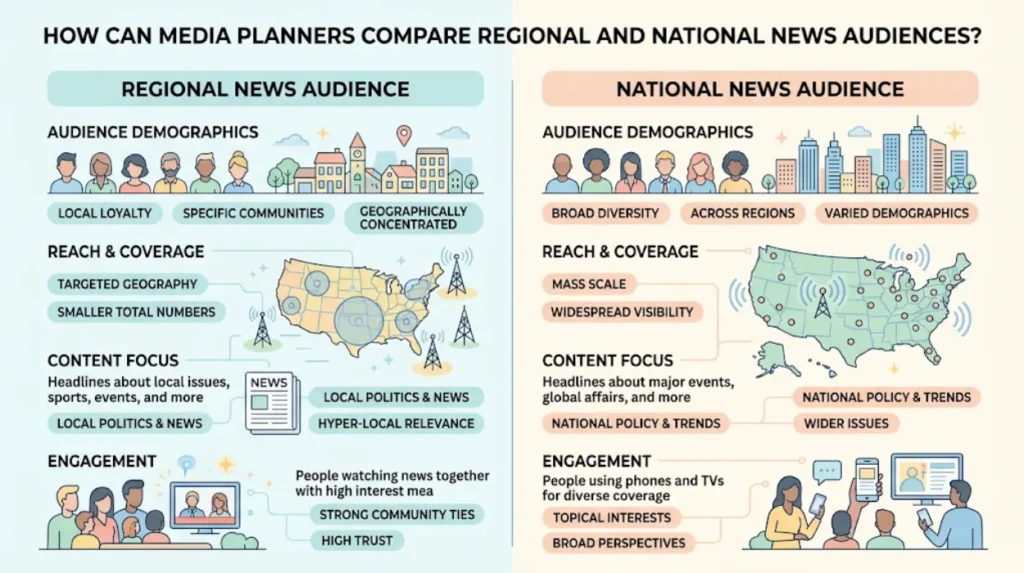
National titles provide broad geographic coverage. Regional titles provide more concentrated local audiences.
Both can serve a UK campaign, but their audience roles differ.
A national title can provide broad exposure across multiple regions. A regional title can provide concentrated reach within a specific city or locality. When both are included, cross-title analysis establishes how much additional audience the regional placement contributes.
The analysis also supports portfolio-level planning.
For example, a planner selecting a national publication and four London-focused titles can examine whether the regional titles collectively expand local reach or primarily duplicate existing national-title readers.
This creates a clearer distinction between reported reach and incremental reach.
Why does incremental reach matter?
Incremental reach represents additional people reached after existing audience exposure is considered.
Suppose a media plan includes Title A and Title B. Title A reaches 500,000 people and Title B reaches 300,000. The combined figure is not automatically 800,000 unique people.
If 100,000 people appear in both audiences, the combined unique audience is lower than the sum of the two reported figures.
Cross-title audience analysis makes this distinction visible.
How does Times Intelligence Media Group Audience Insights Services support media planning?
Times Intelligence Media Group Audience Insights Services convert audience and engagement data into structured media planning intelligence, allowing organisations to evaluate title selection, audience duplication, geographic coverage, and incremental reach before committing campaign budgets.
The service supports decisions at the portfolio level.
Instead of assessing publications independently, planners can evaluate the combined audience produced by several placements.
This creates a more complete media planning framework:
- Define the campaign audience.
- Select relevant national and regional titles.
- Establish comparable audience measures.
- Identify shared audience segments.
- Calculate incremental reach.
- Assess geographic coverage.
- Compare engagement indicators.
- Build the final media portfolio.
Time Intelligence Media Group states that its audience insights approach processes multiple data sources to create a broader view of audience dynamics and supports customised analysis around specific media objectives.
How does audience overlap affect media budget allocation?
Audience duplication affects how efficiently a fixed media budget expands unique reach.
If two placements repeatedly reach the same people, adding another title with a different audience profile can change portfolio composition more significantly than adding another highly overlapping title.
This does not mean overlap is always undesirable. Repeated exposure can serve frequency objectives. The key requirement is knowing whether the campaign objective prioritises frequency, unique reach, geographic concentration, or a combination.
Audience insights provide the data needed to distinguish these objectives.
What reporting can decision-makers expect from cross-title audience analysis?
Cross-title audience reporting presents audience size, overlap, unique reach, geographic distribution, engagement measures, and portfolio-level findings in a format that supports media planning, campaign evaluation, and future publication selection.
A useful report separates individual title performance from combined portfolio performance.
Typical reporting sections include:
- Audience profile by title
- Shared audience between titles
- Unique audience contribution
- Geographic distribution
- Engagement indicators
- Audience concentration
- Portfolio reach
- Incremental reach
- Cross-title observations
Time Intelligence Media Group’s wider reporting methodology uses executive summaries, KPI dashboards, placement information, qualitative analysis, and outcome reporting for UK clients.
The same structured reporting principle supports audience intelligence because decision-makers need both the underlying measurements and the interpretation of those measurements.
How can reports support future media planning?
Audience analysis becomes more valuable when findings are retained across campaigns.
A media team can compare planned and actual audience performance, identify recurring audience overlaps, and refine future title selection.
Historical reporting also creates a consistent evidence base for evaluating changes in audience behaviour over time.
Explore More Expert Insights:
Time Intelligence Media Group Sponsored Content Services for Brand Entity Building
Time Intelligence Media Group Sponsored Content Services With Google-Compliant Link Attributes
Which UK media planning situations benefit from audience overlap analysis?
Audience overlap analysis supports campaigns involving multiple regional titles, national publications, geographic targeting, repeated media placements, audience expansion, and portfolio optimisation where duplicated readership affects the interpretation of total campaign reach.
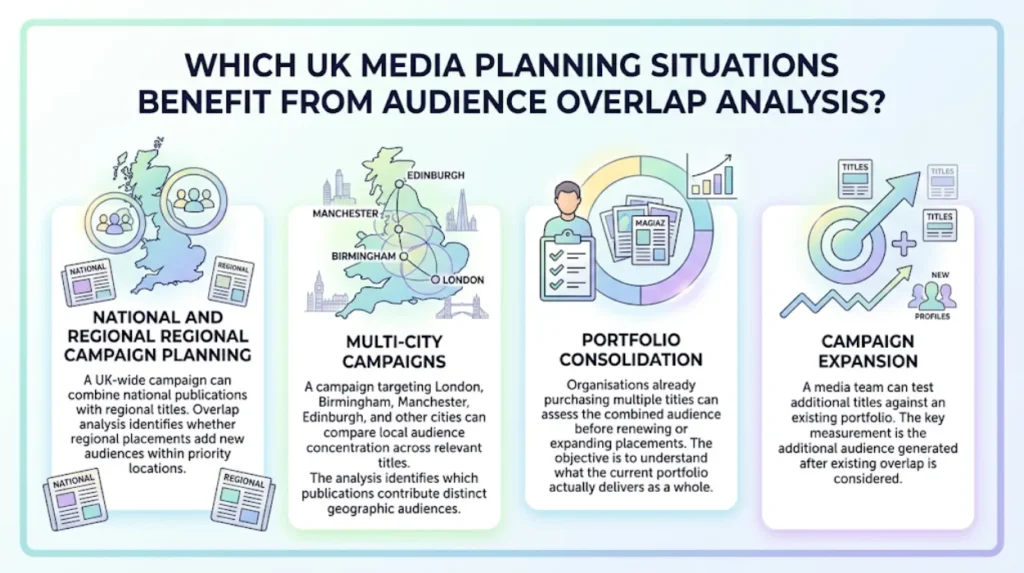
Several practical use cases demonstrate where the analysis applies.
National and regional campaign planning
A UK-wide campaign can combine national publications with regional titles. Overlap analysis identifies whether regional placements add new audiences within priority locations.
Multi-city campaigns
A campaign targeting London, Birmingham, Manchester, Edinburgh, and other cities can compare local audience concentration across relevant titles.
The analysis identifies which publications contribute distinct geographic audiences.
Portfolio consolidation
Organisations already purchasing multiple titles can assess the combined audience before renewing or expanding placements.
The objective is to understand what the current portfolio actually delivers as a whole.
Campaign expansion
A media team can test additional titles against an existing portfolio. The key measurement is the additional audience generated after existing overlap is considered.
How does audience overlap analysis connect with broader media intelligence?
Audience overlap analysis connects publication-level audience data with broader media intelligence by showing how reach, engagement, geography, and title selection interact across a complete UK media portfolio rather than within isolated publication measurements.
Audience intelligence becomes more useful when connected to wider media planning activity.
The earlier educational stage explains audience overlap and why duplicated readership matters. The practical analysis stage explains how to analyse audience overlap across regional and national titles. The decision stage applies those principles to a defined media portfolio.
This progression creates a clear planning workflow.
Businesses beginning with audience overlap can use the concept to understand duplicated readership. Organisations already assessing and analysing audience overlap can move toward title-level evaluation and portfolio planning.
Time Intelligence Media Group also provides other media services, including PR distribution, banner advertising, sponsored content, events media coverage, media partnerships, and audience insights.
How can organisations use Time Intelligence Media Group Audience Insights Services?
Organisations can use Time Intelligence Media Group Audience Insights Services to evaluate UK news audiences, compare regional and national titles, identify duplicated readership, assess incremental reach, and build media plans based on structured audience intelligence.
The decision process begins with the campaign objective.
A national awareness campaign requires different audience measurements from a local lead-generation campaign. A multi-region campaign also requires different geographic comparisons from a single-city campaign.
The selected titles then form the analysis set.
Time Intelligence Media Group can structure audience research around the defined media requirement and report the relevant audience and engagement indicators. Its published service material describes customised analytics designed around specific media objectives and reporting requirements.
The final output gives media planners a clearer evidence base for publication selection.
For organisations reviewing regional and national news placements, this means evaluating the combined audience, not simply adding individual publication figures.
What is the next step for a cross-title audience analysis?
A practical starting point is to define the target audience, geographic markets, existing publications, proposed publications, campaign objective, and required reach measure.
The analysis can then establish where audiences overlap and where each title contributes additional reach.
For media teams evaluating several UK news titles, Time Intelligence Media Group Audience Insights Services provides a dedicated route for examining audience composition, engagement, geographic distribution, and cross-title relationships.
This approach connects audience research directly with media planning decisions and creates a measurable framework for evaluating the contribution of each selected publication.
FAQs
Q1: What is cross-title audience overlap analysis?
Ans: Cross-title audience overlap analysis measures how much the same audience reads or engages with multiple news titles. It helps media planners identify duplicated reach across regional and national publications and improve audience targeting.
Q2: How does audience overlap analysis improve media planning?
Ans: Audience overlap analysis shows where different publications reach the same readers, helping planners assess incremental reach and duplicated exposure. This supports more informed media planning, audience segmentation, and publication selection.
Q3: What audience data is used to measure overlap between news titles?
Ans: Audience insights services can use readership, demographic, geographic, behavioural, and engagement data to identify shared audiences between news titles. Cross-title analysis can then distinguish unique reach from overlapping readership.
Q4: Can audience overlap analysis compare regional and national news audiences?
Ans: Yes, cross-title audience analysis can compare regional and national news audiences using factors such as location, readership behaviour, demographics, and media consumption patterns. This can reveal where regional and national titles reach similar or distinct reader groups.
Q5: What can Times Intelligence Media Group audience insights services reveal?
Ans: Times Intelligence Media Group audience insights services can reveal audience composition, readership patterns, geographic reach, and overlap between different news titles. These insights can support media planning decisions by clarifying duplicated and incremental audience reach.



