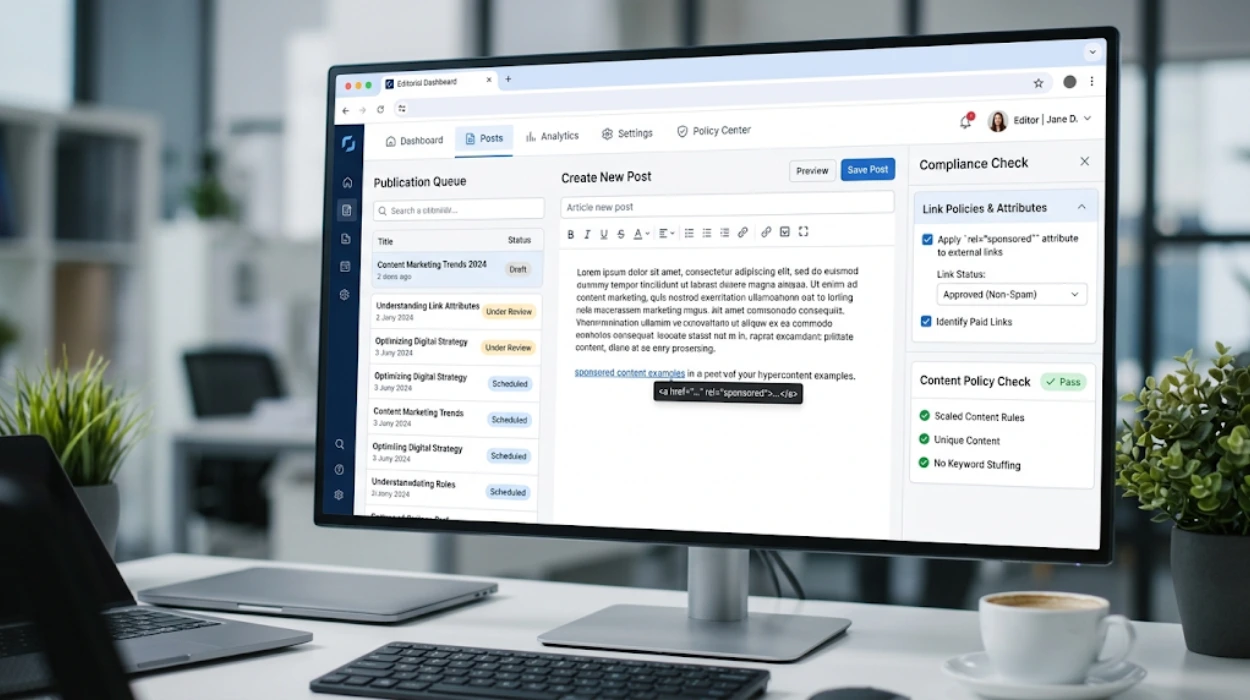
Sponsored content combines editorial material with commercial sponsorship. Google permits paid links used for advertising and sponsorship when the links are properly qualified. Publishers also need to prevent paid links from passing ranking credit and avoid producing large volumes of low-value content.
What does Google consider sponsored content?
Sponsored content is publisher content created or distributed through a commercial arrangement, where payment, products, services or another benefit supports publication. Google permits this activity when paid links are qualified, and the content does not exist primarily to manipulate Search rankings.
A sponsored article can provide legitimate information to an audience while also serving a commercial purpose. The commercial relationship does not automatically make the article spam.
The critical distinction is between advertising value and ranking manipulation. Google identifies paid links intended to pass ranking credit as link spam. Its policies specifically include paid links and sponsored or native advertising containing links that pass ranking credit.
For example, a technology publisher can publish a sponsored article about enterprise cybersecurity. The article can include a link to the sponsor’s website. That link requires an appropriate qualifying attribute when the relationship involves payment or sponsorship.
What makes a sponsored article different from ordinary editorial content?
The commercial relationship is the defining difference. Editorial content generally reflects the publisher’s independent content process. Sponsored content exists through a commercial arrangement with an advertiser, brand or organisation.
The article still needs useful information, relevant context and readable structure. Sponsorship does not remove the requirement to produce content that serves users.
This distinction becomes important when publishers manage multiple sponsored placements. A repeatable publishing process needs controls for both content quality and link qualification.
How should paid links in sponsored content be qualified?
Paid links in sponsored content need a qualifying link attribute that prevents the paid relationship from passing ranking credit. Google explicitly recognises rel="sponsored" and rel="nofollow" as qualifying values for advertising and sponsorship links.
The two most relevant attributes are:
rel="sponsored"identifies links created as part of advertising or sponsorship arrangements.rel="nofollow"tells Google not to associate the link with a normal editorial endorsement or ranking credit.
Google specifically states that buying and selling links for advertising and sponsorship does not violate its policies when the links are qualified with rel="nofollow" or rel="sponsored".
For sponsored content workflows, rel="sponsored" provides a direct description of the commercial relationship.
What does a compliant sponsored link look like?
A sponsored link can use the following HTML structure:
<a href="https://example.com" rel="sponsored">Learn more</a>A publisher can also use:
<a href="https://example.com" rel="nofollow">Learn more</a>The purpose is to prevent the paid placement from functioning as a ranking-manipulation mechanism.
Anchor text also requires attention. A publisher needs to avoid creating paid links with heavily optimised commercial anchor text when the purpose is to influence rankings. Google specifically identifies paid articles containing links that pass ranking credit or optimised anchor text as examples of link spam.
What process should publishers follow before publishing sponsored content?
A sponsored content workflow needs five controlled stages: commercial review, editorial planning, link review, technical validation and publication monitoring. Each stage checks whether the article provides user value and whether every paid link has an appropriate qualifying attribute.
1. Review the commercial relationship
Record whether the article involves payment, sponsorship, products, services or another commercial benefit.
This establishes whether links within the article require commercial link qualification.
2. Define the editorial purpose
Identify the specific user problem the article addresses.
For example, a sponsored article about accounting software can explain:
- Common accounting workflow problems
- Financial reporting requirements
- Software evaluation criteria
- Integration considerations
- Practical implementation steps
The article needs a defined informational purpose rather than a collection of keywords and promotional links.
3. Review every external link
Create a link inventory before publication.
For example:
| Link type | Review requirement |
|---|---|
| Sponsored destination | Use an appropriate sponsored or nofollow qualification |
| Independent editorial source | Review according to its actual relationship |
| Internal publisher link | Check relevance and destination |
| Commercial promotional link | Confirm its commercial status |
| Reference source | Verify accuracy and relevance |
This process prevents one unreviewed link from creating a compliance problem.
4. Validate the HTML
Inspect the final page source or CMS-generated markup. Confirm that the intended rel attribute is present on relevant paid links.
A visual editor can display a normal hyperlink while the underlying HTML contains no qualifying attribute. Technical validation therefore forms a separate stage.
5. Monitor after publication
Review the published page after deployment. Check the rendered link, destination URL, anchor text and HTML attribute.
This matters when a CMS automatically modifies links, templates or tracking parameters.
How does scaled content affect sponsored publishing?
Scaled content becomes a Google spam concern when many pages are created primarily to manipulate Search rankings instead of helping users. The production method does not determine the issue by itself; the central factor is user value and the purpose behind large-scale publication.
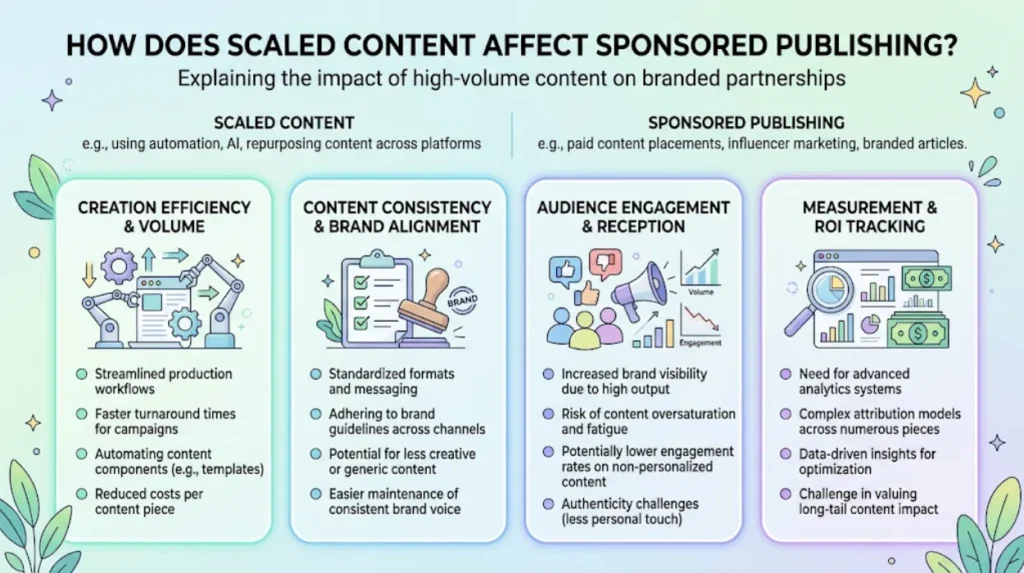
Google defines scaled content abuse as generating many pages primarily to manipulate Search rankings rather than help users. Its examples include large volumes of low-value AI-generated pages, scraped content, automated transformations and pages containing keywords without meaningful value.
This distinction matters for publishers operating large sponsored-content programmes.
Publishing 500 sponsored articles does not automatically establish scaled content abuse. The relevant assessment concerns what those pages contain and why they were created.
What does low-value scaled sponsored content look like?
Common examples include:
- 100 near-identical articles targeting different cities
- Automatically rewritten versions of the same sponsored article
- Pages created only to place commercial anchor text
- Keyword-focused articles with little useful information
- Multiple pages combining copied material without additional value
- Automatically generated articles published without meaningful editorial review
For example, producing 50 articles that repeat the same five paragraphs while changing only the city name creates limited informational value.
A stronger process creates distinct articles around distinct user needs. A London-focused article about financial compliance can address UK-specific requirements, while an article about software implementation can address integration, training and workflow management.
How can publishers maintain content quality across multiple sponsored articles?
Publishers can maintain quality through defined editorial briefs, original research, factual verification, unique article structures, relevant sources and human quality control. Each sponsored page needs a clear information purpose rather than relying on repeated templates or keyword substitutions.
A scalable editorial system needs consistent controls without making every article identical.
Use structured editorial briefs
Each brief can specify:
- Primary search intent
- Target audience
- Core subject
- Required evidence
- Relevant examples
- Commercial disclosure requirements
- Paid link destinations
- Required link attributes
- Editorial review criteria
This creates consistency at the process level rather than through duplicated article text.
Use original information
Original information can include verified statistics, expert explanations, case-specific details, product documentation or clearly sourced industry information.
For example, a sponsored cybersecurity article can explain a specific compliance requirement and connect it to documented business processes instead of repeating generic statements about cyber threats.
Keep commercial references relevant.
A sponsored link needs contextual relevance. A financial services article can link to a relevant financial service. An unrelated commercial link inserted solely for ranking purposes creates a different link context.
Relevance also improves the user’s ability to understand why the destination exists.
What should publishers check before a sponsored article goes live?
A pre-publication checklist should confirm commercial disclosure, content originality, factual accuracy, link relevance, paid-link attributes, anchor text, crawlability and page quality. The final review needs both editorial and technical checks before publication.
A practical checklist includes:
- Confirm the article’s sponsorship arrangement.
- Confirm the content has a defined user purpose.
- Verify factual claims.
- Remove duplicated or automatically reproduced sections.
- Review every outbound link.
- Identify every paid or sponsored link.
- Apply
rel="sponsored"orrel="nofollow"where appropriate. - Review anchor text.
- Check destination relevance.
- Inspect the final HTML.
- Confirm the page is accessible to search engines.
- Review the published page after deployment.
Google states that content appearing in Search must comply with its Search policies, and violations can result in lower visibility or exclusion from Search. Its spam policies also apply to attempts to manipulate generative AI responses in Google Search.
What are the benefits of a structured sponsored content process?
A structured sponsored content process creates consistent controls for paid links, editorial quality and publication standards. It helps publishers separate advertising relationships from ranking manipulation while maintaining useful content, relevant links and repeatable quality assurance across multiple campaigns.
The main operational benefits include:
Consistent link governance
A documented process identifies paid links before publication and assigns the appropriate qualification.
Better editorial control
Content briefs and quality reviews reduce duplication and low-value pages.
Easier campaign management
A central workflow lets publishers manage multiple sponsored articles without treating every publication as an isolated task.
Clearer technical validation
HTML checks identify missing attributes that visual CMS reviews can overlook.
Better long-term content management
Published articles can be reviewed periodically for outdated claims, broken destinations, incorrect links and changes to commercial relationships.
Explore More Expert Insights:
How to Refresh a Published Research Report and Preserve the Rankings, Backlinks and Citations It Has Already Earned
How to Translate Technical Findings Into Plain-English Report Sections Without Losing Statistical Accuracy
When should businesses use a structured sponsored content workflow?
A structured workflow becomes relevant when a business publishes sponsored articles across multiple publishers, campaigns, topics or destinations. It is particularly useful when paid links, editorial requirements and large publication volumes need consistent review before and after publication.
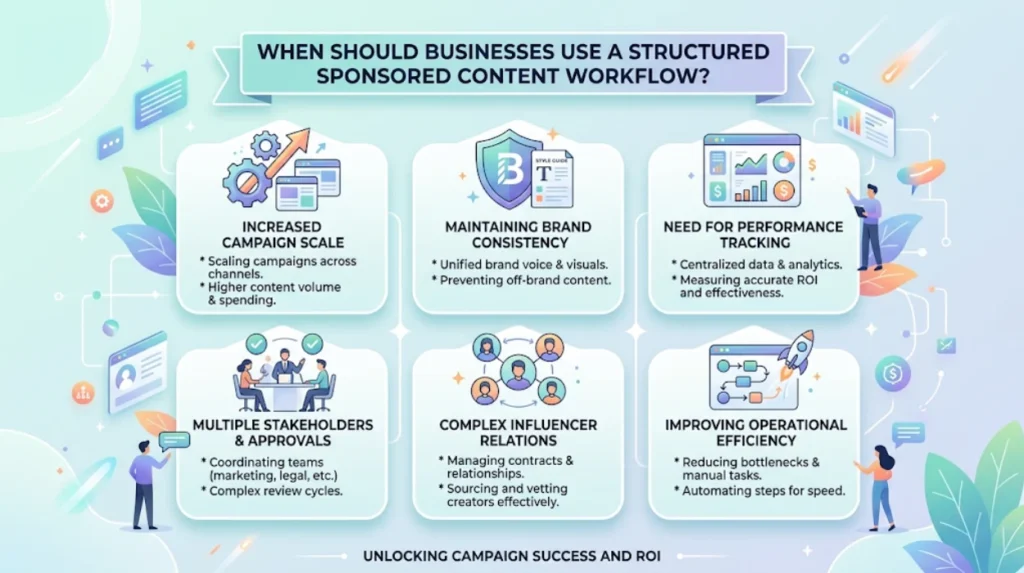
Typical use cases include:
- Brand awareness campaigns
- Industry publication partnerships
- Native advertising campaigns
- Sponsored research articles
- B2B thought leadership
- Product education campaigns
- Corporate reputation programmes
- Multi-publisher content distribution
For example, a B2B software company running a 20-publication campaign can maintain one central link register, one editorial checklist and one technical validation process.
A media team can then distinguish between content production, commercial relationship management and link governance.
Businesses evaluating implementation options can explore sponsored content services for workflows that combine publication management with Google-compliant link attributes.
What is the practical framework for Google-compliant sponsored publishing?
The practical framework is simple: create useful content, identify commercial relationships, qualify paid links, avoid ranking-manipulation tactics, control scaled production and validate every published page. These controls apply across individual articles and larger sponsored content programmes.
The process can be reduced to six stages:
- Define the purpose — establish the user’s informational need.
- Create useful content — provide original, relevant and factually supported information.
- Identify paid relationships — record sponsorship and commercial arrangements.
- Qualify paid links — use appropriate
rel="sponsored"orrel="nofollow"attributes. - Control publication scale — prevent large volumes of repetitive, low-value pages.
- Audit the final page — inspect content, links, attributes and technical implementation.
Google’s current spam policies explicitly distinguish legitimate advertising and sponsorship from paid links used to manipulate rankings. They also identify scaled content abuse as a separate issue when large volumes of pages are created primarily for Search manipulation.
For publishers and brands, compliance therefore depends on the complete publishing process rather than on a single HTML attribute. Link qualification addresses the commercial relationship, while editorial quality and controlled production address the broader content environment.
FAQs
Q1: What are Google’s rules for sponsored content and paid links?
Ans: Sponsored content should clearly disclose its paid nature, while paid links should use appropriate link attributes such as rel="sponsored" or rel="nofollow". These practices help distinguish advertising from editorial links and reduce the risk of violating Google’s spam policies.
Q2: Which link attribute should be used for paid links in sponsored content?
Ans: Google recommends using rel="sponsored" for links created as part of advertisements, sponsorships, or other paid arrangements. The nofollow attribute can also be used, particularly when a publisher does not want to identify the link specifically as sponsored.
Q3: Can sponsored content include links without violating Google’s spam policies?
Ans: Yes, sponsored content can contain links when the paid relationship is properly disclosed, and the links use appropriate attributes. Publishers should avoid using paid links primarily to manipulate search rankings or pass ranking credit.
Q4: What is scaled content and how can sponsored publishers avoid spam issues?
Ans: Scaled content refers to producing large amounts of content primarily to manipulate search rankings rather than provide useful information. Sponsored publishers should maintain original, relevant, useful content and apply appropriate quality controls across paid content at scale.
Q5: How can Times Intelligence Media Group publish sponsored content that complies with Google?
Ans: Times Intelligence Media Group can support compliant sponsored publishing by clearly identifying paid content, applying appropriate sponsored or nofollow link attributes, and avoiding practices intended to manipulate search rankings. Content should also provide genuine value rather than being produced solely for search-engine visibility.